In my last post I briefly discussed the ways that the sacred has been represented. In this post I want to continue this discussion, and in particular explore how metaphysical ideas can be visually represented. The term metaphysics has a long history and is used in a variety of ways. It literally means ‘after physics’ and is generally understood to be a branch of Western philosophy. For the purposes of this discussion, I will use Thomas Mautner’s suggestion that metaphysics is:
An inquiry into or a theory of that which lies beyond nature and transcends the limits of ordinary experience
(Mautner 2000: 351)
I also suggest that metaphysics is primarily concerned with the relationship between nature and the transcendent. Metaphysics specifically explores the relationship between the creative cause and creation. In religious terms metaphysics considers the connection between the sacred and profane.
Metaphysical Diagrams

Metatron’s Cube: Named after the Archangel Metatron. This is regarded as a representation of the structure of creation. It is suggested that Metatron’s Cube contains all the shapes that exist in the universe.
One significant way that religious traditions have attempted to visually represent the relationship between the sacred and the profane is by using geometric diagrams. These metaphysical diagrams share some common features.
- They represent the manifestation of the transcendent through different stages of creation.
- They reveal the deep structure of creation.
- They represent creation as being inherently harmonious.
- They are often linked to a numerical view of creation.
- They are frequently considered to be maps that show how adherent can return to the sacred.
- To interpret the meaning of these metaphysical diagrams often requires initiation and esoteric knowledge.
Ilanot
A good example of these sacred diagrams can be found in the Jewish mystic traditions known as the Kabbalah.
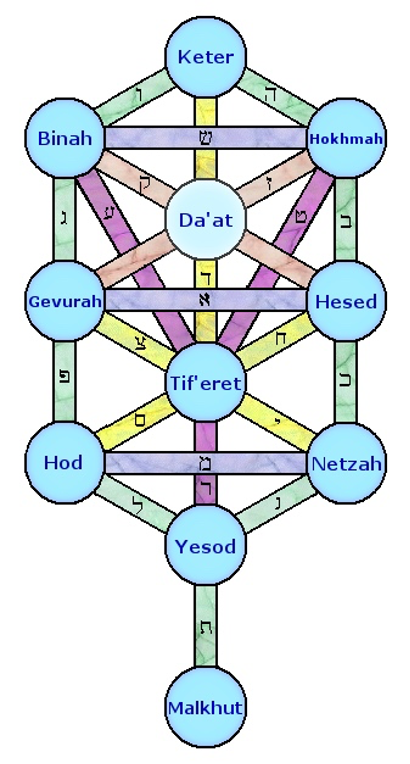
Ilanot (literally ‘tree’ and sometimes understood as the Tree of Life) are diagrams of the creative process that developed in Kabbalah from about the 14th century. They are composed of nodes, called serifot, which J.H. Chages (n.d) calls ‘skeleton keys that unlock all reality’. There are also channels that represent both the descent of the sacred and the return path. Keter represents the absolute transcendent source of all being – sometimes referred to as Ein Sof, which means ‘without end’. There are ten serifot (emanations), that represent the manifestation of the sacred ultimately ending with the material world – Malkhut.
Sacred Geometry
There is often a numerical aspect to these metaphysical diagrams. For example, the ilanot in the illustration above has 22 channels and these are associated with the 22 letters of the Hebrew alphabet, and each has an esoteric meaning. This links these metaphysical diagrams to what is called sacred geometry.
Sacred geometry suggests that creation is governed by mathematics and that this can be represented through geometric shapes. Sacred geometry explores the process of creation and the relationship between creative source and creation.
The grand book of the universe …. was written in the language of mathematics, and its characters are triangles, circles and other geometrical figures, without which it is impossible to understand a word of it.
Galileo cited in Michell 2012: xvi.
Sacred geometry ascribes symbolic and sacred meanings to certain numbers, shapes and proportions. These significant numbers, shapes and proportions are often used in sacred architecture, as well as metaphysical diagrams. Sacred architecture and these metaphysical diagrams therefore reflect the hidden patterns of creation.
Yantras
Mandalas found in tantric forms of Hinduism and Buddhism are exemplars of what I am calling metaphysical diagrams. Tantra refers specifically to a range of texts that originated in India around the 6th century BCE. Tantric texts can be found in Hinduism, Buddhism and Jainism. The focus of these texts is on ritual practice and achieving spiritual enlightenment.
The metaphysical diagrams found in the Hindu tradition are more accurately called yantras, which Madhu Khanna describes as ‘potent and dynamic sacred symbols’ (Khanna 1981: 9). There are many different yantras, however as well as sharing the general features of metaphysical diagrams listed above, they also have some other common aspects that are derived from the Tantric world view.
- The most significant part of the yantra is the central invisible point that represents the potentiality of all creation known as the bindu.
- Yantras frequently depict the interrelationship between masculine and feminine principles.
- Yantras often indicate a homology between the macrocosm (the cosmos) and the microcosm (the individual).
- Yantras are invariably linked to mantra. While there is no absolute definition of mantra, I will define a mantra as a sacred sound that is regarded as having power. Mantra can be regarded as the sonic aspect of the visuality of the yantra. Mantras are often also visually inscribed in yantras using Sanskrit script.
- Specific yantras and their accompanying mantras are associated with particular Hindu deities
Sri Yantra
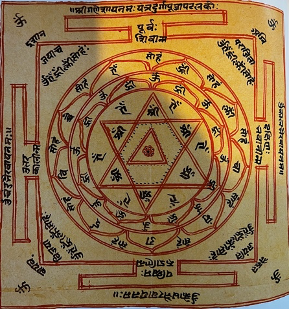
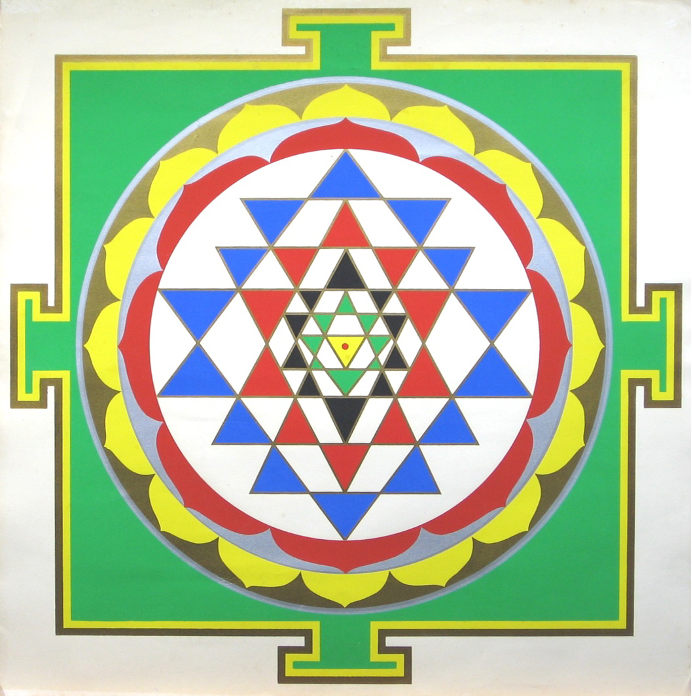
Perhaps the most known Yantra is the Śrī Yantra. At the very centre of the Śrī Yantra is the bindu. Although it is marked by a red dot in this reproduction, the bindu is normally left invisible. The bindu represents the un-manifested potential of creation.
Just as the seed is not a ‘manifested’ tree yet holds the essence of a tree, so the bindu holds a universe not yet differentiated
Khanna 1979:71
The un-manifested centre is also mysterious and ineffable and therefore can only be inferred and not represented. It is the invisible centre and source of the cosmos.
The manifestation of the universe from this undifferentiated potentiality is represented by nine overlapping triangles – five pointing down representing the female principle Śakti and four pointing up symbolising the male principal Śiva. There can be no Śiva without Śakti and no Śakti without Śiva.
The triangle is significant in sacred geometry, as it is the least number of lines that can enclose a space. The triangle is also especially significant in Hindu metaphysical ideas as it represents the three aspects of the cosmos – creation, preservation and destruction.
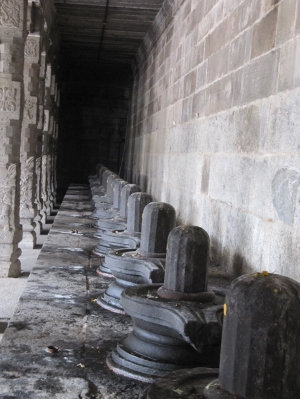
in South India.
This interrelationship between Śiva and Śakti is also represented in another aniconic form – liṅga (male) and yoni (female). The liṅga is the most common image of Śiva in Hindu temples. The column represents the male principle and the pedestal represents the female principle. This is sometimes interpreted in sexual terms, the column being a phallic symbol and the yoni representing female genitalia. However, while in some, relatively obscure, tantric sects the sexual imagery is significant, for most Hindus the liṅga is only perceived as an abstract representation of Śiva. The liṅga is more commonly associated with a mythic narrative of Śiva manifesting as a column of light.
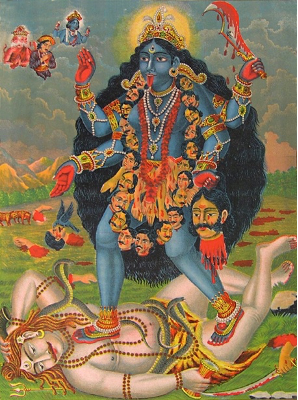
This interconnection between the female and male principles is also represented in the iconic form of the anthropomorphic manifestation of Śakti standing on the inert body of Śiva – though this of course reverses the polarity of the liṅga and yoni. Śakti is the feminine animating force of creation, whereas Śiva is pure consciousness and is regarded as inert. It is sometimes said that Śiva is Śava – ‘a corpse’ – without the enlivening power of Śakti. Consequently, both aniconic and iconic styles can be regarded as metaphysical diagrams.
The overlapping triangles are bounded by a circle. The circle is also a very significant shape in sacred geometry.
The circle, with its perimeter measured by the irrational number 𝜋, and with no point where it begins or ends, is the natural symbol of the divine eternal element of creation.
Michell 2012: 22
In Hindu and Buddhist traditions the circle represents the concept of saṁsāra, the cycle of life, death, re-birth and re-death.
The Lotus
Moving out from the centre of the Sri Yantra, there are two lotuses: the first with eight petals and then a lotus with sixteen petals. Each of the petals of the eight-petal lotus is associated with a specific goddess (deva). Each of the sixteen petals of the outer lotus is linked with the sixteen components of existence – the five elements (earth, water, fire, air and ether), the ten organs of perception and actions (smell, taste, sight, touch, hearing, communication, manipulation, locomotion, digestion, procreation) and the mind.
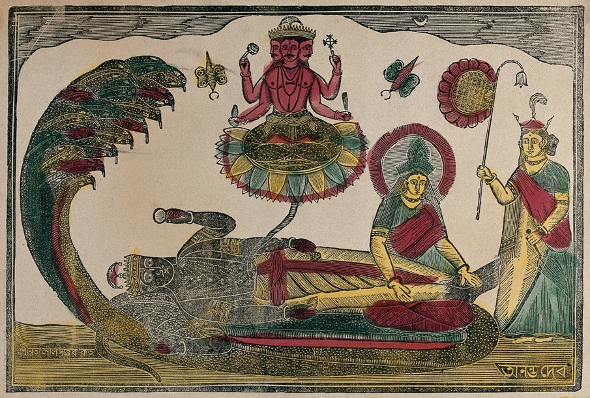
The lotus is a common symbol in Hindu iconography.
The lotus may represent the universe, the rising of beauty of form from the formless, or literally the swampy depths of the pond
Elgood 2000: 64
The lotus is associated with the creation of the cosmos and is also represented in more figurative iconography In this image – a lotus emerges from the naval of the reclining Viṣṇu, who represents the primordial cause and the lotus unfolds to reveal the form of Brahma the deity that is associated with creation
The lotus is also a symbol of the seven spiritual centres of the individual referred to as cakras – ‘wheels’ Tantra proposes that as well as a physical body, we also have a psycho-spiritual anatomy, which maps onto our material body. The cakras are located in this subtle body and correspond to different levels of being. The microcosmic structure of the individual is regarded as equivalent to the macrocosmic structure of the cosmos.
Tantra has created a system of psychic ‘crosspoints’ in which the infinite world of time and space are seen reflected in the psycho-physical structures of man.
Khanna 1981: 121
Kuṇḍalinī (‘She Who Is Coiled’) is regarded as the individual’s source of Śakti. and is depicted as a serpent. Kuṇḍalinī sleeps in the cakra that is located at the base of the spine. This cakra corresponds to the material world Through meditation and yogic exercises Kuṇḍalinī can be woken. Śakti then rises through the different cakras in the subtle body, enabling the aspirant to realise increasingly higher planes of spirituality. Eventually, after much practice, the tantric aspirant raises Kuṇḍalinī to the seventh cakra, which is located above the head, and is represented as a 1,000 petalled lotus. This is the abode of Śiva, pure consciousness. Once Kuṇḍalinī Śakti merges with Śiva, duality is transcended and the aspirant ‘experiences the microcosm of their body as the macrocosm of the universe’ (Ramos 2020: 72).

Overall the Sri Yantra represents what Richard H Davis terms ‘the oscillating universe’. Tantric Hindu metaphysics suggest that there is an endless cycle of creation and destruction – or more precisely the cosmos alternates between manifest and un- manifest states.
Within each cycle, the cosmos begins as an undifferentiated “something” from which evolves, in orderly sequence the multiplicity of creation that we see all around us. In time the cosmos exhausts itself , and all this multiplicity merges once again into its undifferentiated source.
Davis 1991: 42.
The movement from the bindu at the centre to the outer square of the Sri Yantra represents the manifestation of the cosmos and the movement from the periphery to the sacred centre represents the re-absorbtion of the cosmos back into the sacred source.
Mandalas
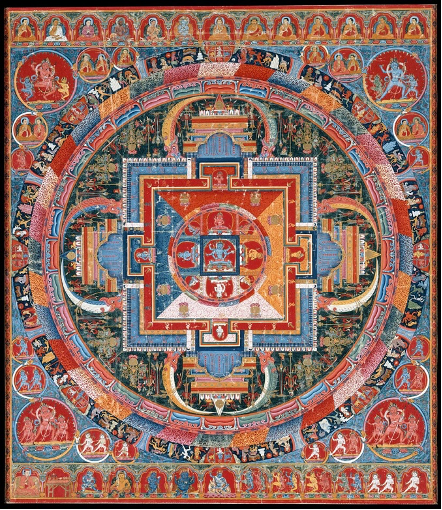
Sacred diagrams are also important in Buddhism, particularly in the Tantric forms of Buddhism primarily found in Tibet, Bhutan and Nepal. These diagrams are called mandalas, which more or less translates as ‘sacred circle’. Mandalas are often an interesting mix of iconic and aniconic elements. They include both geometric patterns and figurative representations of deities and Buddhas. The geometric form of the mandala ‘captures the deities’ cosmic, indefinable qualities’ (Ramos 2020: 142).
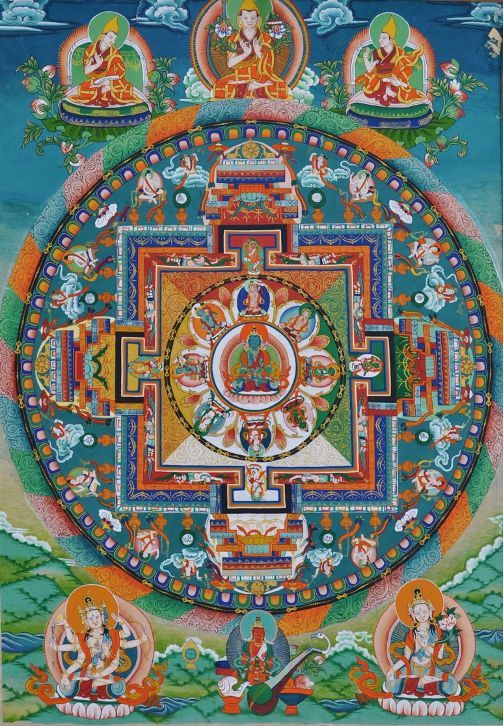
In Tantric Buddhism, the historic Buddha is regarded as one of many Buddhas. Most mandalas are dedicated to a particular Buddha, who is depicted at the centre. This particular mandala is associated with Akshobya Buddha, who is depicted at the centre of the mandala. Akshobya Buddha represents overcoming anger, which is regarded as one of the prime obstacles to achieving enlightenment. He represents the transformation of anger into wisdom. The circle surrounding the Buddha at the centre is a ring of protection, depicted in this example by eight goddesses.
The square is colour coded to indicate the cardinal directions (red at the top – west; green to the right – north; white at the bottom – east; yellow to the left – south). The square is perceived as a celestial palace. The outer ring of the mandala represents the phenomenal world. Like the yantra, the mandala represents the oscillating movement of manifestation of the cosmos outward from the sacred centre and the inverse movement from the phenomenal periphery returning to the sacred centre.
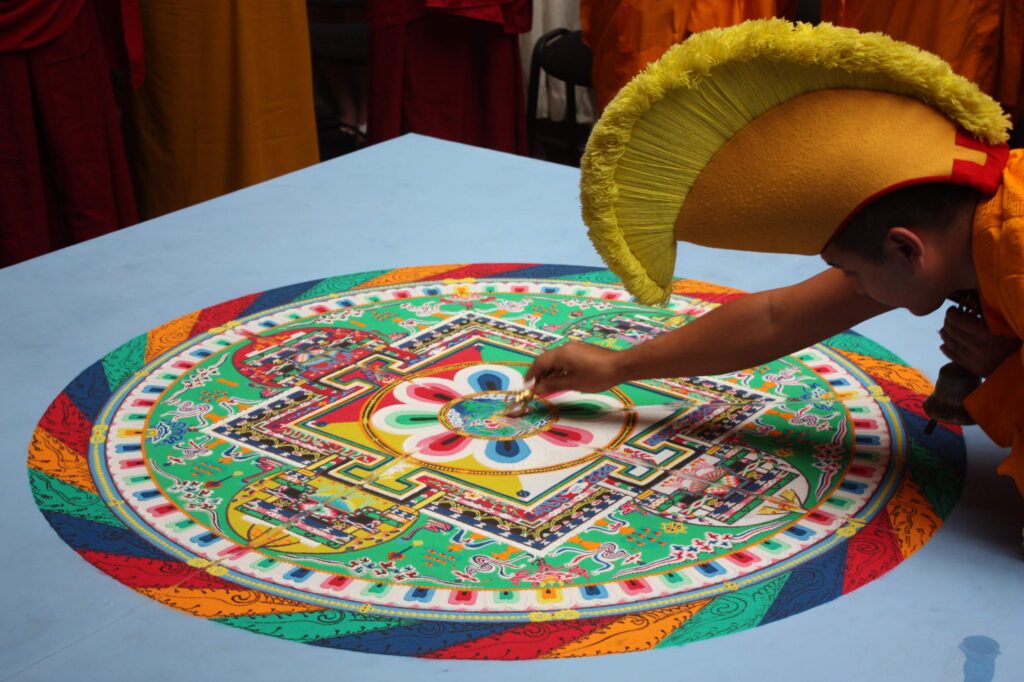
Mandalas are an aid to visualisation. Perhaps the most potent mode of visualisation is in the actual production of the mandala. The significance of the process of making a mandala is exemplified by the sand mandala. These are large mandalas painstakingly constructed from coloured sand. Originally these mandalas would have been made from ground minerals, such as lapis lazuli, but now coloured and ground marble is used.
The process is regarded as a sacred act. The space that where the mandala is to be made is first purified and the making of the mandala is accompanied by chanting mantras.
As each speck of coloured powder alights upon the consecrated ground, the yogin must have the firm conviction that another Buddha has descended from the sky in order to become manifest in the very fabric of the maṇḍala. In this way the entire structure is made of Buddhas and has enlightenment as its very essence (Boord 1998: 83)
Boord 1998: 83
The most significant part of the process is the erasing of the mandala. The coloured sand is swept from the periphery to the centre, and gathered up and often ritually scattered in a river. The eradication of the mandala signifies the two important and interrelated Buddhist concepts of impermanence and non-attachment. Impermanence suggests that everything in the cosmos is inherently ephemeral, and therefore we should not become attached to phenomena.
Conclusion
Ilanot, yantras and mandalas are complex visual representations of religious world views. They are diagrammatic as they reveal ‘the features of exposition, rather than its actual appearance’ (Shorter Oxford English Dictionary). However, to fully understand how these metaphysical diagrams reveal the hidden structures of the cosmos and elucidate the relationship between the creative cause and creation often requires initiation into esoteric knowledge.
These metaphysical diagrams exist on a scale from the purely geometrical, such as the Sri Yantra, to the figurative, such as the image Śiva and Śakti. However, many such as the Tibetan mandalas, include both geometric and figurative features. The geometric aspects of these visual representations have a numerical aspect and are linked to sacred geometry. This sacred enumeration is often significant in religious architecture. These metaphysical diagrams are not simply decorative but are often incorporated into meditative and ritual practices, best exemplified by the sand mandalas.
References and Sources
Boord, M (1998) Maṇḍala: Meaning and Method. Performance Research 3(3) pp 78–84.
Chages, J.H. (n.d) A Very Brief History of the Ilan Genre. Ilanot. Available at: https://ilanot.haifa.ac.il/site.
Davis, R.H. (1991) Ritual in an Oscillating Universe. Princeton: Princeton University Press.
Elgood, H. (2000) Hinduism and the Religious Arts. London: Cassell.
Khanna, M. (1981) Yantra: The Tantric Symbol of Cosmic Unity. London: Thames and Hudson.
Mautner, T. (Ed). (2000) The Penguin Dictionary of Philosophy. London: Penguin.
Michell, J (2012) How the World is Made: The Story of Creation According to Sacred Geometry. London: Thames and Hudson.
Ramos, I. (2020) Tantra: Enlightenment to Revolution. London: Thames and Hudson.
Other Sources
The Mandala of Vajrayogini. Available at: https://www.youtube.com/watch?v=khs0f4zTPbg
A fascinating video in which the Bhutanese artist Dash Karma Ura explains the ritual and symbolic significance of
making a sand mandala of the Tantric goddess Vajrayogini. This mandala was made as part of the British Museum’s
exhibition on Tantra in 2020.
Sand Mandala. Available at: https://www.youtube.com/watch?v=WBrYUlOYK0U
A short and informative video on making a sand mandala dedicated to the healing Buddha.
Himalayan Art Resources. Available at: https://www.himalayanart.org/search/set.cfm?setID=91
An extensive digital archive of the art of Nepal, Tibet and Kashmir that has numerous examples of mandalas.