

In this post I will look at some of the ways in which two of my interests – food and religion – intersect. All religious traditions have a great deal to say about food and eating. Religious traditions might indicate what we should and should not eat. Religions may also specify how foods should be prepared, who we should eat with, and when and how we should eat. Most religions regard both fasts and feasts as integral to their faith. In many ways distinct foodways define religious communities. If we are interested in religions as lived traditions, then it is imperative that we should attend to their foodways. Graham Harvey (2015: 32) asserts ‘foodways are so frequently central to religious acts … that they may define ‘religion’ as much as they differentiate between religions’.
Avoiding and Abstaining
All religious traditions suggest avoiding or abstaining from certain foods. Avoiding certain foods might be integral to the daily life, such as the Jewish rules of kashrut which prohibits certain foods and combinations of foods. For example, combining meat and dairy is forbidden and eating pork is proscribed. Most Hindus are vegetarian or at least avoid eating meat from cows.
As well as being an integral aspect of everyday lived religion, forbidding the consumption of certain foods can be a factor in the construction of religious identity. What to eat and what not to eat can be the subject of controversy not only between different religious traditions, but also within specific traditions.
Religious traditions also indicate abstinence from certain foods at particular times of the year. For example, Muslims fast between dawn and dusk during the holy month of Ramadan and many Christians avoid consuming luxurious food during Lent.
Food Laws
Some religious traditions, most noticeably Islam and Judaism, have clearly defined rules about what can be eaten and what must be avoided. In Islam, for example, there is a distinction made between what is halal (permitted) and what is haram (forbidden) foods.
Forbidden unto you (for food) are: carrion and blood and swine flesh, and that on which hath been invoked the name other than Allah, and the strangled, and the dead through beating, and the dead through falling from a height, and that which hath been gored to death, and the devoured of wild beasts, saving that which ye make lawful (by slaughter) and that which hath been immolated to idols and that ye swear by the divining arrows. This is an abomination.
Qur’an 5:3 cited by the halal Monitoring Committee
As this quote indicates, the Qur’an explicitly forbids the consumption of carrion, pork and meat that has not been slaughtered in the prescribed way. The Qur’an also explicitly prohibits alcohol. However, despite this Qur’anic injunction it is not always clear what other foods are classified as halal and what is haram, and different schools of Islam draw the line in different places.
Shi’ite Islam tends to be more restrictive on food matters than Sunni forms of Islam. For Twelver Shi’ites, the form of Shi’ism dominant in Iran, fish without scales are forbidden. This prohibition is found in the Shi’a book of jurisprudence Al-Lum’a, composed in the 14th century. However, what defines a scale is ambiguous. The generally accepted criterion for determining what constitutes a scale is that scales should be able to be scraped off without tearing the skin.

The Al-Lum’a also indicates that ‘the eggs of the fish follow the fish itself’ (cited in Chehabi 2010: 132). Caviar are the eggs of the sturgeon, and consequently if the sturgeon is haram so too is caviar.
Iran’s northern coastline on the Caspian Sea has some of the finest sturgeon for caviar. Traditionally sturgeon, and by extension caviar, was considered to be haram as the scales of a sturgeon cannot be removed without damaging the skin. The Shia website Al-Islam lists sturgeon as non-halal.
However, caviar was a major export for Iran. This led to a dilemma after the Iranian Revolution of 1979 that established Islamic law. The Ayatollah Khomeini had the sturgeon examined by experts who found that the fish had an extra covering near the fins and tails that were deemed to be scales. Consequently, Khomeini issued a ruling (fatwa) that the sturgeon, and therefore caviar, could be classified as halal. (For a fuller description of this decision see H.E. Chehabi’s fascinating 2010 essay). Whilst caviar is not widely eaten in Iran, The Islamic Republic is a major exporter.

This brief case study of whether caviar is halal or haram suggests that in the contemporary world it becomes increasingly problematic to determine how food rules, particularly in Islam and Judaism, can be applied. This challenge is due to two interconnected reasons.
- The chain between farm and plate has become so long and complex that we can no longer be certain of the ways in which food has been produced.
- Although food packaging lists ingredients, the composition of these ingredients is often unclear.
Both Jewish food laws (kashrut) and Islamic rules indicate that animals for consumption must be slaughtered and prepared in a particular defined way. Both Jewish and Islamic food laws decree that the animal should not be stunned and must be killed with a single slash to the throat and the blood drained from the flesh. UK Law indicates that whilst animals should be stunned before slaughter an exception can be made for religious communities.
When animals are slaughtered fairly locally it is relatively easy to be assured that they are butchered according to the relevant food laws. However, most people, particularly in the developed West, buy meat in supermarkets and the provenance is unknown. It is also extremely difficult to identify where meat is from and whether it complies with religious food rules when eating out.
Consequently, a system of certification has developed, that confirms that food conforms to religious laws.
Kosher Certification is the stamp of kosher approval by a rabbinic Agency verifying they have checked the products ingredients, production facility and actual production to ensure all ingredients, derivatives, tools and machinery have no trace of non-kosher substances.
Orthodox Union 2023


Foods that are certified then get a recognisable stamp. The Kashrut Division of the London Beth Din (KLBD) is the main certifier in the UK for assuring that foods are kosher, it has its own stamp of authentication. It also produces a Kosher Nosh Guide, which has a list of products, such as soft drinks, that are kosher. It also indicates what additives are problematic. KLBD also has produced an app so that you can check whether products are kosher.
However, there are three significant challenges to the certification process.
- There is such a proliferation of new food products that it is impossible to verify all foods on the market. Although the
Kosher Nosh Guide is updated annually it is still very limited. - There is no central authority for certifying foods. In the UK there are twelve halal certification organisations. The main two are The Halal Food Authority (HFA) and the Halal Monitoring Committee (HMC). This can cause problems as the different organisations do not necessarily agree on some details of food laws.
- Certification is based on trust. There are two aspects on this. Firstly, you have to trust that the person or organisation is sufficiently qualified to make the decision. There are, for example, disputes about what constitutes orthodoxy. There have been instances where caterers or butchers who have been denied kosher certification have challenged the decision in courts on the grounds that the individual who had refused certification was not an Orthodox Rabbi (see Lewis 1985).
You must also trust that the certification process is rigorous. In his book Green Deen: What Islam Teaches About Protecting the Planet – Ibrahim Abdul-Martin refers a study which identifies ‘various forms of inadequate certification of halal meat, such as “drive-by,” in which a shaykh drives by and reads a prayer as he passes by the slaughterhouse. He concludes that ’50 percent of Muslims in America are eating questionable and doubtful halal meats’ (Abdul-Martin 2010: 146).
Fasting and Asceticism
Many religions prescribe a period of fasting. For example, Muslims are enjoined to fast between sunrise and sunset during Ramadan – the ninth month in the Muslim calendar. Fasting is perceived as a spiritual discipline which enables Muslims to focus on religious, rather than worldly affairs. The fact that virtually all Muslims across the world fast during this month fosters a sense of community.
Fasting, as a means of focusing on the spiritual rather than the material world, is also associated with asceticism. This association between fasting and asceticism is particularly strong in Jainism, a religious tradition that emerged in India at around the same period of Buddhism. The vast majority of Jains are vegetarian. This emphasis on avoiding meat is linked to the concept of non-violence (ahiṃsā), which is a core philosophical belief in Jainism
Asceticism in Jainism is linked to the philosophical idea of karma. This is a very complex concept, and the Jain idea of karma differs slightly from Hindu and Buddhist ideas. In Jainism karma is perceived as a physical substance that adheres to the otherwise pure and formless soul (jiva). However, all three traditions agree that karma is the engine that drives the cycle of life death and rebirth. Karma is generated through actions. The wheel of transmigration is regarded as inherently unsatisfactory and therefore the ultimate goal is to escape this cycle. This entails not only avoiding accruing karma, but also the elimination of karma that has already been accumulated

Two Jain Monks. Watercolour painting available at:
https://wellcomecollection.org/works/sf3mv6fx
To eliminate karma, and therefore to achieve liberation from the cycle of transmigration, requires withdrawal from the material world. Food is inherently an aspect of the material world, and therefore eating, even in moderation, accrues karma. The logical conclusion to this idea is to gradually diminish one’s intake of food. In Jainism there is a practice known as sallekhana ‘cutting down consumption of food … so that the body is “scoured out” (sallikhita) of its negative factors and the mind can be focused upon spiritual matters as death approaches’ (Dundas 1992: 155).
Sallekhana is highly ritualised, and is very rarely performed. Nonetheless, William Dalrymple gives a fascinating account of his encounter with a Jain nun who has undertaken sallekhana. In his conversation with the nun, she suggested that that this fast to death is ‘the culmination of our life as ascetics’. She also emphatically denies that it is a form of suicide. She stated that ‘suicide is a great sin, the result of despair. But sallekhana is a triumph over death, an expression of hope’ (Dalrymple 2010: 5).
Feasts, Community and Blessings
Most religions also have a tradition of feasting. Often, feasting and fasting are associated with each other. For example, Ramadan ends with the festival eid al-fitr – ‘breaking the fast’ which often involves a feast. When I was staying on the Sivananda Ashram in Rishikesh, the Hindu festival of Shivaratri was celebrated by 24 hours of fasting and ended at 4:00 in the morning with a special feast.

Volunteers preparing food at the Golden Temple. Image from https://www.goldentempleamritsar.org/best-places-to-visit/india/golden-temple/guru-ka-langar.php
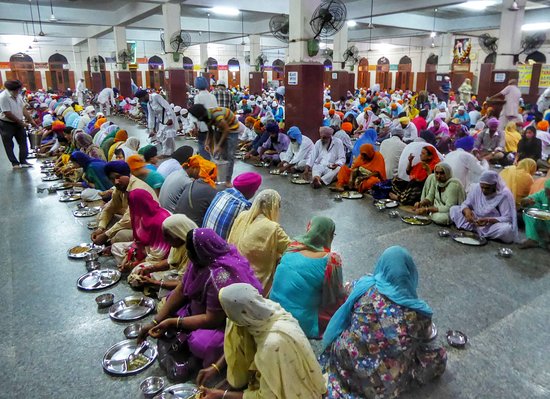
The laṅgar at the Golden Temple. This photo of Amritsar is courtesy of Tripadvisor
Eating together also fosters a sense of community. This sense of community is also reinforced when people also prepare food together. All Sikh places of worship (gurdwara) have a community kitchen and refectory known as laṅgar. As well as instilling a sense of community, the laṅgar illustrates a number of core concepts in Sikhi. The kitchen is predominately run by volunteers from the community. Cooking and serving food in the laṅgar is regarded as service – which is called seva. Seva is not simply about serving the Sikh community, but also is about serving everybody. For example, during lockdown many of the gurdwaras in the UK delivered food to people in isolation.
The laṅgar is open to all regardless of caste or religion. Furthermore, everybody sits on the floor together in lines known as paṅgat. There are two interrelated aspects to this. Firstly, it is a departure from the Hindu injunction that certain castes should not eat together. It also emphasises the egalitarian ethos of Sikhi. The food served in laṅgars is exclusively vegetarian, this ensures that no one is excluded no matter what religious dietary prohibitions they might have.
According to Sikh tradition, even the Mughal Emperor Akbar sat with everyone else for laṅgar when he visited the Golden Temple in Amritsar, the most important Sikh place of worship. The laṅgar at the Golden Temple is probably the largest kitchen in the world and caters to up to 100,000 pilgrims and visitors every day.
Food is also regarded as a blessing. This is clear in the Hindu notion of prasad – which more or less means ‘grace’. Going to a Hindu temple often involves taking a range of items such as flowers, incense and sweets. These are then taken into the temple where they are offered to the images of the deities (mūrti) by the Brahmin priests. These offerings then become transformed from mundane objects into prasad and are regarded as being imbued with sacred power. Often the devotee has their forehead marked with sacred ash (vibhūti), given a flower and a handful sweets that have been offered to the deity. The sacred power is then ‘absorbed or internalized when the prasada is placed on the devotee’s body or swallowed’ (Fuller 1992:74).
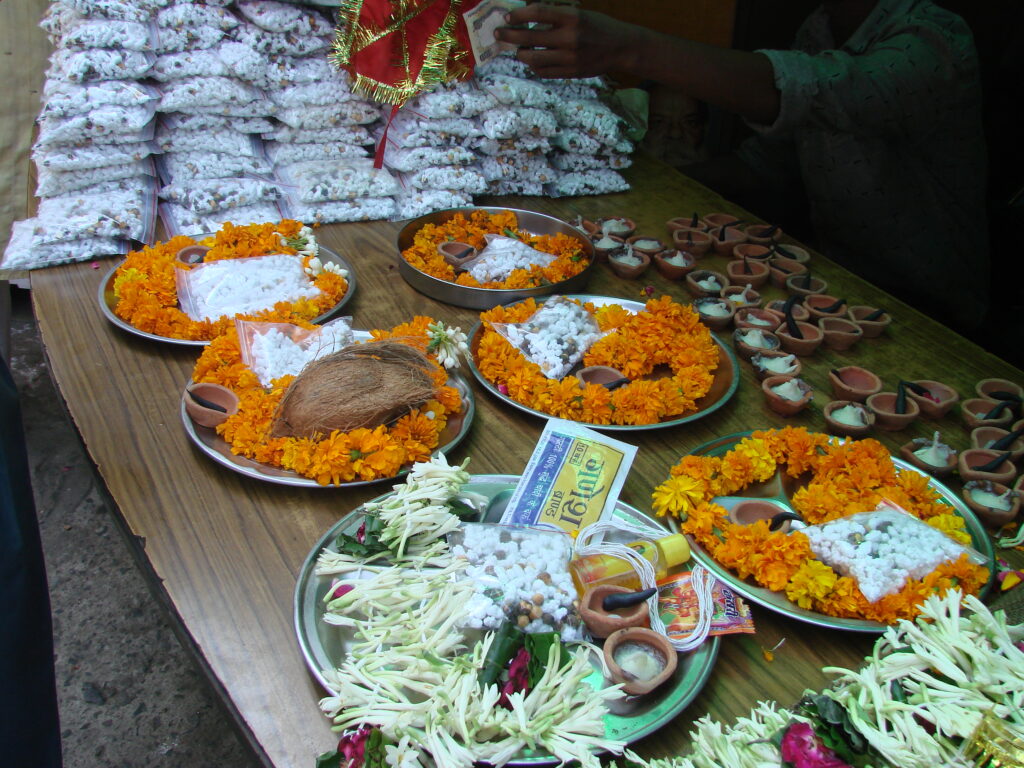
Plates of offerings, with flowers, incense , sweets etc., for sale are common outside most Hindu temples in India. The devotee then gives the plate to the Brahmin priest, who then offers it to the mūrti. The offerings are transformed into prasad, and the devotee then receives some back as a blessing.
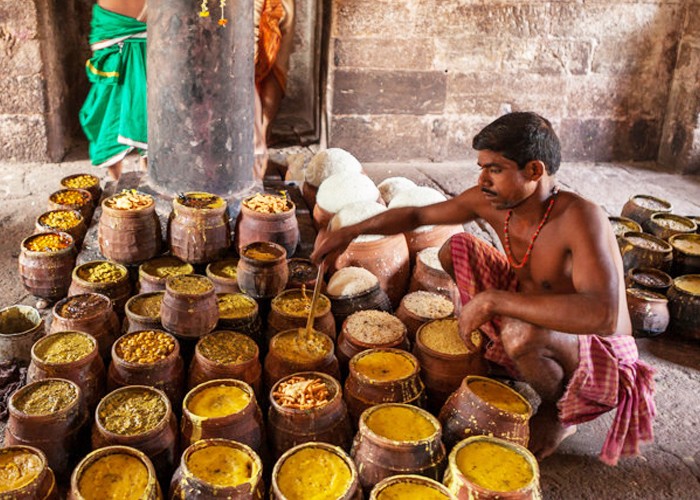
The kitchen at the Jagannath Temple Puri. Image from https://iskcondesiretree.com/profiles/blogs/the-kitchen-of-lord-jagannath-biggest-in-the-world-by-saroj-kumar
In some temples more substantial food is prepared and offered to the deities. Perhaps the most famous of these is the temple to Jagannath in Puri. It is said that more than a hundred dishes are prepared daily. The food is prepared in the temple kitchen by about six hundred specialised priests, who are all from a distinct lineage. The food is cooked in special clay pots, which are only used once. The food is not only vegetarian, but the recipes are traditional and predate the introduction of many vegetables – for example no potatoes or cauliflowers are used.
The deities Jagannath and his brother Balbhadra and sister Subhadra are offered food five times daily. This food is then available for devotees to purchase. I was lucky enough to be able to try this prasad, when I was staying in Puri. Although there are some clearly recognisable dishes like various preparations of rice and assorted dahls, they are very distinctive and quite different to anything else that have eaten in India.
Conclusion
If one wants to have any understanding of religions as lived traditions, it is imperative to look at the relationship the tradition has with food and eating. Conversely, to comprehend religious attitudes towards food it is also necessary to know something about beliefs, ethics and mythic narratives.
In the contemporary world it has become increasingly challenging for adherents of religions to comply with edicts about what to eat, what to avoid eating, when to eat and who one can eat with. We are often unaware how our food has been produced as the food chain is increasingly long and complex, we consume much more processed foods and expect to eat out regularly. Various strategies have been adopted, such as certification, to help people make food choices that are consistent with their religious identity. In an increasing secular society, there is also some recognition of the importance of food in adherents’ lives. For example, many places of work and educational institutes in the UK acknowledge and make allowances for Muslims whist they fast during Ramadan.
References
Abdul-Martin, I. (2010) Green Deen: What Islam Teaches About Protecting the Planet. SanFrancisco: Berret-Koehler
Publishers.
Chehabi, H.E. (2010) How Caviar Turned Out to be Halal. D. Goldstein (ed.) The Gastronomica Reader. Berkley: University
of California Press, 129–138.
Dalrymple, W. (2010) Nine Lives: In Search of the Sacred in Modern India. London: Bloomsbury
Dundas, P. (1992) The Jains. London: Routledge.
Fuller, C.J. (1992) The Camphor Flame: Popular Hinduism and Society in India. Princeton University Press
Halal Monitoring Committee, UK (2023) Available at https://halalhmc.org/resources/definition-of-halal/
Harvey, G. (2015) Respectfully Eating or not Eating: Putting Food at the Centre of Religious
Studies. Scripta Instituti Donneriani Abosenis 26, 32–46. Available at: https://journal.fi/scripta/issue/view/4707
Lewis, M.F. (1985) Kashrut and Controversy. Judaism 34(3), pp. 334–343
Orthodox Union https://oukosher.org/what-is-kosher/
The World’s Largest Kitchen – a short video about the laṅgar at the Golden Temple