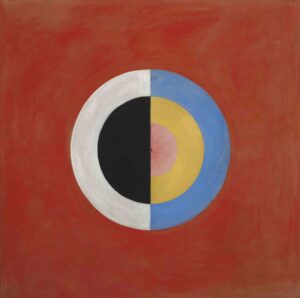
In part this post was motivated by my recent visit to the exhibition of paintings by Hilma af Klint (1862–1944) and Piet Mondrian (1872–1944) at Tate Modern. Both af Klint and Mondrian were inspired by the idea that there is an invisible spiritual reality that unified all being, which is hidden from and yet intrinsically connected with the material and sensory world. This spiritual reality, though concealed, is not completely inaccessible and much of both af Klint and Mondrian’s art can be understood as attempts to depict this underlying and unifying reality.
Both Mondrian and af Klint were inspired by Theosophy. Theosophy was a development from Spiritualism. Whilst Theosophy and Spiritualism are now marginal and often dismissed as being rather eccentric, they were both extremely influential at the end of the 19th century and the beginning of the 20th century in the United States and Europe. In particular, Spiritualism and Theosophy had a significant impact on the visual arts. Spiritualism and Theosophy were integral to the development of abstract art.
Spiritualism
Spiritualism must not be confused with spirituality. Spirituality is a rather vague concept that refers to the idea that the primary source of the sacred resides within oneself. (see Heelas 2008). On the other hand, Spiritualism specifically refers to the belief that the self continues after the death of the physical body in the form of a spirit.
Principally, the ‘spirit’ is understood by Spiritualists to be an ethereal personality which holds the essence, the vital persona, or immanence of the once living as absent from the physical world
Davies 2022: 51
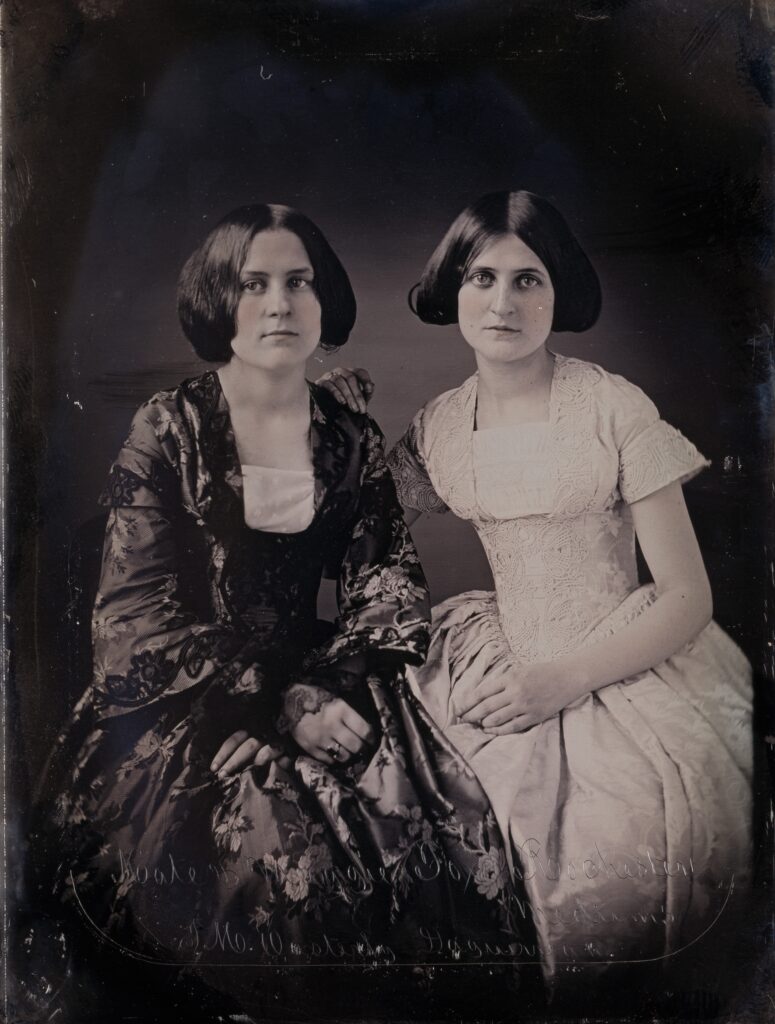
https://commons.wikimedia.org/wiki/File:Kate_and_Maggie_Fox,_Spirit_Mediums_from_Rochester,_New_York.jpg
Spiritualism suggests that not only does an individual’s life continue in an ethereal form after death in a different realm of being, but it is also possible to communicate with the spirit of the deceased. Communication with spirits of the dead was prevalent amongst certain groups, such as the Shakers, in the early 19th century. However, it was the mysterious noises, that came to be known as the ‘Rochester Rappings’, at the house of the sisters Margaret and Kate Fox in 1848 that was the catalyst for a surge in interest in communicating with the spirit world in the United States. The two sisters claimed that these knocking sounds were a communication from a murdered peddler, whose undiscovered body was buried in the cellar.
The telegraph played a very significant role in the spread of Spiritualism. The first telegraph message had been sent by Samuel Morse in 1844. The telegraph seemed to have some similarities with the ‘Rochester Rappings’. Like the telegraph the seemingly random tapping from the spirit world had to be decoded in order to make sense. The telegraph also demonstrated that it was possible to communicate with someone who, for all intents and purposes, was invisible. These similarities led to the communication with the post-mortem realm to sometimes be referred to as ‘the spiritual telegraph’. Furthermore, the telegraph enabled accounts of the Rochester Rappings to be disseminated quickly and far afield. The Fox sisters became popular mediums.
By the mid 19th century séances, where people gathered to communicate with the spirit world, had become popular on both sides of the Atlantic.
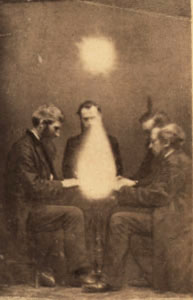
https://en.wikipedia.org/wiki/S%C3%A9ance
Theosophy
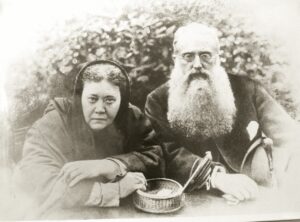
Image from The Theosophical Society of America: https://www.theosophical.org/news/announcements/65-about-us-sp-709/olcott/1825-portrait
In 1874 Henry Steel Olcott, an active advocate of Spiritualism, met the eccentric Russian emigré Helena Blavatsky at a séance held by the Eddy brothers in Vermont. At the Eddy brothers’ séances musical instruments would seem to play on their own and strange lights would appear, and many claimed spirits would materialise. However, both Blavatsky and Olcott, although convinced that there was something mysterious and other worldly happening at the Eddy’s farm, were not convinced that it was a communication with the spirits of the deceased.
Together Olcott and Blavatsky founded the Theosophical Society in 1875 to investigate occult phenomena. The theosophical ideas of Olcott, Blavatsky and their colleagues were influenced by a number of significant factors: the idea of evolution, scientific discoveries, the tension between science and religion, and the appreciation of non-European cultures and religions.
Evolution
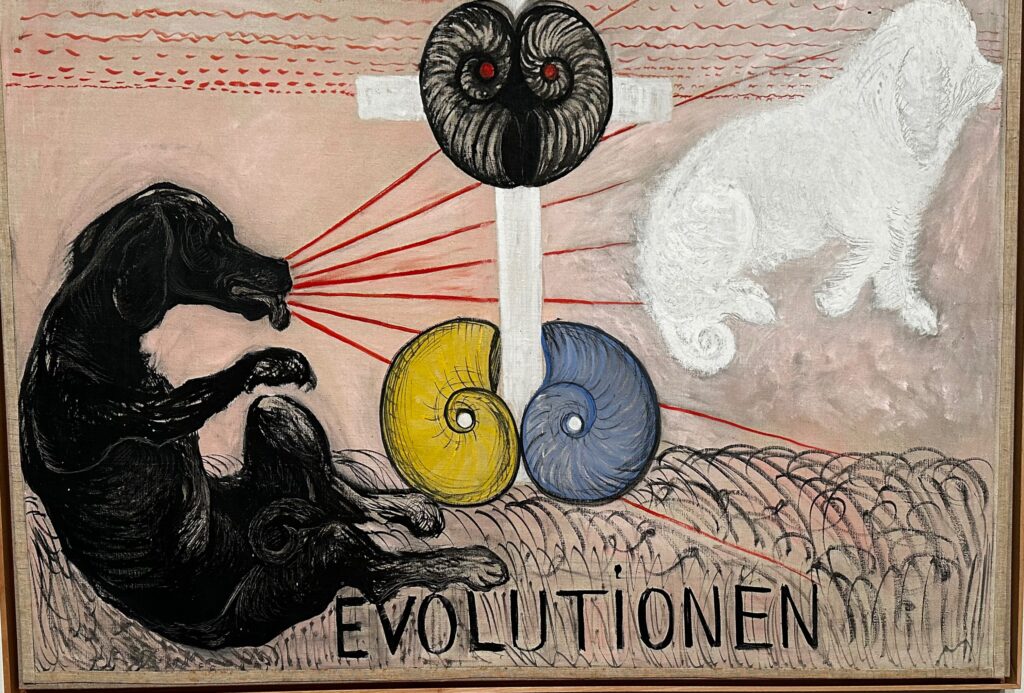
Hilma af Klint: The Evolution – Group VI, number 5 (1908) The soul is embodied in a dog.
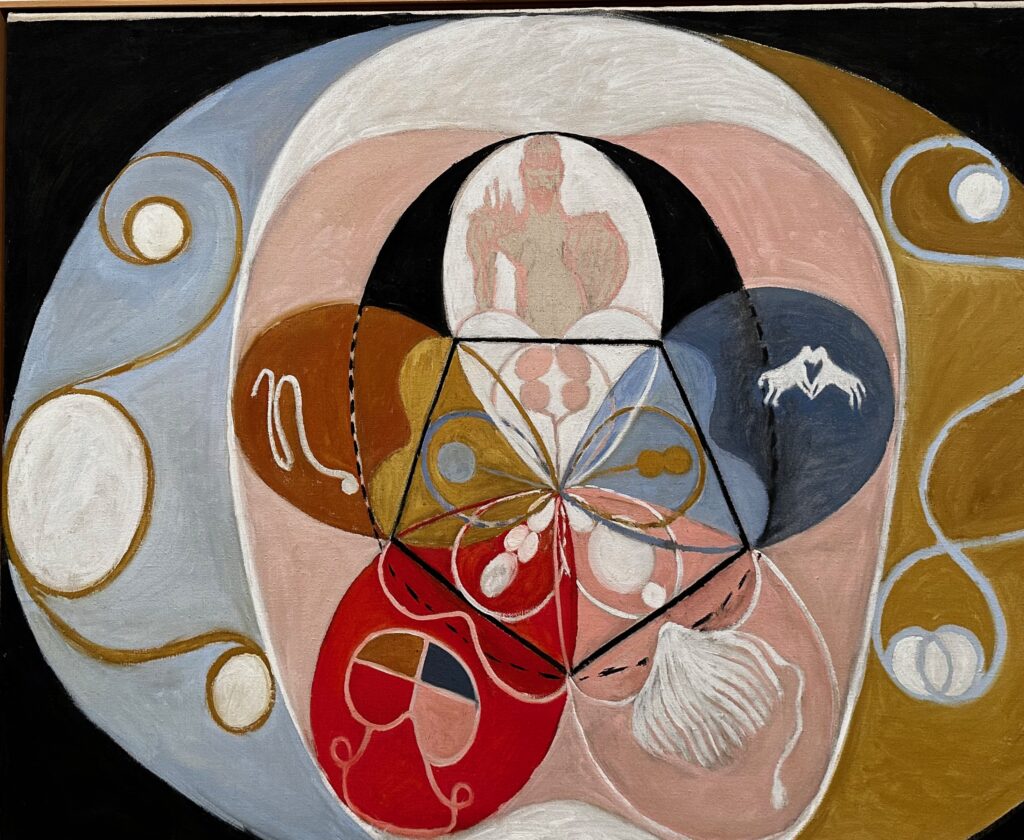
Hilma af Klint: The Evolution – Group VI, number 13 (1908)
The soul has ascended to a higher level of being
The idea of evolution was outlined by Charles Darwin in 1859 in his book On The Origin of Species. Theosophy suggests that as well as evolution of physical species, there is also a spiritual evolution. The Theosophists concluded that there were very advanced spiritual beings that Blavatsky referred to as the Masters, with whom she and other adepts could communicate.
This idea of a spiritual evolution was linked to a belief in a hierarchy of levels of being, and that evolution entailed a development from the material plane of existence to ever more rarefied levels of spiritual being. These ideas of a spiritual evolution and a succession of increasingly pure strata of existence can be identified in the art of both af Klint and Mondrian.
Scientific Discoveries
The end of the 19th century was a period of great scientific discovery. The existence of invisible forces, such as X-rays and radioactivity, were discovered in this period, and this led to the supposition that there are non-material realms of being.
The end of the 19th century also saw the increasing availability of cameras, which could instantly and accurately document aspects of the visual world. Consequently, artists began to experiment with visually representing what cannot be seen, and moved away from representational art that depicted physical likenesses.
For example, the manifesto of the group of artists who called themselves the Transcendental Painting Group, formed in 1938 suggests:
The word ‘Transcendental’ has been chosen as a name for the group because it best expresses its aims, which are; to carry painting beyond the appearance of the physical world, through new concepts of space, colour, light and design, upon planes that are termed idealistic and spiritual.
Middleman 2019: 62
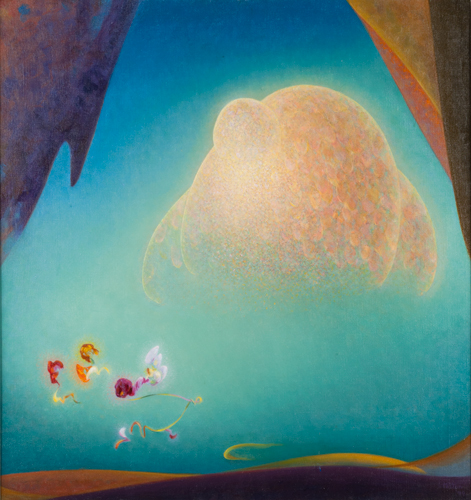
Agnes Pelton – a member of the Transcendental Painting Group. Nurture (1940) Image from the Nora Eccles Harrison Museum of Art. https://artmuseum.usu.edu/social-media/pelton-york
Science and Religion
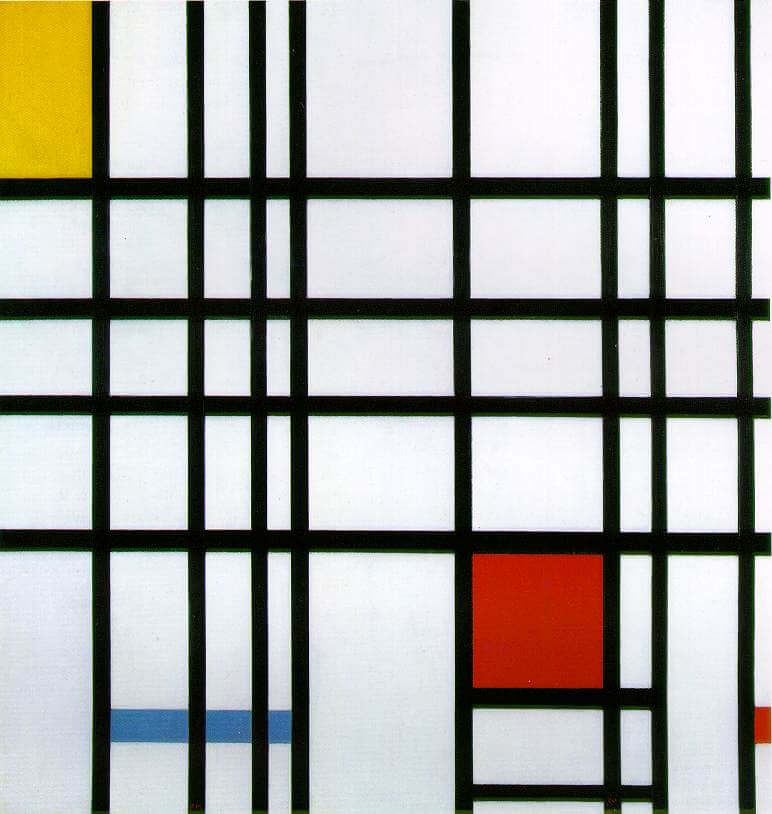
Mondrian calls this style of art of intersecting vertical and horizontal lines with blocks of primary colours neo-plasticism. Mondrian’s aim was to represent the reality which is the basis of all particular forms.
The appearance of natural forms changes but reality remains constant
Piet Mondrian
The scientific discoveries and theories that emerged in the late 19th and early 20th centuries created a tension between religion and science. There was a spectrum of attitudes, with scientism at one pole and religious faith at the other. Scientism suggests that it is only through scientific methods that the truth about life can be revealed – that only phenomena which can be measured in some way can exist. Religious faith, on the other hand, suggests the existence of a reality that transcends the empirical world. Spiritualism and Theosophy suggested that scientism failed to accept that there is a transcendent reality and religious faith failed to acknowledge that this transcendent reality is also subject to universal law. One of the aims of the Theosophical Society is ‘to investigate the unexplained laws of nature and the powers latent in man’ (cited in Chryssides 1999: 89).
In many ways, much of af Klint and Mondrian’s art can be understood as diagrams of the spiritual. Diagrams are utilised in science to visually represent a perceived objective reality which cannot be directly apprehended through the senses, such as the structure of the atom. Laura Stamps (2023: 90 ) observes, scientific diagrams are both ‘representative and abstract’. Much of Klint and Mondrian’s art depict non-material modes of existence which, because they transcend the empirical, can only be represented in abstract ways.
Non- European Cultures
The study of non-European cultures, in the late 18th century was restricted to a small group of academics. However, by the end of the 19th century interest in non-European cultures, particularly Hindu and Buddhist ideas had spread to the wider population. Blavatsky and Olcott were both inspired by Hindu and Buddhist philosophies.. The Theosophists suggest that all particular religious traditions are expressions of a universal truth. This theosophical idea influenced both Mondrian and af Klint.
All religions have the same fundamental content; they differ only in form. The form is the external manifestation of this content and thus an indispensable vehicle for the expression of primary principles.
Piet Mondrian cited in Nabi 2023: 129
Hilma af Klint produced a series of paintings – Series II – which represent different religions in a diagrammatic form. Through depicting the different religious traditions primarily as circular af Klint intends to emphasise that, whilst there are minor differences of form, all religions are inherently alike.
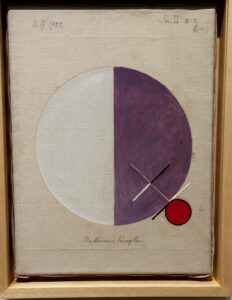
Hilma af Klint: The Teachings of Buddhism
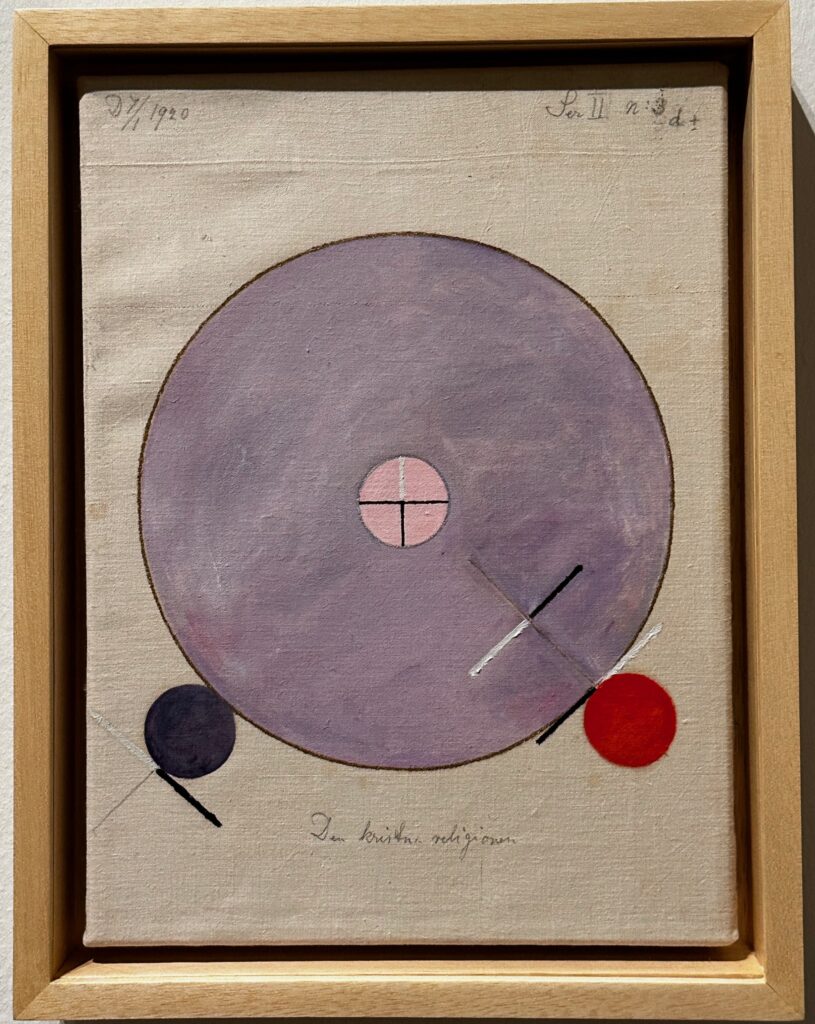
Hilma af Klint: The Christian Religion
Spiritualism and Art
There are two interrelated types of Spiritualist art: the psychic portrait and the channelled vision.
The Psychic Portrait
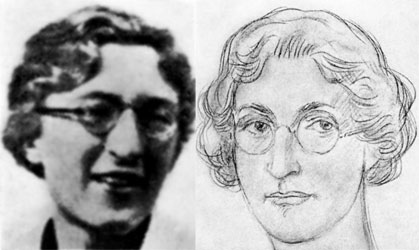
Spirit portrait of Rodha Ring by Frank Leah
Image from Faces of the Living Dead http://www.snppbooks.com/faces-of-the-living-dead.html
In the psychic portrait the spiritualist artist produces a likeness of the deceased. who is unknown to the artist but is recognised by someone else. For example, the cartoonist Frank Leah (1886–1972) was renowned in spiritualist circles for his portraits of the deceased. Although as Susan Farrow, the editor of Psychic News, writes in the introduction to Paul Miller (2010) book on Leah:
Leah hated the word ‘dead’ being applied to his Spirit visitors, because he insisted that they were vibrantly alive. They were not phantoms who bore resemblance to the conventional idea of ghosts. To him they were as natural and normal as the people he met on the street
In Miller 2010:10
These psychic portraits, whilst clearly recognised by the bereaved and had a physical resemblance to the deceased are often idealised in some way, as they represent the spirit of the person and not their physical embodiment.
The Channeled Vision: Georgina Houghton (1814–1884)
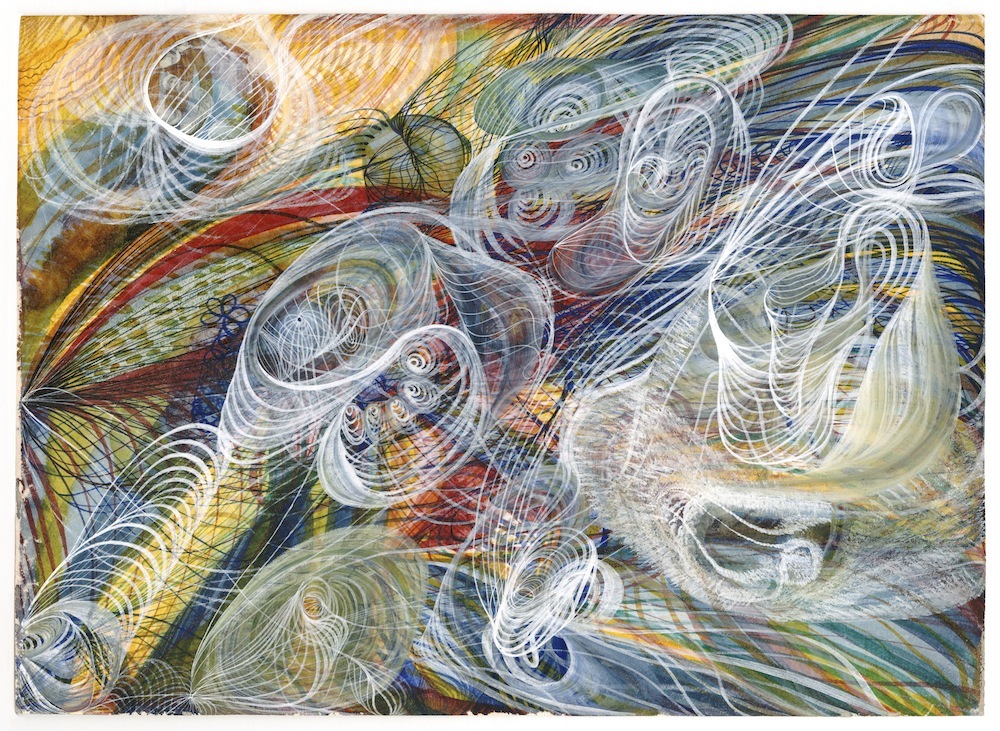
Georgiana Houghton: Glory be to God 1864
From the Victorian Web https://victorianweb.org/painting/houghtong/2.html
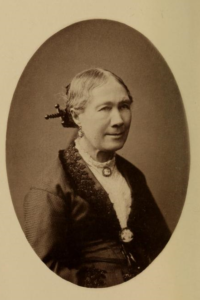
Georgiana Houghton
The channelled vision, sometimes referred to as automatism, is when the artist is passive and believes that their hand is guided by a spirit to create an image. A good example of the channelled vision is the art of Georgiana Houghton.
I must explain that in the execution of the Drawings my hand has been entirely guided by Spirits, no idea being formed in my own mind as to what was going to be produced
Houghton 1871 cited in Althaus, Mühling & Schneider 2018: 40
Houghton, who was a trained artist, became involved in Spiritualism after attending a séance in 1859. Houghton was convinced that her sister Zilla who had died in in 1851 communicated with her. Initially her involvement with Spiritualism was to enable her to contact the spirits of her family. Houghton came to hear of the spiritual drawings of other Spiritualists and, as an artist, decided to ask the spirit of her beloved sister Zilla, who was also an accomplished artist, to guide her hand. However, although the spirit of her sister did not appear, a spirit of an artist called Henry Lenny did guide her hand. Over the years she acquired a number of guiding spirits, including deceased artists such as Titian and archangels. She often indicated on the back of her paintings who the guiding spirits was, and sometimes a cryptic message on how to interpret the image.
Houghton believed that her paintings are a visual insight into the spirit world, evidence of the existence of spirits and proof that it was possible to communicate with the deceased
While Houghton became relatively well known in the Spiritualist world, she was not particularly well known in the art world. Her swirling, almost psychedelic, images were so different from most Victorian art that it left many viewers bewildered. Houghton herself suggested:
The character of the work is so totally unlike all mortal experience.
Houghton 1871 cited in Althaus, Mühling & Schneider 2018: 43
In 1871 Houghton organised an exhibition of 155 of her works in London. It received mixed reception, and she only sold one piece and secured one commission. One critic, for example, wrote ‘they deserve to be seen as the most extraordinary and instructive example of artistic aberration’. Another critic suggested that Houghton’s exhibition ‘will disgust all sober people’ (cited in Higgie 2023: 64–5). In many ways Houghton anticipated the developments in artistic conventions that followed her, but she was ahead of her time and disappeared into obscurity. Although recently there has been a reappraisal of her work. For example, in 2016 the Courtauld Gallery in London organised a retrospective of many of Houghton’s work. In the review of the exhibition the art critic for The Guardian:
Rescued at last, her genius soars. With their layered, almost three dimensional worlds of wild colour touched off by subtle, delicate lacy mist, these powerful creations remind me of some of Jackson Pollock’s paintings.
Jones 2016
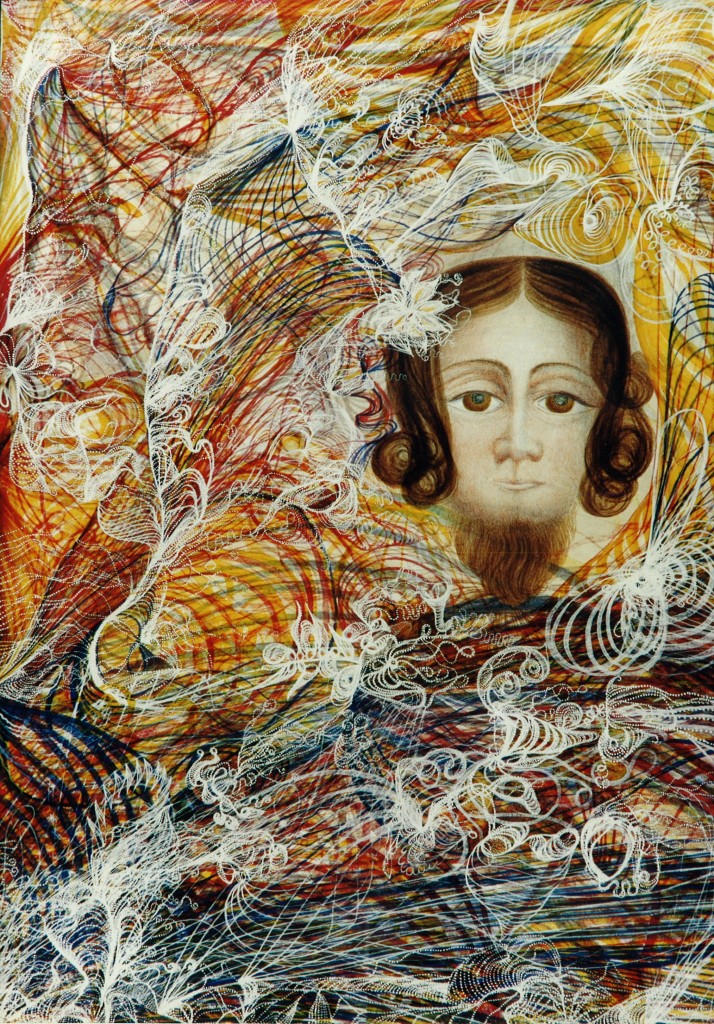
Georgiana Houghton: Portrait of the Lord Jesus. 1868
https://en.wikipedia.org/wiki/Georgiana_Houghton
We would perhaps consider Houghton’s art to be abstract, but the idea of abstract art does not really emerge until several decades after Houghton. Although it is now challenged, the beginning of abstract art is often associated with the paintings of the Russian artist Wassily Kandinsky (1866–1944). Houghton even precedes the work of Hilma af Klint.
Theosophy and Art: Hilma af Klint (1862–1944)

Hilma af Klint in her studio c 1895
https://en.wikipedia.org/wiki/Hilma_af_Klint
Af Klint, like Georgiana Houghton was also an accomplished artist. She studied at the Swedish Royal Academy of Arts. She had an interest in Spiritualism, which also seems to have been prompted by the death of a sister. However, Spiritualism seemed to lack any in-depth philosophical dimension, and af Klint became more attracted to the ideas of theosophy and joined the Theosophical Society in 1889. She was also interested in the ideas of Rudolf Steiner (1861–1925), the founder of Anthroposophy, which was a spin off from Theosophy.
In 1896, af Klint along with four other women formed a group called ‘The Five’ (De Fem) to collaboratively understand the spiritual dimension. In particular The Five produced channelled drawings often including spirals and floral forms.
Far from being random images, these forms created part of a highly codified visual language that was being developed by The Five and was inspired by their faiths and by their esoteric philosophical explorations
Grant 2023: 104
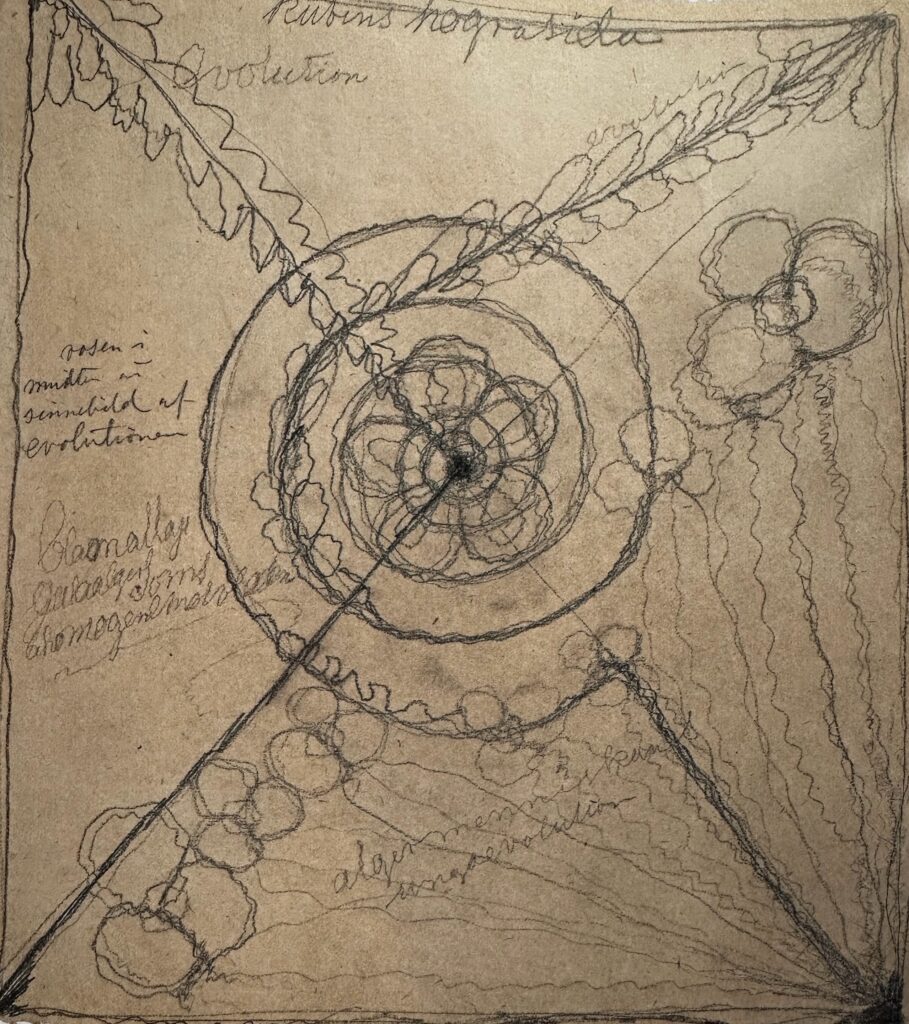
De Fem: Spiritualist Drawing. From Grant 2023: 107
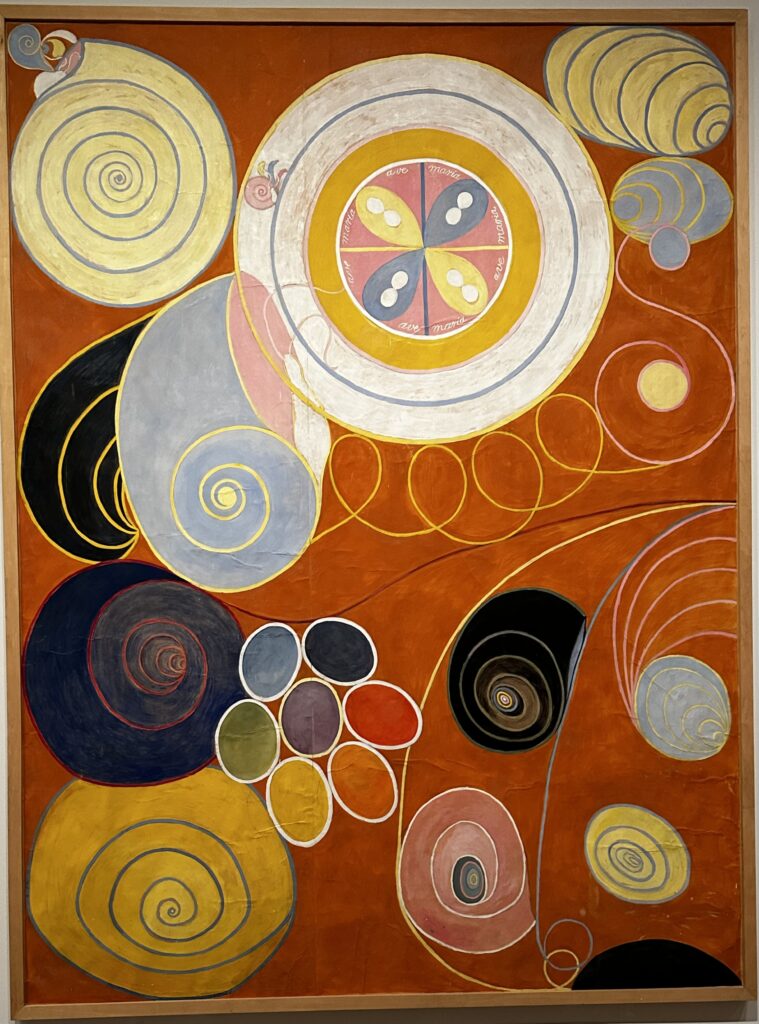
Hilma af Klint: The Ten Largest: No 3, Youth 1907
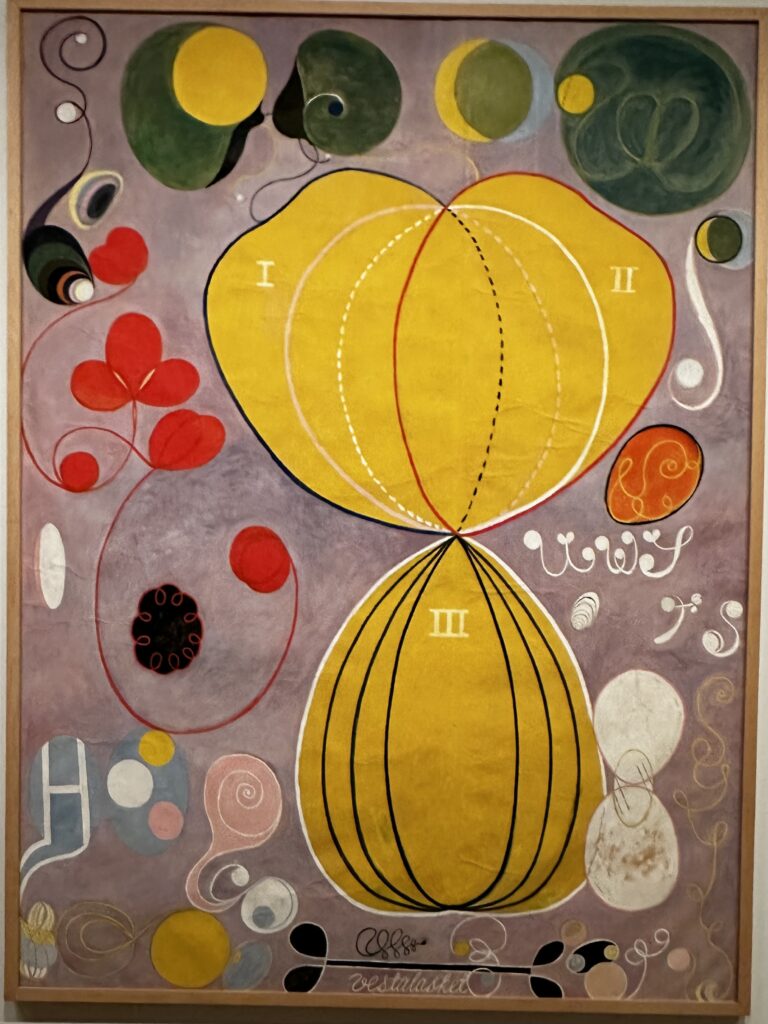
Hilma af Klint: The Ten Largest. No 8, Adulthood 1907
In 1906 af Klint was ‘commissioned’ by a spirit guide called Amaliel to produce a series of paintings. Between 1906 and 1915 she produced 193 works for Paintings for the Temple. Af Klint indicated that she was simply a conduit for the spirits.
The pictures were painted directly through me, without any preliminary drawings and with great force. I had no idea what the paintings were supposed to depict; nevertheless, I worked swiftly and surely without changing a single brush stroke.
Af Klint in Althaus, Mühling & Scneider: 87.
However, she also indicated that she was not entirely passive in the process of producing these striking images.
It was not the case that I was to blindly obey the High Lords of the Mysteries but that I was to imagine that they were always standing by my side.
In The Solomon R Guggenheim Foundation 2023.
Perhaps the most impressive of the paintings are The Ten Largest, which measure 3:28 x 2.40 meters (10.7 x 7.9 ft). These large brightly coloured abstract images of spirals, circles and naïve flowers are reminiscent of the designs of the traditional women’s costumes of the rural community of Gagnef, which af Klint had visited. ‘These hand-made clothes were decorated with socially coded patterns that were often abstracted from the surrounding landscape’ (McNab 2023: 23). Af Klint titled these colossal images after the four ages of life: childhood, youth, adulthood and old age. However she suggested that not only did these large paintings represent a spiritual evolution, but that they also depicted planes of being that existed beyond our material reality.
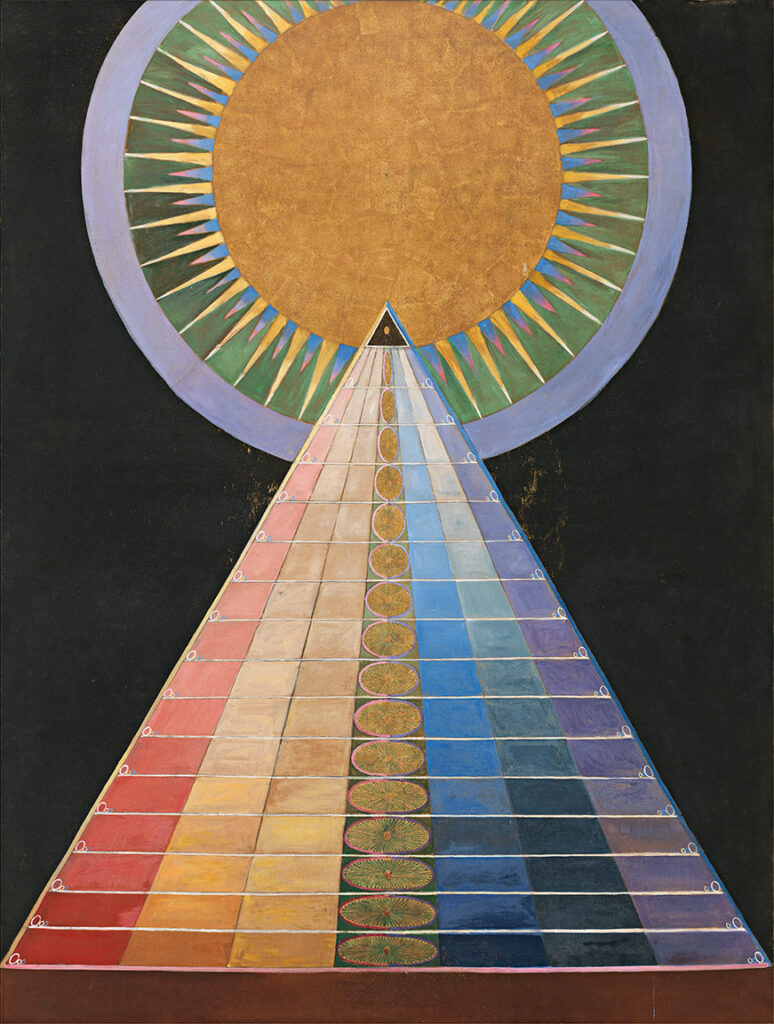
Hilma af Klint: Group X, Altarpiece No 1. 1915.
Image from Solomon R Guggenheim Foundation
https://www.guggenheim.org/teaching-materials/hilma-af-klint-paintings-for-the-future/paintings-for-the-temple
Af Klint intended these 193 images to be displayed in a temple that would be a spiral shaped building. The temple design would architecturally represent the dominant concepts depicted in the paintings, namely the ascent from the material plane of existence to more rarefied spiritual levels of being. Just before she died, af Klint indicated that most of her paintings, including the 193 Paintings for the Temple should not be exhibited for 20 years after her death.
Like Georgiana Houghton, af Klint’s ground-breaking work has not been acknowledged until fairly recently. With the critically acclaimed retrospective at the Guggenheim Museum in New York in 2018, and the exhibition in 2023 alongside the work of Piet Mondrian at the Tate Modern in London, her importance is beginning to be recognised.
Conclusion
Spiritualism and particularly Theosophy were immensely influential for many aspects of culture in the late 19th and early 20th century. However, their impact has largely been ignored as they are now regarded as marginal at best. In particular, the Spiritualist and Theosophical idea that there are other invisible planes of existence beyond the purely material, which nonetheless could be accessed, had a huge impact on the development of abstract art. One cannot understand the art of Piet Mondrian, Georgina Houghton or Hilma af Klint without reference to the fact that their worldviews were informed by Spiritualism and Theosophy.
Both Georgiana Houghton and Hilma af Klint’s ground-breaking work has not been acknowledged until recently. The key figures associated with abstraction are Piet Mondrian and Wassily Kandinsky. However, af Klint’s The Ten Largest were painted about 3 years before Kandinsky really started to experiment with abstraction, and Houghton preceded af Klint by nearly 4 decades. The importance of these two innovative artists is slowly being recognised. Not only were they pivotal in the emergence of abstract art, but they were also influential in finding new ways of visually representing transcendent states of being. Why have these two significant artists remained in obscurity for so long? I suggest that it is probably because of the patriarchal nature of the art world, and they were both women.
Useful Sources and References
Althaus, K. Mühling, M. & Schneider, S. (2018) World Receivers. Munich: Hirmer.
Chryssides, G.D. (1999) Exploring New Religions. London: Cassell.
Davies, A.B. (2022) Considering Spirituality in Contemporary Spiritualist Art. Journal for the Study of Spirituality. 12(1), pp.
50–61.
Grant, S. (2023) Hilma af Klint and The Five. In Nabi, N.A. Fer, B. & Stamps, L (eds.) Hilma af Klint & Piet Mondrian: Forms of
Life. London: Tate Publishing, 104–106.
Heelas, P. (2008) Spiritualities of Life: New Age Romanticism and Consumptive Capitalism. Oxford: Blackwell.
Higgie, J. (2023) The Other Side: A Journey into Women, Art and the Spirit World.London: Weidenfeld and Nicolson.
Jones, J (2016) Georgiana Houghton: Spirit Drawings Review – Awe Inspiring Visions of a Victorian Medium. The Guardian,
15 June. Available athttps://www.theguardian.com/artanddesign/2016/jun/15/georgiana-houghton-
spirit-drawings-review-courtauld
Middleman, R. (2019) Outlying Modernism: Agnes Pelton, Theosophy and Gender.In Scheer, C. Turner, S. & Mansell, J.
(eds.) Enchanted Modernities: Theosophy, the Arts and the American West. Lopen: Fulgur Press
Miller, P. (2010) Faces of the Living Dead: The Amazing Psychic Art of Frank Leah. York: Saturday Night Press Publications.
First published in 1943.
Nabi, N.A. (2023) Life of Forms: Theosophy, Technology and Transnational Modernism. In Nabi, N.A. Fer, B. & Stamps, L
(eds.) Hilma af Klint & Piet Mondrian: Forms of Life. London: Tate Publishing, 157–161
Stamps, L. (2023) Evolution (Not Revolution) in Nabi, N.A. Fer, B. & Stamps, L (eds.) Hilma af Klint & Piet Mondrian: Forms
of Life. London: Tate Publishing 87–91.
Websites
The Solomon R. Guggenheim Foundation (2023) Hilma af Klint: Paintings for the Future.
A brief introduction to the first solo exhibition of Hilma af Klint’s paintings held at the Guggenheim Museum in New York in
2018. This includes a short and useful video about af Klint.
https://www.guggenheim.org/exhibition/hilma-af-klint
The Hilma af Klint Foundation
https://hilmaafklint.se
Georgiana Houghton
https://georgianahoughton.com