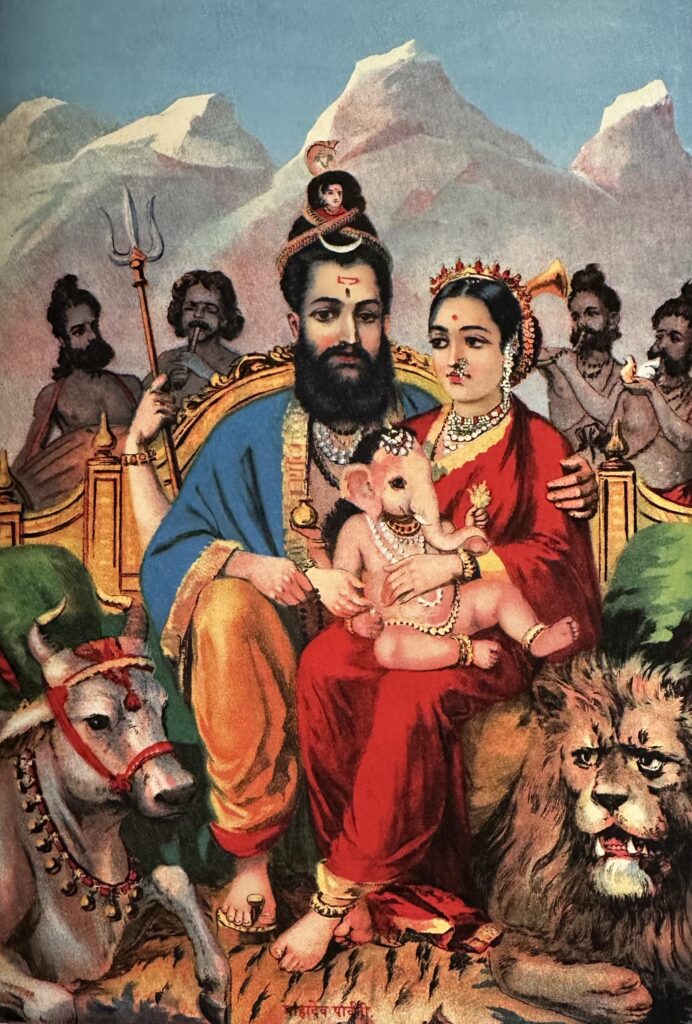
Image from Davis 2012: 105
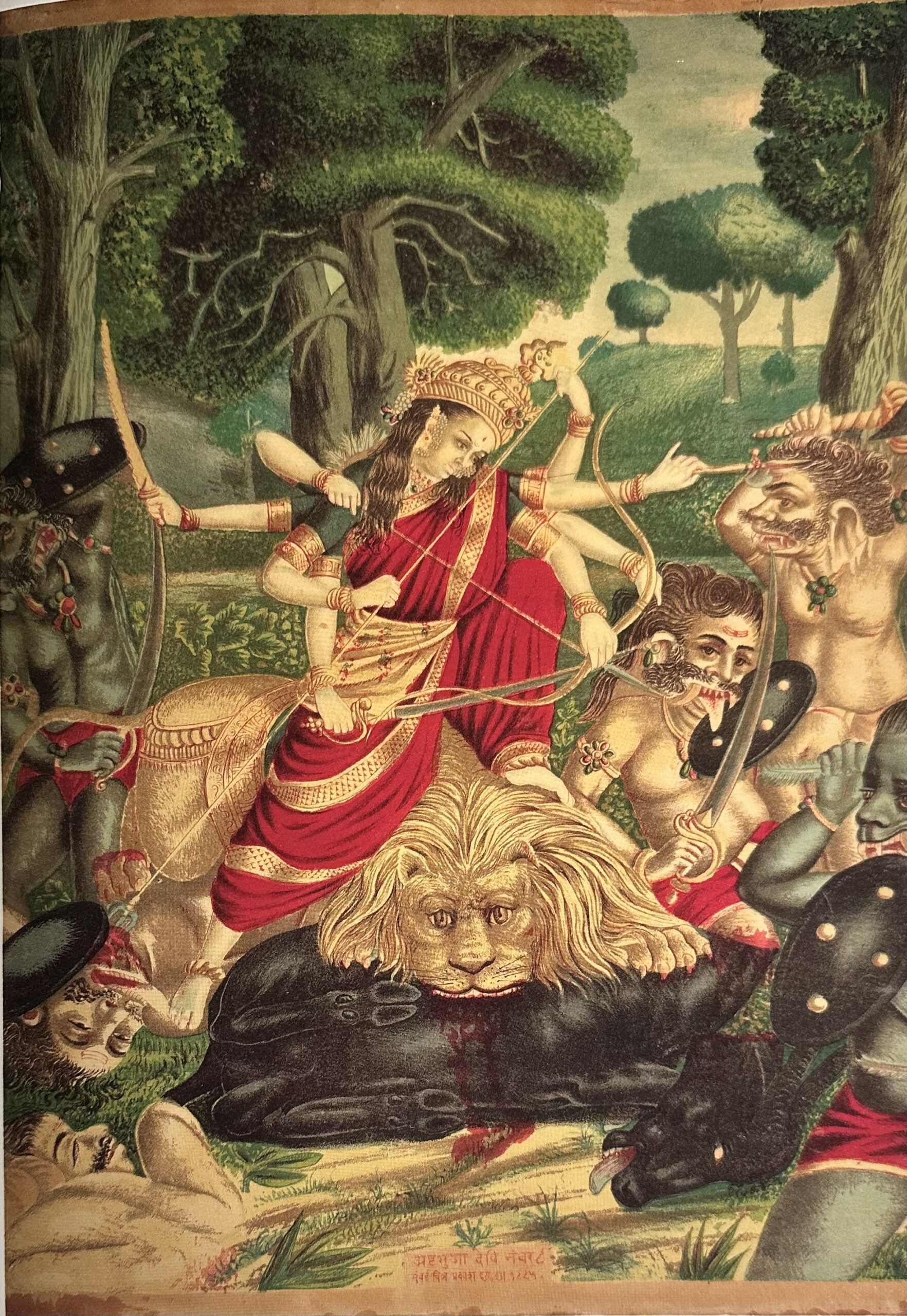
Image from Davis 2012: 59
This discussion is a slightly modified and expanded version of an article that I published in Challenging Religious Issues (21: 2024) – a journal for A-Level students in Religious Studies.
Introduction
There is a paradox at the heart of Hindu approaches to gender relations. On the one hand Hindu society is deeply patriarchal, and women are often regarded as secondary and subservient to men. On the other hand, goddesses are an important focus of Hindu devotional practices. Hindu goddesses are often regarded as aspects of one supreme Goddess and manifestations of a primordial female power known as śakti. Furthermore, it is believed that this sacred power is inherent in all women. This suggests that some aspects of the Hindu traditions are empowering for women.
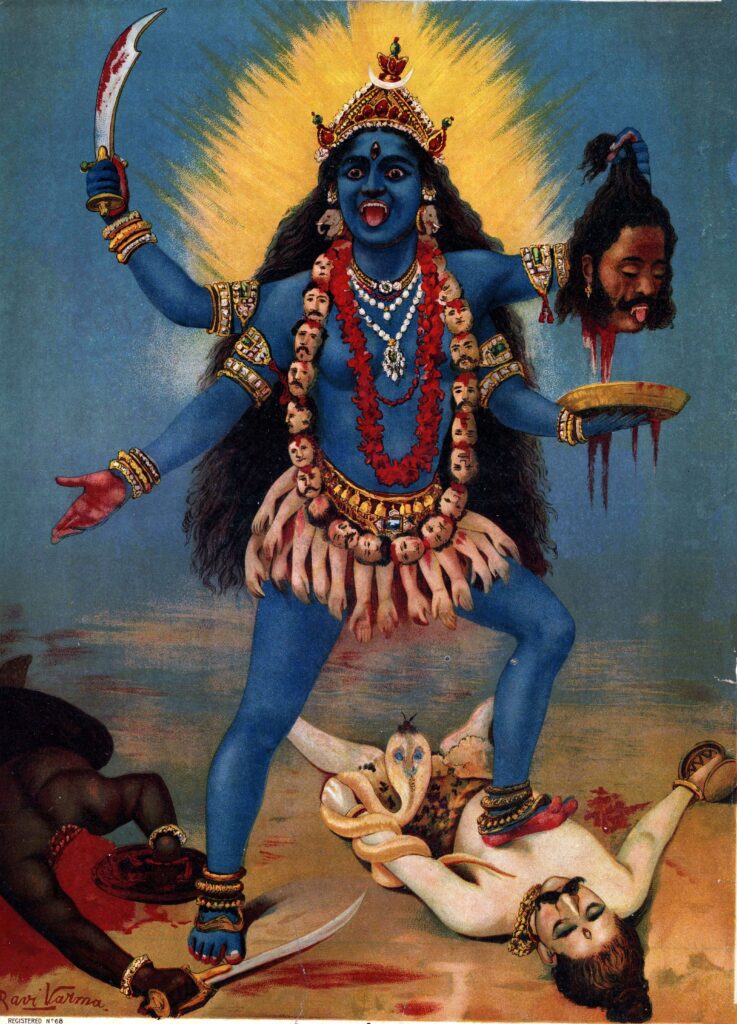
Hindu goddesses are represented in diverse and contradictory ways. Goddesses are sometimes depicted as being totally dependent on their male consort. This is perhaps exemplified by Sītā, who is frequently envisioned as totally devoted and obedient to her husband Rāma. However, the goddess Kālī is not only characterised as fiercely independent but is also represented as dominant and standing on the inert body of the god Śiva.
The Dutiful Wife
It is not possible to understand the nature of gender relations in the Hindu traditions without comprehending the concept of dharma. There is no direct translation of the term dharma in English, but it has connotations of law, justice, religion and righteousness. Dharma translates as ‘what holds together’. It is therefore regarded as the key to social and moral order. Dharma can also signify ‘duty.’ Consequently, strīdharma is often translated as ‘the duties of women’ and it is suggested that if these duties are not maintained, family, society, and the moral order will collapse.
The idea of strīdharma is particularly onerous for married women. Many of the ideas about the nature of women and the duties for married women can be found in a text commonly called The Laws of Manu (henceforth Manu).This text was probably composed between the first century BCE and the second century CE. Although most Hindus have little direct knowledge of this text, it has come to define an orthodox understanding of gender and marriage. Manu suggests that women are inherently dependent on men and should dedicate their lives to the service of their husband.
A girl, a young woman, or even an old woman should not do anything independent, even in (her own) house.
(Manu 5:147 cited in Doniger 1991, p.115)A virtuous wife should constantly serve her husband like a god, even if he behaves badly, freely indulges his lust, and is devoid of any good qualities.
(Manu 5: 154 cited in Doniger 1991, p.115)
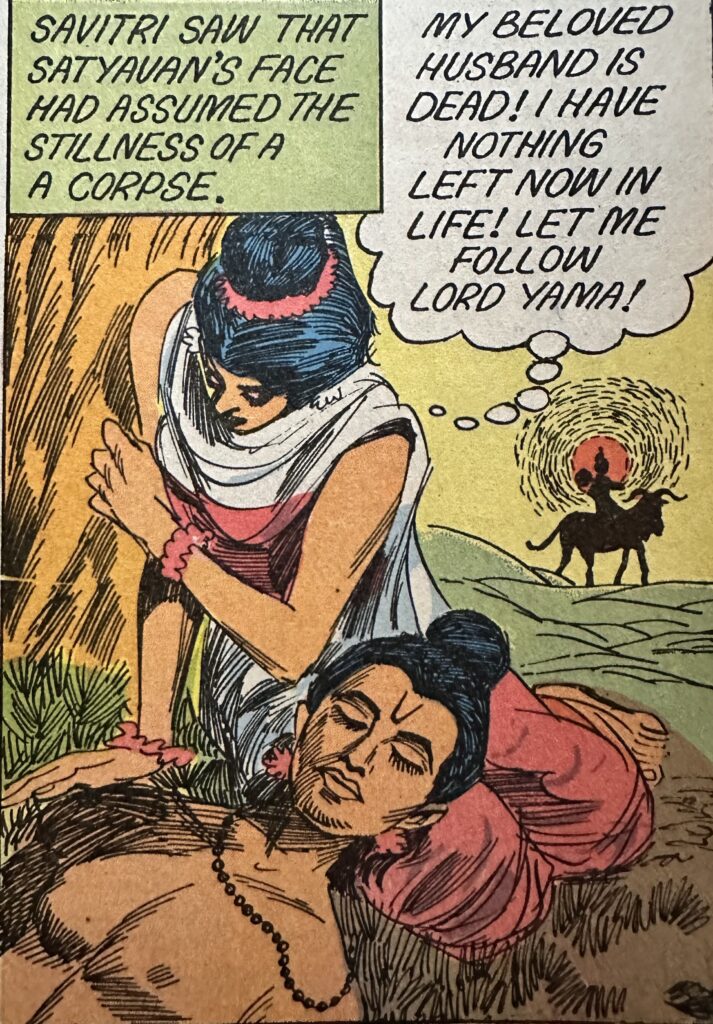
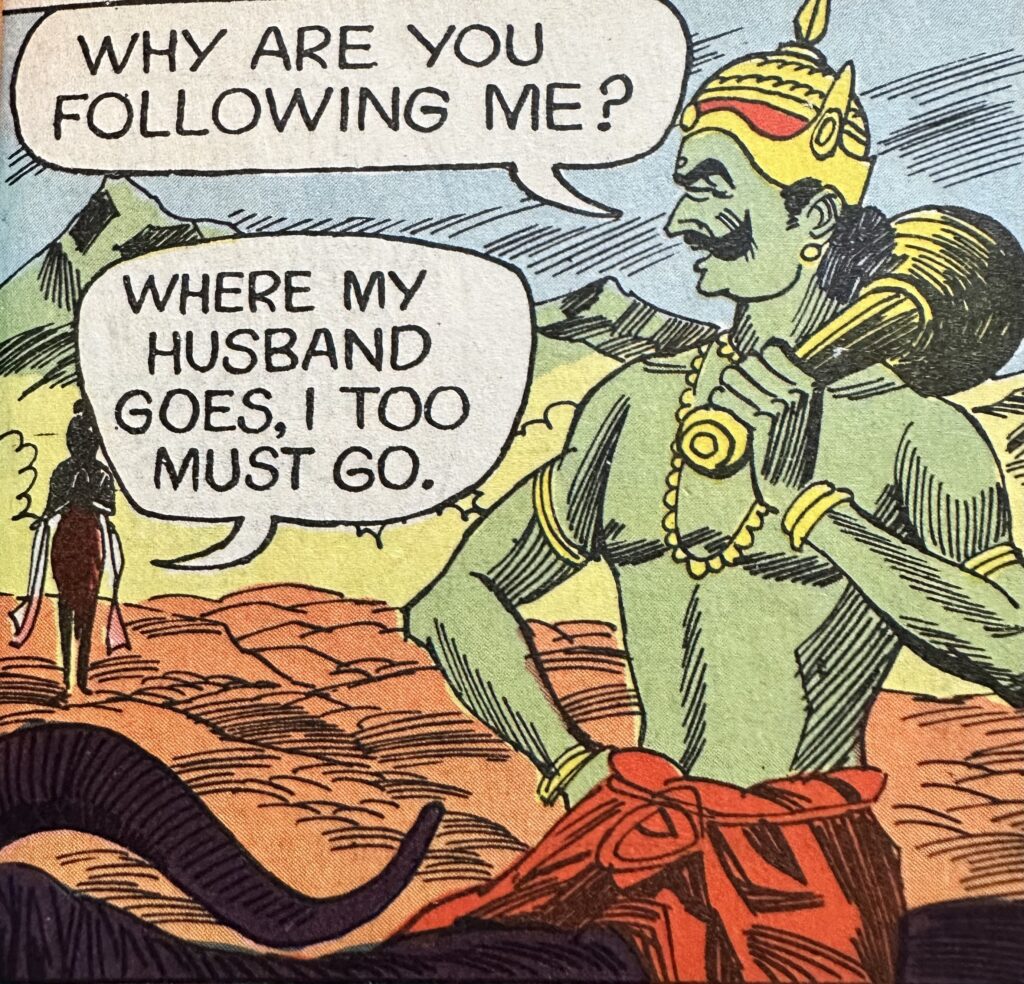

The dutiful wife is sometimes referred to as pativratā – ‘one who takes vows for her husband’, which indicates that a woman’s role is solely to ensure the health and wellbeing of her spouse and family. This suggests that women can have no independent existence. This idea that women are inherently dependent upon men is particularly noticeable in attitudes towards widows. One of Susan Wadley’s informants in her study of widows in rural north India indicated: ‘[The husband] is the main pillar of life. When he dies, then there is nothing for women’ (cited in Wadley 1995, p.92). The death of the husband before the wife is sometimes represented as a failure of dharma.
There are many narratives about the dutiful wife, but the concept is perhaps exemplified by the story of Sāvitrī, who marries the exiled prince Satyavat. Unfortunately, it is prophesied that Satyavat would die within a year. The day comes and Satyavat dies in Sāvitrī’s arms. However when Yama, the god of death, comes to collect his soul, Sāvitrī follows him, and eventually tricks Yama into restoring Satyavat’s life.
Sītā: The Archetypal Good Wife
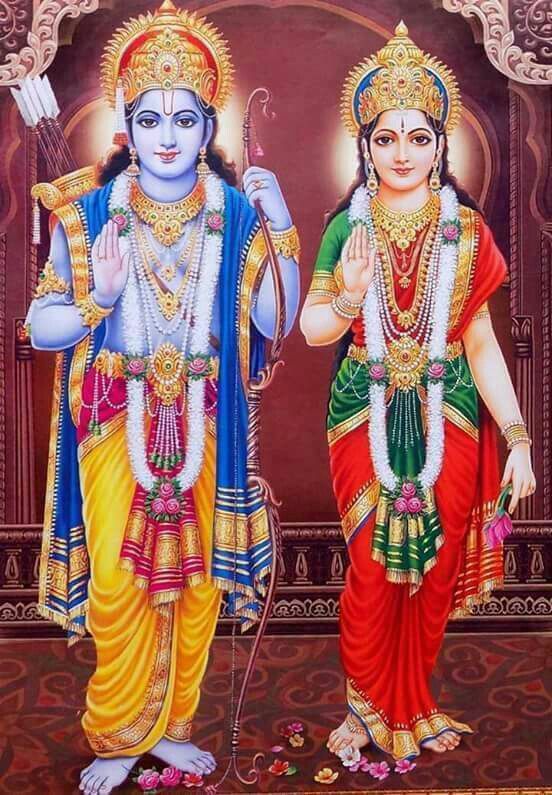
Perhaps even more influential than Manu in shaping ideas about the dutiful wife is the narrative of Sītā found in the epic tale the Rāmāyaṇa. Although there are many different versions of the Rāmāyaṇa (see Richman 1994) the core narrative recounts how Rāma is banished to the forest for fourteen years. During this time his beautiful wife Sītā is kidnapped by the ten headed demon (asura) Rāvaṇa. Much of this mythic tale recounts how Rāma sets off to rescue Sītā, and ultimately defeats Rāvaṇa in battle.
When Rāma is banished, he suggests that Sītā, as a woman who has lived all her life in luxury, would not be accustomed to the hardships of living as an exile in the forest, and therefore should remain behind in the city. However, Sītā asserts that her duty is to stay with her husband:
A wife alone follows the destiny of her consort. O Bull among Men; therefore, from now on my duty is clear.
Deprived of her consort, a woman cannot live.
(The Rāmāyaṇa of Valmiki 2:27 & 2:29 cited in Kinsley 1987, p. 71–2)
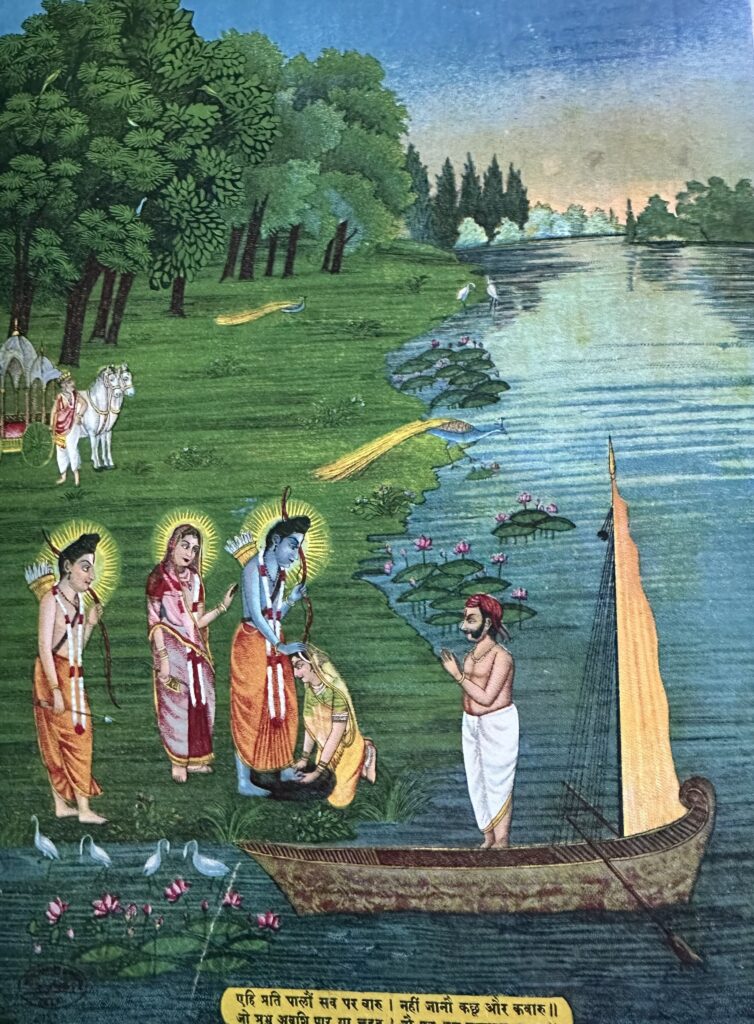
Image from Davis 2012
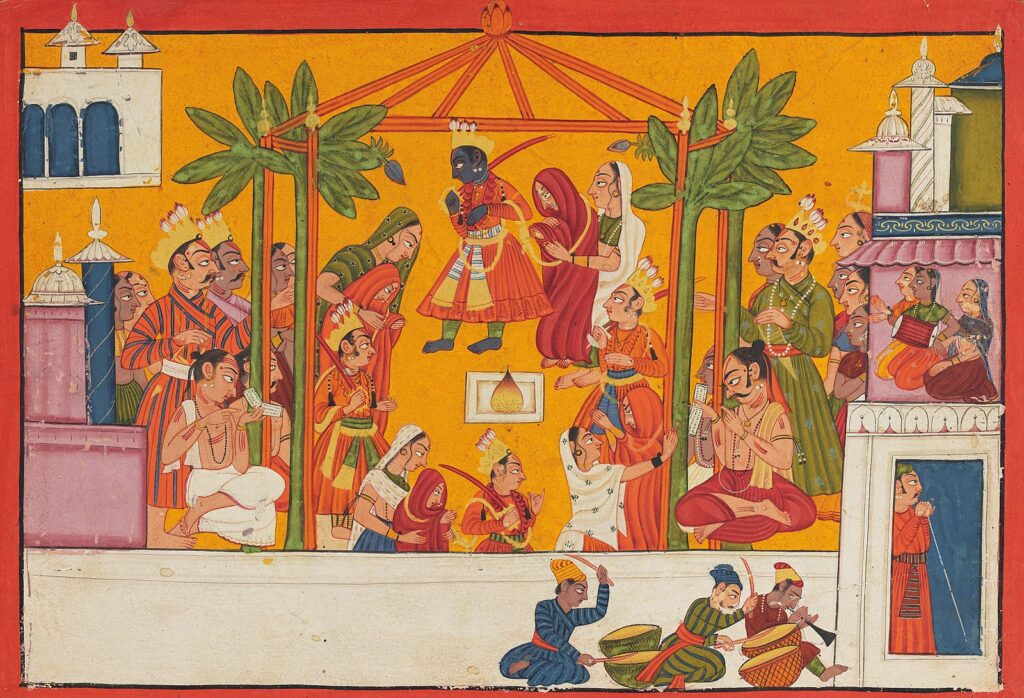
Image from Wikipedia

Wendy Doniger O Flaherty characterises the goddesses, like Sītā, who are depicted as subordinate to a male deity as ‘goddesses of the breast’. These goddesses of the breast are ‘auspicious, bountiful and fertile, linked to the life-cycle … provide role models for the wife (Doniger O’Flaherty 1980, p. 90–91).
It is important to note that there are other versions and readings of the Rāmāyaṇa that do not necessarily represent Sītā as simply docile and subservient to Rāma.
In the 16th century the female Bengali poet Chandrabati, wrote a version of the Rāmāyaṇa from Sītā’s point of view. There are also many folk songs sung by women in villages across India that take Sītā’s viewpoint. Chandrabati’s retelling of the Rāmāyaṇa and the women’s folk songs focus on the perceived mistreatment of Sīta after Rāma defeats Rāvaṇa and has rescued Sītā. Rāma questions whether Sītā had remained faithful as she had been staying, albeit under duress, in another man’s house and demands that she prove her virtue by undergoing a trial by fire. She emerges from the fire unscathed and thereby proves her purity. Nonetheless, once Rāma has assumed the throne, there are rumours amongst the population about Sītā’s fidelity. Bowing to public pressure Rāma banishes, the now pregnant, Sītā to the forest.
These women’s retellings of the epic tend to downplay the masculine heroics of the more traditional recensions of the narrative and are often highly critical of Rāma’s treatment of Sītā. These versions told from Sītā’s perspective reflect the suffering and injustice that many Hindu women experience. Nabaneeta Dev Sen argues: ‘If patriarchy has used the Sita myth to silence women, the village women have picked up the Sita myth to give themselves a voice’ (Sen 2021).
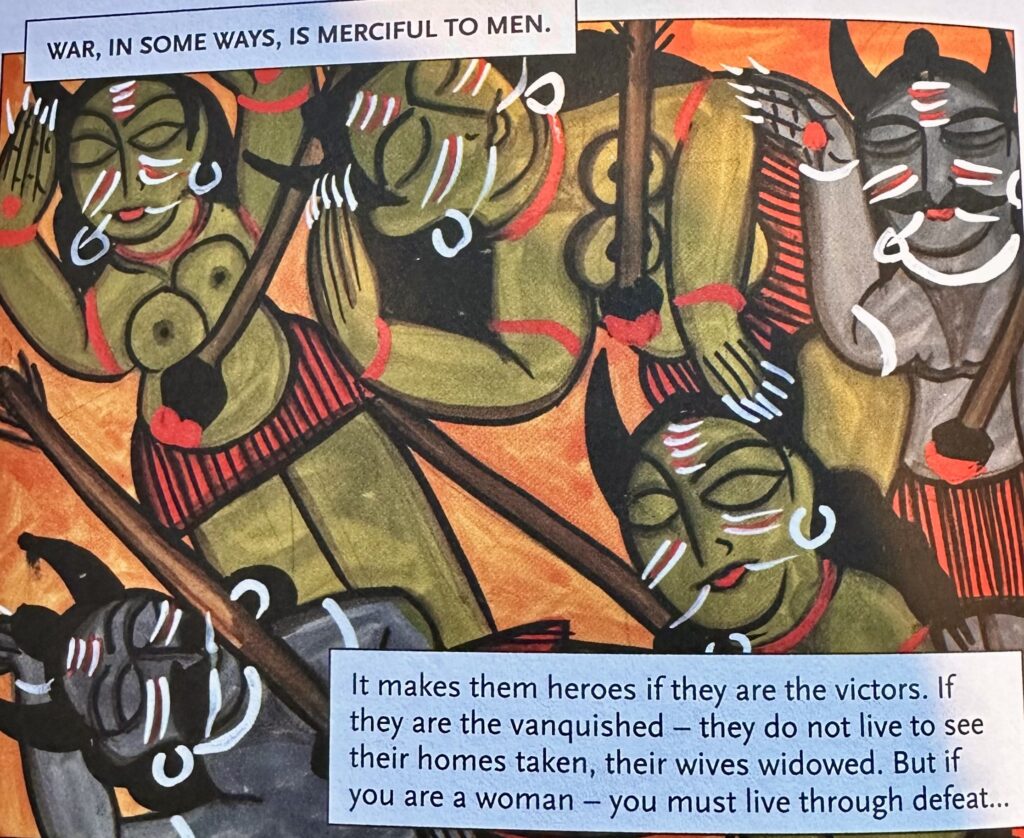
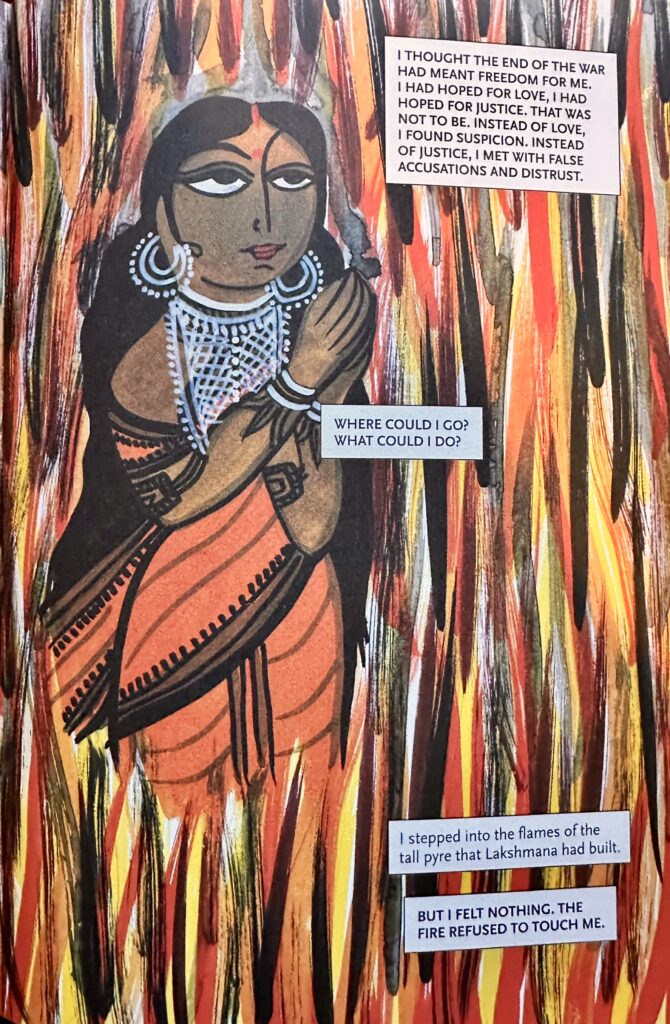
Kālī: Fierce and Independent.
Wendy Doniger O’Flaherty contrasts goddesses of the breast with goddesses of the tooth, who are dangerous and defy the norms of femininity. These goddesses are represented as being independent or dominating their male consort. The most recognisable example of the fierce and independent goddess is Kālī. In both iconographic and narrative representations Kālī seems to be the antithesis of the pativratā, epitomised by Sītā.Kālī is often depicted as being naked, dark blue in colour, wearing a garland of severed heads and with a protruding tongue. She is described as sexually promiscuous and dwelling in the cremation grounds. Kālī challenges social conventions and is associated with the margins of society.

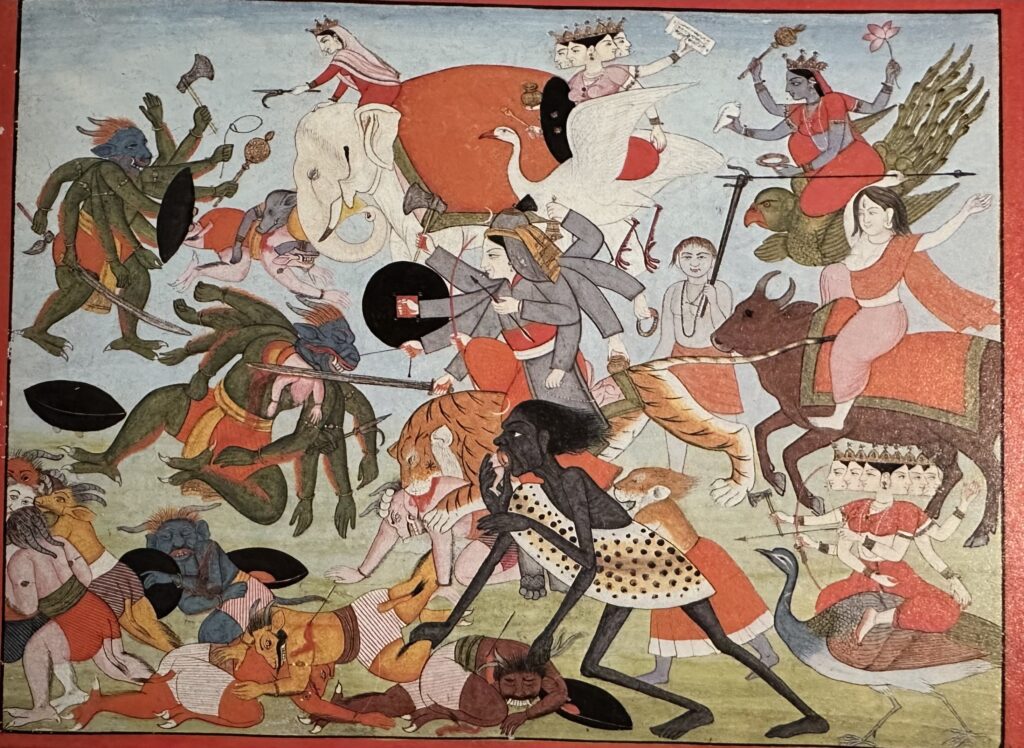
Images from Mookerjee 1985
Kālī is also represented as a fierce warrior, a traditionally male role. In the important text the Devī Māhātmaya, it is recounted that the demon (asura) Mahiṣa who was invincible to all male opponents, defeated the gods and evicted them from heaven. Consequently, the homeless gods collaborate and the goddess Durgā emerges from their combined energy. However, the gods have neglected to inform Durgā that only a naked woman could defeat Mahiṣa and Kālī manifests out of her anger. This can be interpreted as the female rage against, rather than the calm acceptance of, the patriarchal norms of Hindu society. Female power achieved what male power was unable to. David Kinsley suggests Kālī is a ‘symbol of the “other” ways of being female that male-dominated mainstream society sees as dangerous’ (Kinsley 1998, p. 81).
Kālī is frequently represented as standing on the inert body of the god Śiva, which seems to suggest that the female dominates the male. Kālī represents śakti, the female animating power of creation. This is often interpreted as Śiva being śava – ‘a corpse’ without the vivifying force of śakti. However, there are also other ways of interpreting the representation of Kālī standing over the inert body of Śiva. This interpretation suggests that Kālī is so furious that she becomes totally out of control and in her rampage threatens to destroy the entire world. To halt her destruction, Śiva lies on the ground. On stepping on her consort, Kālī calms down. Usha Menon, observes that many of her Hindu women informants suggest that at the moment she stepped on Śiva, Kālī ‘realized her sense of duty as a wife and as a nurturing mother to the world’ (Menon 2002, p.47). In this interpretation, Kālī’s protruding tongue does not signify sexual promiscuity, but a sense of shame at her realisation that by standing on Śiva, societal norms have been transgressed.

Mahadevi and Śakti
All goddesses are regarded as manifestations of śakti, which is believed to be the primordial power that creates and sustains the cosmos. Linked to the concept of śakti, as an inherently female power, is the idea of Devī – ‘The Goddess’, sometimes referred to as Mahādevī– ‘The Great Goddess’. The numerous distinct goddesses are perceived as being different manifestations or aspects of this one supreme Goddess, who is regarded as being both immanent and transcendent. Mahādevī, is equated with the supreme reality, the source of all being.
By you this universe is borne, by you this world is created.
By you it is protected, O Devī, and you always consume it
at the end.
O you who are [always] of the form of the whole world,
At the time of creation you are of the form of the creative
force,
At the time of sustentation you are the form of the
protective power,
And at the time of the dissolution of the world, you are the
form of the destructive power.
(Devīmāhātmya 1:75–77 cited in Bose 2023, p.17)
In this verse, Devī is identified with the cycle of creation, maintenance and destruction of the cosmos, which is more commonly associated with the male deities Brahma, Viṣṇu and Śiva respectively. Sometimes it is suggested that whilst these three gods are identified with creation, maintenance and destruction, they do so only because they are commanded to do so by Māhādevī. In other words, the male deities are represented as dependent and subordinate to the goddess, rather than vice versa.
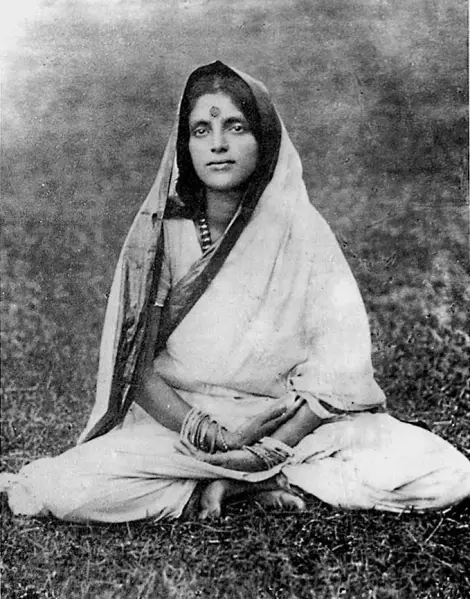
Image from The Cosmic Mother
It is suggested that women have the power of śakti, whereas men do not. For example, one text suggests: ‘Every woman, O Goddess, is your form, your body concealed in the universe’ (Mahānirvāṇa Tantra 10.80,1 cited in Bose 2023, p.76). Consequently, it is often believed that only women can be channels for the sacred power of the Goddess.
In her fascinating study of goddess possession Kathleen M. Erndl describes several women who gain respect amongst their community by being particularly apt at channelling the goddess. Erndl observes that ‘a transformation takes place through repeated possession, and as a result the woman becomes more and more “goddess like”’ (Erndl 2007, p. 152). This identification of a particular woman as especially capable of being possessed by the goddess can be empowering for the individual. These women are often referred by the honorific Mataji, ‘respected mother’, which is also utilised as an epithet for the Goddess. In some instances, women are regarded as gurus, ‘spiritual preceptor’, a role normally reserved for men.
Erndl makes a wider point. She suggests that it is predominantly women who seek out these matajis for advice and blessing from the goddess. Erndl observes that ‘“hanging out” time before and after the actual trance session … creates a space and opportunity for women of different castes and backgrounds to come together’. Erndl describes these spaces for women as ‘cracks in the patriarchal system … which provides sites for women’s creativity and interconnection’ (Erndl 2007, pp. 156–157).
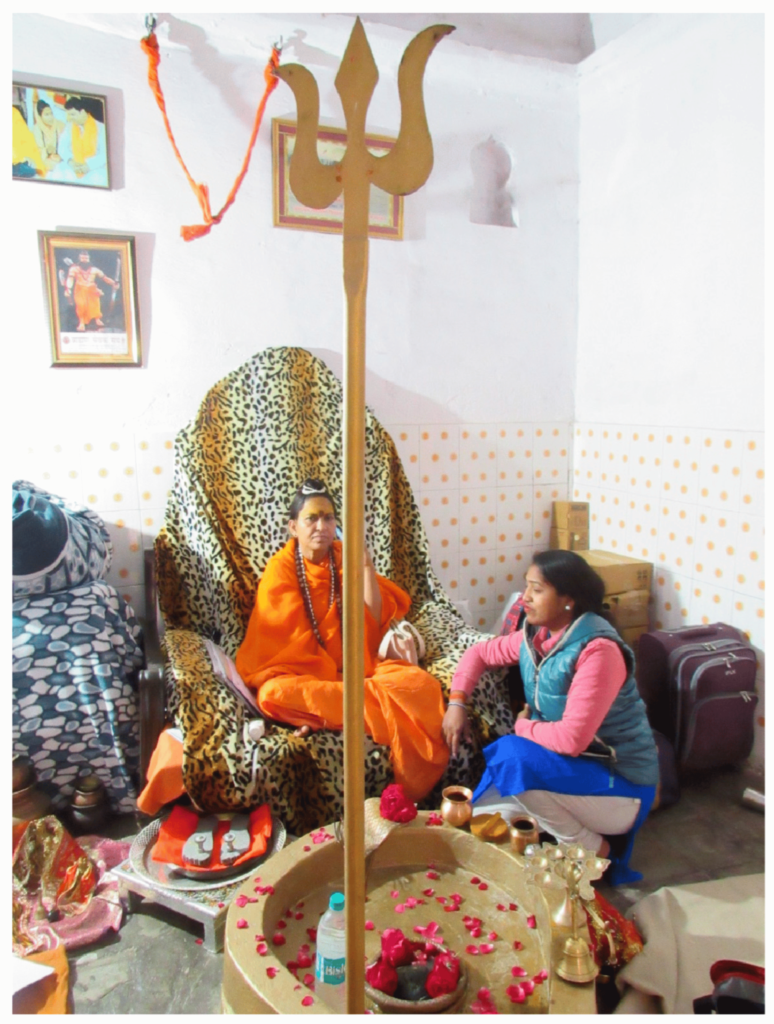
Image from DeNapoli 2023
Conclusion
Hindu discourses about gender relationships are complex and often appear contradictory. There is no doubt that many women’s lives are constrained by the apparent patriarchal nature of Hindu beliefs and practices. In particular, the concept of dharma has an impact on the lives of Hindu women. Strīdharma suggests that it is the duty of women to serve their husbands, and the dharma texts, like Manu, frequently suggest that women are inherently inferior to men. However, an important tradition within Hinduism also represents the sacred as intrinsically female. In particular, the concept of śakt can be a resource for women to challenge the dominant patriarchal norms of Hindu beliefs and practices.
Sources
Arni, S. & Chitrakar, M. (2011) Sita’s Ramayana. Tara Books
Bose, M. (2023) Women in the Hindu World. San Rafael, CA. The Oxford Centre for Hindu Studies, Mandala Publishing.
DeNapoli, A. (2023) Everyone Drinks from the Same Well”: Charismatic Female Gurus as “Religious Feminist Influencers”
in South Asian Hinduism. Religions. 14(6) Available at https://www.mdpi.com/2077-1444/14/6/785
Doniger, W. (1991) The Laws of Manu. London: Penguin.
Doniger O’Flaherty, W. (1980) Women, Androgynes and Other Mythical Beasts. Chicago: University of Chicago Press.
Erndl, K.M. (2007) The Play of the Mother: Possession and Power in Hindu Women’s Goddess Rituals. In Pintchman, T.
(ed.) Women’s Lives and Rituals in the Hindu Tradition. Oxford: Oxford University Press, pp. 149–158.
Kinsley, D. (1987) Hindu Goddesses: Visions of the Divine Feminine in the Hindu Religious Tradition. Delhi: Motilal Banarsidas.
Kinsley, D. (1998) The Ten Mahāviyas: Tantric Visions of the Divine Feminine. Delhi: Motilal Banarsidas.
Menon, U. (2002) Making Śakti: Controlling (Natural) Impurity for Female (Cultural) Power. Ethos 30 (1/2) pp.140–157.
Richman, P. (ed.) (1994) Many Rāmāyaṇas: The Diversity of a Narrative Tradition in South Asia. Oxford: Oxford University
Press.
Sen, N.D. (2021) When Women Retell the Ramayan. Manushi (February 16). Available at https://www.manushi.in/when-women-retell-the-ramayan.
Wadley, S. (1995) No Longer a Wife: Widows in Rural India. In Harlan, L. & Courtright, P (eds.) From the Margins of Hindu
Marriage. Oxford: Oxford University Press, pp. 92–118.
Also see:
https://www.manushi.in Manushi is a feminist journal that has been in publication since 1978. It predominately has articles written by women. Whilst it mostly deals with women’s issue it is also concerned with social justice more widely.
https://www.youtube.com/watch?v=MmVlnOXBFb4 A short video from the Oxford Centre for Hindu Studies in which the renowned scholar Jessica Frazier outlines the relationship between Hinduism and Feminism.
https://www.youtube.com/watch?v=2Vr-IS6cjLA Trailer for The Forgotten Woman a documentary about widows in India by the controversial director Deepa Mehta. Also see her 2005 film Water.