
This is the introduction to the posts that will follow about religion and the arts. In this introductory post I explore the question ‘what is art?’. Philosophers of art have spent a considerable amount of time and ink debating this thorny question. There is no consensus on what constitutes art, but in this short overview I will introduce four theories:
- Art as imitation
- Art as representation
- Art as expression
- Art as aesthetic.
I will also look very briefly at the debate on who or what determines whether an image is a work of art.
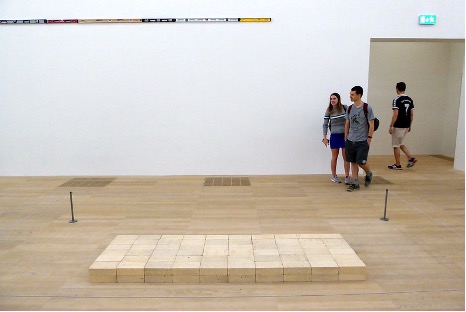
Equivalent VIII, Carl Andre, Tate Modern” by duncan is licensed under CC BY-NC 2.0.
I was working as a bus conductor in the East End of London in 1976 when the Daily Mirror published an article on the minimalist sculpture Equivalent VIII by Carl Andre. This sculpture is a neatly arranged rectangle of 120 ordinary fire bricks, which the Tate Gallery had put on display. The Tate, which received public money, had purchased this sculpture in 1972 for an undisclosed sum. The Daily Mirror headline proclaimed: ‘WHAT A LOAD OF RUBBISH’. This article prompted a great deal of discussion in the canteen of the London Transport garage where I worked. The focus of this discussion was of course those thorny questions:
Some form of art seems to be found in all human cultures throughout time. For example, the sculpture that is known as the Venus of Willendorf is probably at least 25,000 years old. This carving does not actually depict the goddess Venus, who appears in Roman culture much later from around the 3rd century BCE. Nonetheless, this carving clearly portrays the feminine form, is made by human hands and can therefore can be considered to be artistic if not art. However, what we do not know is what purpose it had in the culture of the time – did it have some sort of religious significance or was it purely ornamental?
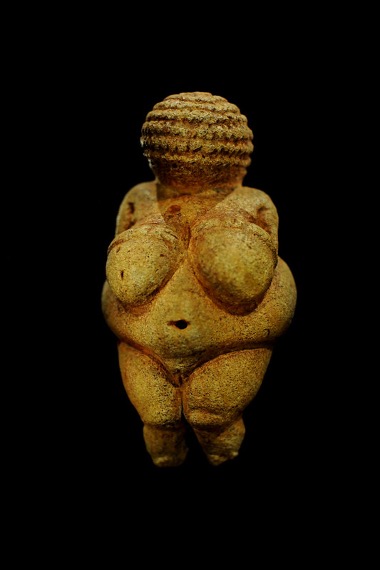
Venus of Willendorf” by mkk707 is marked with Public Domain Mark 1.0.
What is art?
What is the purpose of art?
Art as imitation.
Classical Greek philosophers particularly Plato considered the nature of art and its place in society. Although Plato is often considered to be highly critical of the arts, his attitude is more nuanced than many commentators suggest. Nonetheless, his ideas inform a particular understanding of the arts that is still significant today. Plato uses the term mimesis, which is related to the English term ‘mimic’. In this view art is merely a pale imitation of the real world.
When a painter makes a representation, does he do so by reference to the object as it actually is or to its superficial appearance? Is his representation one of an apparition or of truth? The art of representation is therefore a long way from the truth.
Plato The Republic Book 10:598
Plato in the quote above suggests that art is far removed from reality and is inherently superficial.
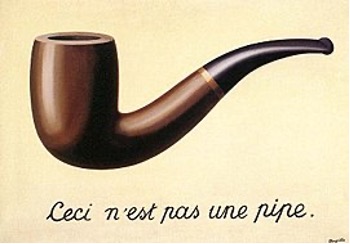
“René Magritte: Ceci n’est pas une pipe.” by outtacontext is licensed under CC BY-NC-ND 2.0.
This idea of art as mimetic is perhaps best captured by the painting by the Belgium artist Magritte The Treachery of Images. In this image Magritte writes ‘this is not a pipe’ beneath a fairly realistic painting of a pipe. The point is that even the most accurate and detailed rendering of a pipe is not a pipe – it cannot be smoked – it is an imitation. This idea is sometimes also expressed as ‘the map is not the territory’ or ‘the word is not the thing’. Maps, of course, have a use, but what is the use of an image of a pipe?
The idea of art as mimetic suggests that art must capture some aspect of the world in as realistic a way as possible – this is sometimes referred to as realism. The term ‘realism’ is contested and used in different ways in different contexts. However, in all its uses realism can be characterised as an attempt in any medium to represent the world as accurately, objectively and truthfully as possible. For example, in the painting White Chevy – Red Trailer, John Salt depicts a caravan and car in the run-down lot as realistically as possible. However, we have to question whether it is possible to depict the world objectively.
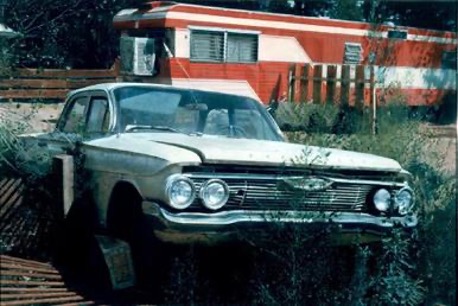
Wikipedia:Fair use images of art
Although, many artists still depict the world as realistically as possible, with the invention of photography in the 19th century realism became less significant. Why bother with trying to accurately depict the world through the medium of paint – a painstaking, time consuming and skilled process – when one could simply point a camera? We might admire Salt’s skill in representing the car and trailer, but surely this scene can be conveyed even more realistically through photography. Consequently, artists like Wassily Kandinski (1866–1944) began to consider the role of art experiment with more abstract styles.
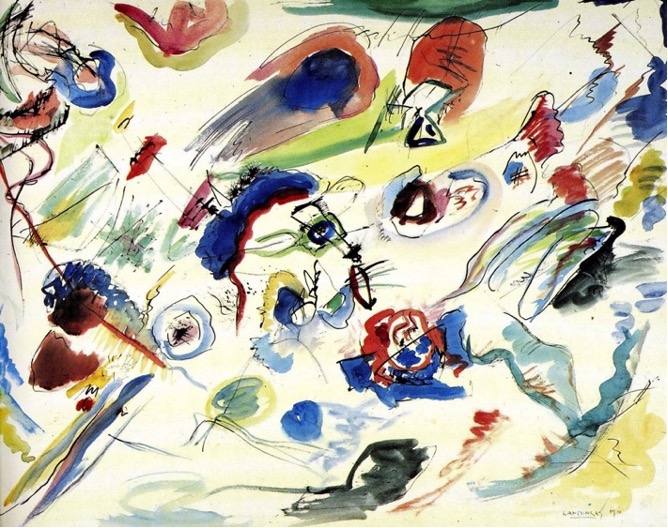
Wikimedia Commons: Original held at Musée National d’Art Moderne Paris
Art as Representation
One way of understanding art is the idea that art is representational. Art ‘re-presents’ the world, in a way that provides a perspective that has the potential to elucidate some aspect of existence. However, representation does not necessarily entail close resemblance. For example, this painting by Picasso can be clearly identified as the head of a woman, but of course no actual woman looks like this.
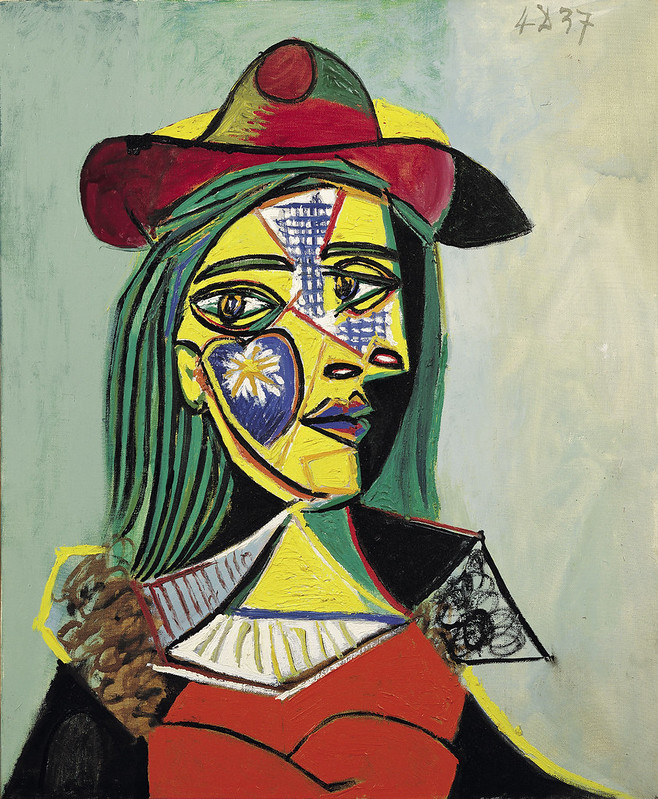
“Woman in Hat and Fur Collar (Marie-Thérèse Walter)” by lluisribesmateu1969 is licensed under CC BY-NC 2.0.
Art as Expression
The question is, what is Picasso trying to achieve through this painting. It is possible to suggest that Picasso was trying to express something about the character of the woman or something about the feminine that cannot be captured in a more life-like portrait. This idea indicates that art has the potential to express something profound about existence that cannot be articulated in any other means. The great dancer Isadora Duncan (1877–1927) when asked to explain a dance is reported as responding: ‘If I could tell you what it meant, there would be no point in dancing it”. This idea that art can express some aspect of existence that cannot be adequately articulated in any other way is significant when we considering the role of the arts in religion.
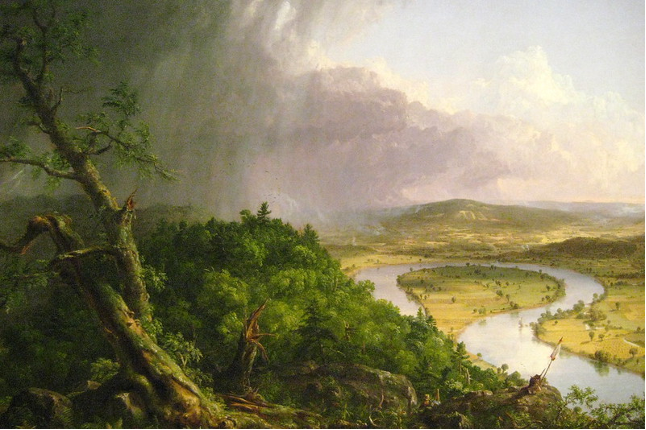
NYC – Metropolitan Musem of Art – Thomas Cole’s View from Mount Holyoke, Northampton, Massachusetts, after a Thunderstorm—The Oxbow” by wallyg is licensed under CC BY-NC-ND 2.0.
It is sometimes considered that there is a distinction between science and art. A common view is that science is concerned with facts and is essentially objective, whereas art is primarily focused on meaning and therefore tends to be more subjective. This suggests that art is primarily expressive, rather than representational. Art expresses the emotional responses of the artist to the world. A landscape painting is therefore not simply a pictorial representation of a particular location, put is an expression of the artist’s response to it. For example, Thomas Cole’s paintings of the American landscape express his belief in the transformative power of ‘scenery as a source of delight and improvement’ (Cole 1836).
In the expressive view art is particularly effective in revealing emotions and meanings that are not visible to the naked eye. There are two aspects to this. First art expresses some emotion that the artist wishes to convey and second art has the potential to evoke an emotional response in the viewer. This is clearly Leo Tolstoy’s understanding of art.
Art is a human activity consisting in this, that one man consciously by means of certain external signs, hands on to others feelings he has lived through, and that others are infected by these feelings and also experience them
Leo Tolstoy cited in Graham 2000:24
Art as Aesthetics
Another commonly held opinion is that art is beautiful. One could argue that both the Picasso portrait and the landscape by Thomas Cole are beautiful – or to put this in another way are ‘aesthetically pleasing’. One can certainly imagine (assuming that you could afford to) choosing to hang either of these paintings on your living room wall. The idea of art as aesthetically pleasing rests on the idea that somethings are beautiful, but others are not. However, distinguishing the beautiful from the ugly is not the same as determining red from other colours. The perception of beauty is subjective – or as it is commonly suggested ‘beauty is in the eye of the beholder’.
While some art is clearly ‘beautiful” other works of art are clearly not. How can an aesthetic view of art account for many of the paintings of someone like Francis Bacon,
which while we might admire, most people would not consider as being beautiful, and probably would not choose to hang on their living room wall. Conversely, there are many phenomena, such as a sunset, that we regard as being beautiful that are clearly not art.
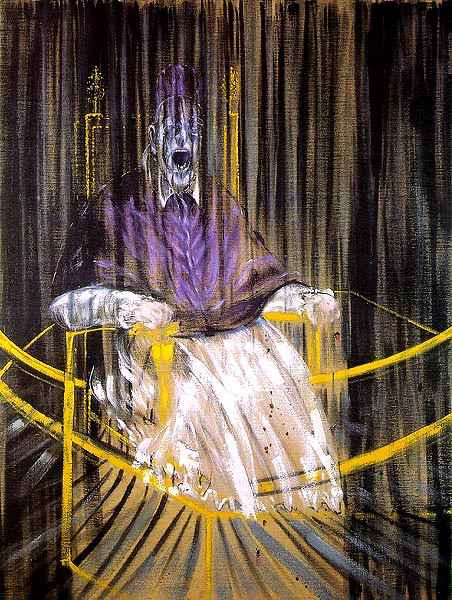
Francis Bacon” by libbyrosof is licensed under CC BY 2.0
In the philosophy of art, aesthetics is considered to be much more than simply the idea of beauty. Art is not merely decorative, and the value of art is more than simply providing sensual pleasure. An image can be categorised as a work of art, because it has the capacity to evoke in the viewer (or listener in the case of music) a special kind of experience. This unique response to works of art is generally referred to as the aesthetic experience. This idea that art can evoke a particular experience becomes particularly important when we start considering the relationship between art and religion.
Linked to the aesthetic theory of art is the question ‘what is art for?’. Most objects that we interact with in the world have a purpose – a chair is for sitting in and so on. However, art does not seem to have any clearly identifiable use as such, yet art in some form has and is an important aspect of every human culture. This has led to the conclusion that ‘art is for art’s sake. The contemplation of art is its own reward and is not for any other purpose.
The Art World
This idea that art is determined by a particular response raises another set of important issues – about authority, value and definition. Is art defined by the maker, the viewer, the context, some combination of these or some other factors? It is a common-sense view that art is produced by artists. However, this is a rather circular argument: who is considered to be an artist is determined by the fact that they create works of art, conversely an image is art because it has been produced by an artist. Furthermore, while it is possible for me to announce that I am an artist, and my doodles are works of art, they have to be recognised more widely as such. This has led to the idea that there are certain individuals who can determine what is art and what is not. The famous literary critic F.R.Leavis suggested:
It is upon a very small minority that the discerning appreciation of art and literature depends
Leavis 19:30

Fair use, https://en.wikipedia.org/w/index.php?curid=11854210
What Leavis is suggesting here is that it takes a certain type of genius (the artist) to produce works of art, but it takes a different type of genius (the critic) to identify genuine works of art. However, what can be referred to as ‘the art world’ not only consists of the artists and critics, but also collectors and curators. It could be suggested that Charles Saatchi, by sponsoring and collecting the works of the group collectively referred to as Young British Artists to public attention, and help them become recognised as genuine artists producing authentic works of art. Perhaps one of the most infamous of these was Tracey Emin’s My Bed, which contributed to her winning the prestigious Turner Prize, and was exhibited in the Tate Gallery. Like the sculpture by Carl Andre, Emin’s work created outrage in the popular press and a debate among the public.
Both Tracy Emin’s bed and Carl Andre’s bricks point us in another aspect of what defines art. Both were displayed at the Tate Gallery in London. So, perhaps the context of encounter needs to be considered. If I had encountered 120 firebricks stacked exactly in the same way in a builder’s yard, I might think that this was a very neat and tidy yard, but not consider it to be a work of art. However, my encounter with exactly the same arrangement of bricks at the Tate, which while it might leave me perplexed, I would engage with in a very different way – as a work of art rather than a resource for building something.

Context becomes important when considering religion and art. Much Western art, until fairly recently, depicted religious themes. Consequently, art galleries are replete with images of the Crucifixion, Madonna and Child and so on. The question here is will responses be different to a painting of Christ when it is moved from a church to an art gallery.
Although there can be no absolute consensus on the nature of art, what art is and what is its purpose, we can understand art in terms of a complex set of relationships that involve artists, critics, curators, context, the media and viewers. An understanding of these relationships and whether we understand art in terms of mimesis, representation, expression or aesthetic experience will determine how we understand the interactions between art and religion.
Terminology
Aesthetic:
Derived from the Greek aesthesis meaning ‘perception by the senses’. Aesthetics is frequently associated with beauty. The term is also used to indicate the philosophy of art.
Aesthetic experience:
The idea that art evokes a very particular response that differs from all other experiences. This is often linked to the idea that art is for art’s sake. It also suggests that art is valuable because it has the potential to induce the aesthetic experience in the viewer or listener.
Expressionism:
The idea that art can express some aspect of the world that cannot be articulated in any other way. Often associated with Romanticism and the aspiration to depict the inner world of experience.
Mimesis:
To imitate or to copy. This idea, derived from the Greek philosopher Plato, suggests that art is purely a pale imitation of the world.
Realism:
Linked to the idea of art as imitation, realism indicates that the artist should depict the world as accurately and as objectively as possible.
Representation:
Something that stands for something else. For example, a portrait stands for/ represents a particular person. A work of art ‘re-presents’ some aspect of the world in a particular medium.
Important Philosophers
The philosophy of art has a long history in the West, and many philosophers have engaged with the two interrelated questions – ‘what is art?’ and ‘what is the purpose of art?’. Arguably the two most significant philosophers of art in the West are Plato and Kant.
Plato (born c427BCE) was a classical Greek philosopher and student of Socrates. One of his most significant works was The Republic. In this work he outlines his vision of the good society’. In Part X of The Republic Plato outlines his theory of art as illusion.
Immamuel Kant (1724–1804) was an important philosopher in the period of European history that is referred to as The Enlightenment. Kant defined art as ‘a kind of representation that is purposive in itself and, though without an end, nevertheless promotes the cultivation of the mental powers for sociable communication’ (Critique of the Power of Judgement). Kant’s definition suggests that art is for arts sake, yet at the same time can perform a social function. Kant also suggests that only a particular type of genius can produce art. This indicates that there are artists, who can for example be distinguished from crafts people. Kant’s ideas underpin the concept of what is sometimes referred to as ‘fine art’.
References
Graham, G (2000) Philosophy of the Arts: An Introduction to Aesthetics. London: Routledge.
Leavis, F.R. (1930) Mass Civilisation and Minority Culture. Cambridge: Minority Press.
Plato. (1987) The Republic. Translated by Lee, D. London: Penguin.
Other Useful Sources
Carroll, N. (1999) Philosophy of Art. London: Routledge.
Cole, T. (1836) Essay on American Scenery. In American Monthly Magazine. Available at
https://thomascole.org/wp-content/uploads/Essay-on-American-Scenery.pdf
Morris, P. (2004) Realism (The New Critical Idiom) London: Routledge.
Nanay, B. (2019) Aesthetics: A Very Short Introduction. Oxford: Oxford University Press.
Perry, G. (2014) Playing to the Gallery. London: Penguin.
Interesting Links
- But is It Art? https://www.moma.org/explore/inside_out/2014/07/24/but-is-it-art-constantin-brancusi-vs-the-united-states
- Carl Andre: Works of Art Don’t Mean Anything https://www.tate.org.uk/art/artists/carl-andre-648/carl-andre-works-art-dont-mean-anything
- Democracy has Bad Taste (Grayson Perry’s Reith Lectures 2020) https://www.bbc.co.uk/programmes/b03969vt
- Young British Artists https://www.tate.org.uk/art/art-terms/y/young-british-artists-ybas
- Tracy Emin ‘My Bed’ https://www.youtube.com/watch?v=uv04ewpiqSc

Great blog, really enjoyed it. Will keep watching this space!