
These letters are also from my second trip (see Letters from India 2) to India. The first three are written from Rishikesh, a place that became very special to me. I have returned to Rishikesh many times since and regard it as a home from home. On my first trip to India I travelled for a short time with an American woman who was into yoga. This was the first time that I had ever come across yoga, as it was not yet popular in the UK. When I was in Madras (now called Chennai), I decided to take some yoga classes. On this return trip I really wanted to do more yoga, and was thinking about going up to Dharamasala in north India, where I had heard that there was a guru teaching yoga to Westerners. However, another traveller that I met in Puri suggested that the guru had gone crazy and indicated that I might try going to the Sivananda Ashram in Rishikesh.
I arrived in Rishikesh and made my way up to the Sivananda Ashram, where I was informed that they were running an intensive three month at the Yoga Vedanta Forest Academy, that would start in just over a month’s time. I was told that if I wanted to join the course that I should write a short essay on my spiritual journey and my reasons for wanting to take the course. I thought this was a good idea as there were some travellers who took advantage of ashrams that provided free food and accommodation. What I wrote was obviously sufficient and I was accepted onto the course.
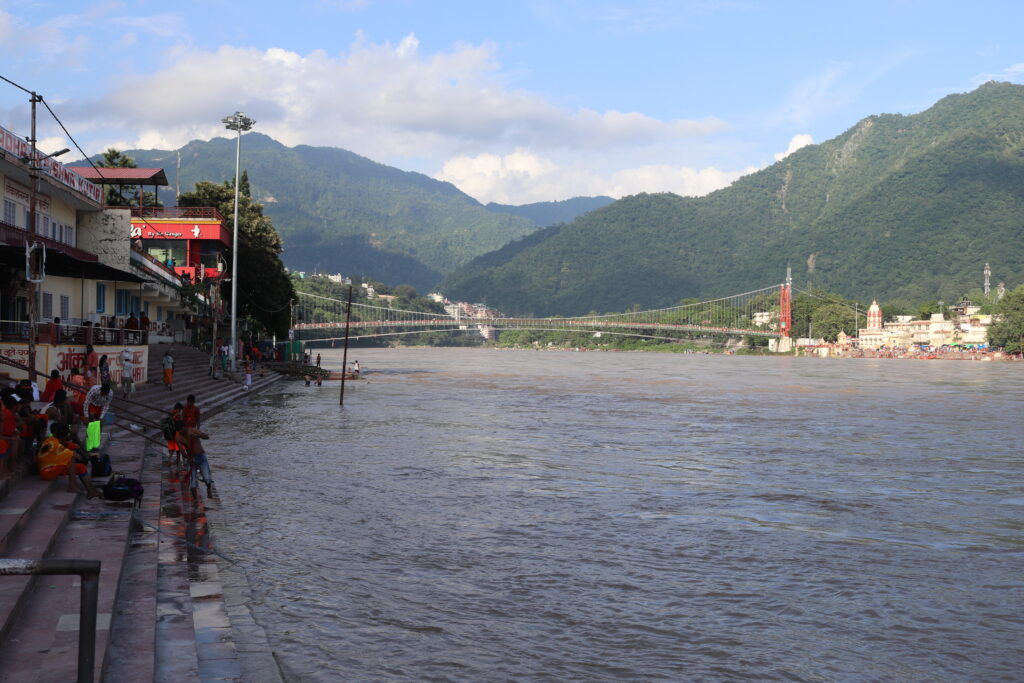
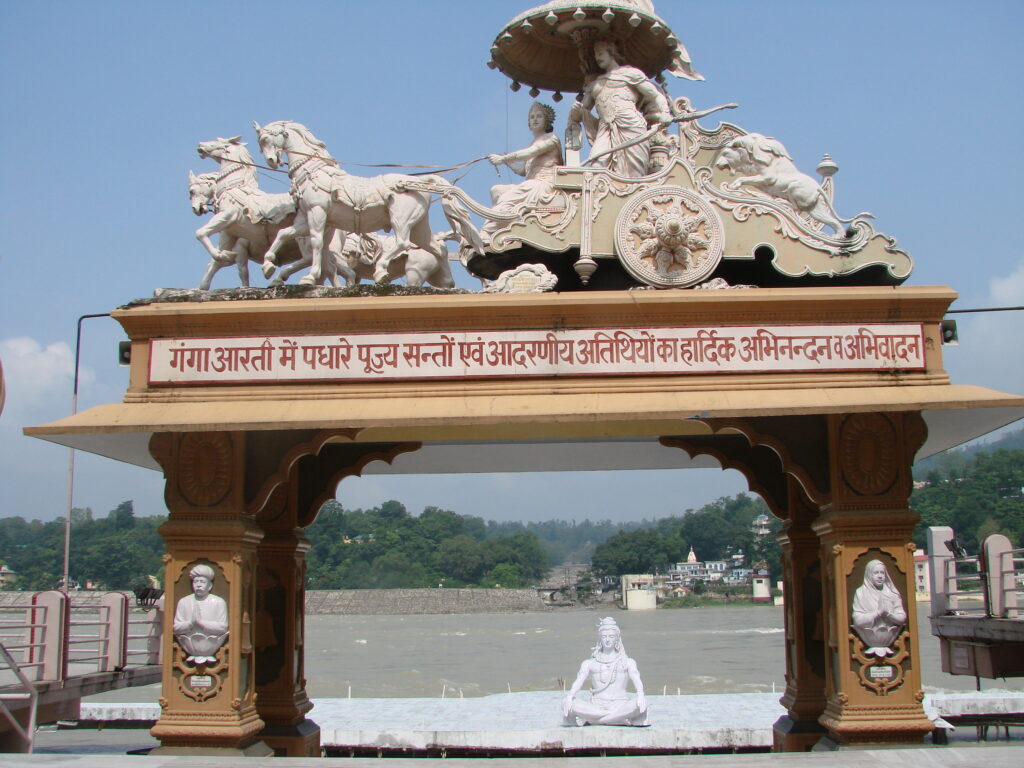
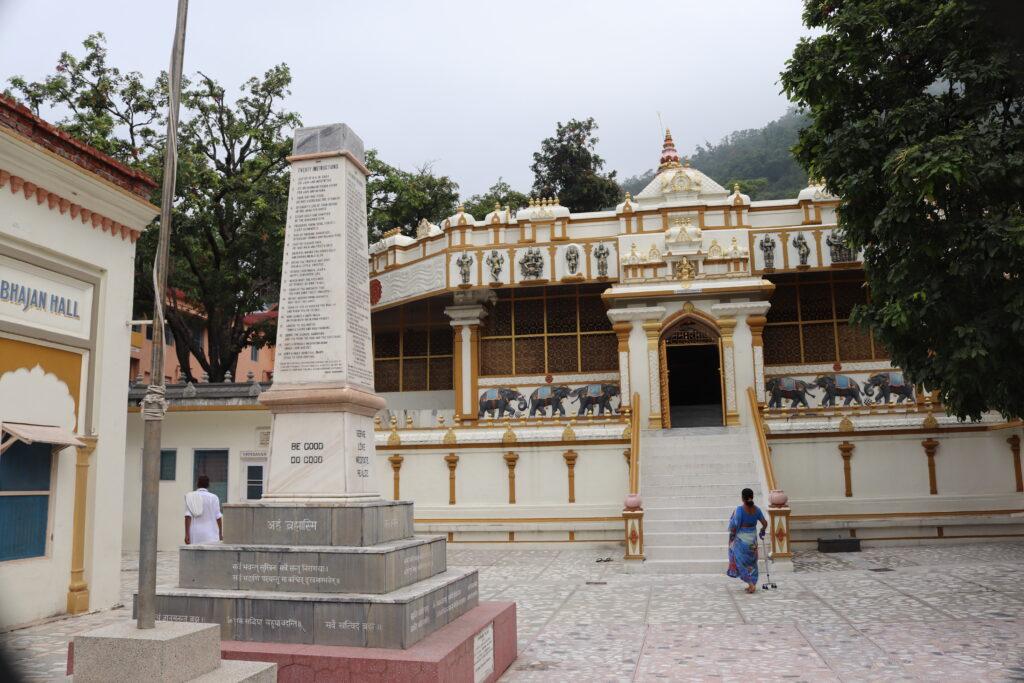
Rishikesh is a pilgrimage place on the banks of the sacred river Ganga. It is very beautiful place located at just over 1,000 feet in densely forested hills. At the time of these letters it was not really a traveller destination. However, in recent years Rishikesh has successfully marketed itself as India’s ‘Capital of Yoga’ and many Westerners keen to learn about yoga and meditation now visit. Sivananda Ashram is still primarily set up for Indian devotees and Western seekers tend to go to one of the many other ashrams or yoga schools in the area.
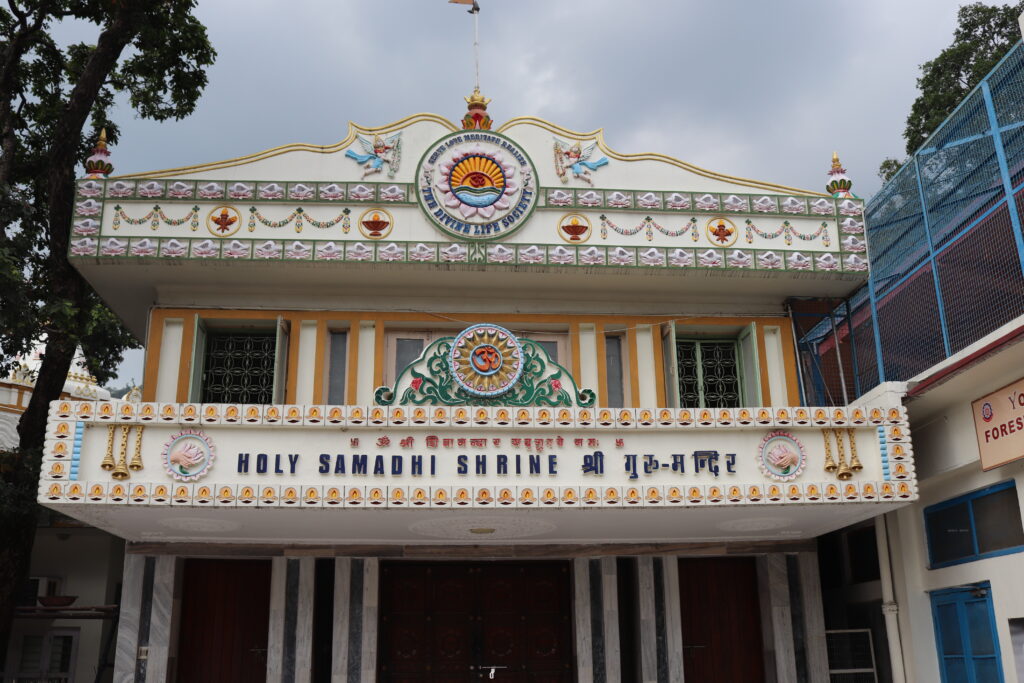
Swami Sivananda (1887–1963) established the ashram in Rishikesh and founded the Divine Life Society in 1936. He was an inspiring teacher and a prolific writer. Although he is not particularly well known, Sivananda was very influential in shaping the way that many Westerners conceptualise yoga and meditation. Sivananda sent his disciple Swami Vishnudevananda to North America in 1957, where he set up a number of yoga schools and ashrams in the USA and Canada.
The Yoga Vedanta Forest Academy, at the time, ran three month residential courses that mixed practical yoga and meditation with lessons on various aspects of Hindu philosophy. The day started at 6:00 with a one hour yoga session. We then had breakfast in the ashram’s large dining hall. We had two hours of lectures in the morning and a further two hours after lunch. There was a group meditation session for those enrolled on the course. After the evening meal we were expected to join the rest of the ashram for congregational worship called satsaṅg (literally ‘good company) in the Samadhi Shrine. There were about 25 of us in total on the course, about eight of whom were Western travellers. This was one of the very last courses that accepted Western participants.
For those interested in learning more about Rishikesh and the Sivananda Ashram see my chapter ‘Clouds Drifting Through a Landscape: Glimpses of Rishikesh in Graham Harvey and Opinderjit Takhar (eds.) Religion and Senses of Place. (Equinox 2021)
Letter One
Life here on the ashram is so intense, there seems to be little time left for oneself, and so much new material and novel concepts (at least to me) to mull over that England seems even more remote than ever. I have now been studying at the Yoga Vedanta Forest Academy since the beginning of December, the course will finish at the end of February. YVFA is a part of Sivananda Ashram in Rishikesh, a beautiful setting by the side of the holy Ganges in the foothills of the Himalayas. Though the Himalayas are not visible, the Siwalik Hills would be classified as mountains anywhere else. As it is on the route to some of the major pilgrimage sites in the Himalayas, Rishikesh itself is a very holy place, there really is a very special and tranquil atmosphere here.
Life begins very early in the day with an hour of hatha yoga between 6:00 and 7:00 in the morning. The term yoga has a much broader meaning than we generally conceive of in the West. Hatha yoga, the practice of asanas (the various different postures) is only a small part – the physical foundation for the various mental and spiritual exercises that form the major part of what is really yoga. It is very difficult to explain. I’m afraid that you will have to wait, until I return, for a more comprehensive description.
After breakfast we have karma yoga, which basically means work without thought of reaping any reward, i.e. we generally keep the garden around the academy clean and tidy. Then we have 2 lectures in the morning and 2 in the afternoon on such subjects as the Upanishads, Bhagavad Gita (2 of the most important pieces of religious writings in the vast collection of Hindu scriptures); Raja Yoga (a step by step scientific progression that culminates in meditation); the philosophy and psychology of yoga; bhakti yoga (the devotional aspect of yoga) etc. Then we have a 45 minute meditation session before the evening meal. In the evening we are expected to attend satsang, a sort of religious assembly that involves a lot of singing and chanting and a short discourse of some sort. As you can well imagine this is a very different experience for me, a vast change from my usual lifestyle. Although I cannot imagine myself living in this sort of community for any prolonged length of time, I feel that I have gained a great deal even in this short time.
Christmas time was especially strange for me. There are quite a few Westerners here on the ashram, so we organised a special Christmas Carol Service (like all enlightened people other religions are regarded as merely different expressions of the same Truth, and not regarded as a threat to their beliefs). So it was not like my normal overindulgent festivities.
There are some incredible powerful charismatic men here – especially the top few swamis (a sort of Indian monastic order) like Krishnananda, who apparently remained in his room for more than 12 years only reading and now lectures and has written several books on the philosophy and psychology of yoga. I’ll try and bring a couple of his books back for you to read, I know you’ll find them fascinating if nothing else. It’s impossible to convey an idea of what it is like on the ashram or my thoughts on a short aerogram. Don’t worry, I am not going to return with shaven head, orange robes and incessantly chanting mantras.
Letter Two
Hope that you are both well. I thought that I had better write fairly promptly to let you know that both your letters have arrived safely. The postal service seems surprisingly efficient, I received them both within 10 days of their being posted. By the way did you ever receive the letter that I sent from Nepal? Thanks a lot for your gift, you cannot know how much I really appreciate it, as at this moment in time I don’t feel it is time for me to leave India yet. It would have been too abrupt a change in circumstances to leave this spiritual oasis and to have had to fly directly back to the UK. I remember the cultural shock that I experienced on returning from my last travels. I was thinking that the effect would be even greater considering the environment in which I have been living these last couple of months.
I feel that I need some time to assimilate the knowledge that I have acquired here and also to think a little on what I want to do on my return. Still all that is some way in the future, back to the here and now. I’m sitting on the roof of the academy building (not in the lotus posture, which although I can do, I still find difficult after so many years of sprawling on floor cushions) enjoying the sun. The weather here is once again getting quite warm after a relatively cool spell. I suppose the winter here is roughly equivalent to a good summer in England.
Everybody is relaxing here after celebrating Shivaratri – ‘The Night of Shiva’. Shiva, as you probably know, is the aspect of destruction (though liberation would probably be a more appropriate rendering) in the major Trinity of the Hindu gods – Brahma the creator and Vishnu the preserver being the other two. So it is a very important festival. He is portrayed in many aspects, but is considered to be the supreme renunciate and is often pictured sitting in the lotus position at his abode on Mount Kailash in the state of samadhi (superconscious awareness) the absolute and ultimate goal of mediation. For the 24 hours leading up to the actual night a mantra (sacred phrase or verse) in praise of Shiva was repeatedly chanted. Everyone on the Ashram was expected to take part. I had to get up at 2 o’clock in the morning for an hour’s chanting and then again in the middle of the day. It was a good experience, a lot of energy can be generated by continuous repetition of a mantra accompanied by furious drumming of tablas and clashing of cymbals. It was interesting to be a participant as opposed to a passive observer.
The following night’s celebration began at about 8:00 o’clock and as well as chanting mantras involved a lot of really nice music and hymns in praise of Shiva. Also there was a very complex and involved puja (worship) which consisted of offerings of numerous items, e.g. water, honey, milk, curds, flowers etc., by pouring them over a lingam – a cylindrical shaped stone set in a platelike disc, which is an emblem for Shiva. The festivities finished at 4:00 o’clock in the morning with a huge feast. As you can imagine, it was a great change from the normal routine here, so there is not a great deal of activity at the moment.
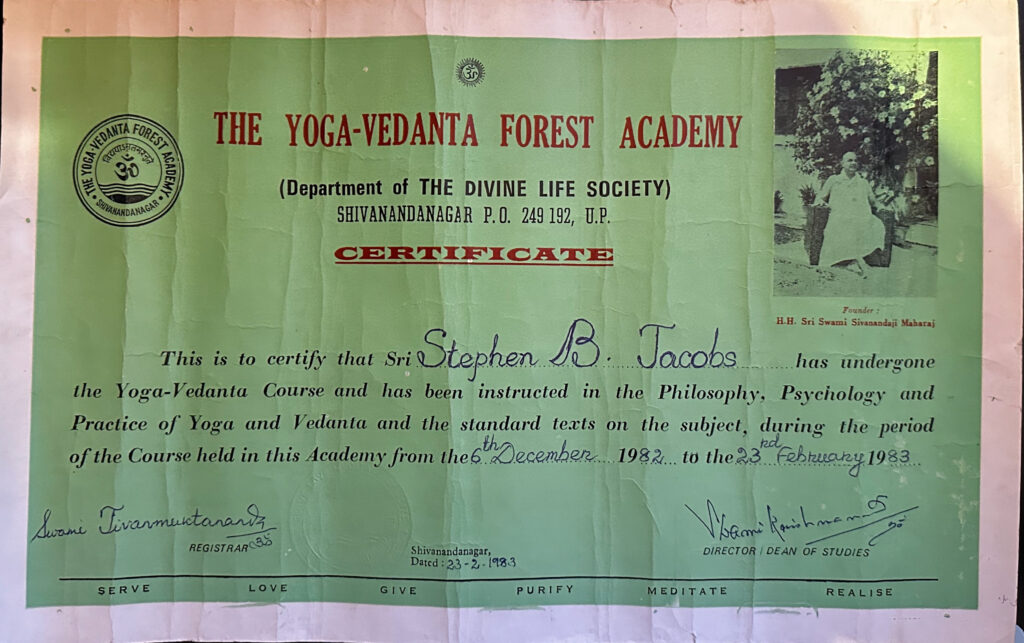
The course is gradually winding down, the actual closing ceremony will be on the 23rd, so the big bad wide world once more looms on the horizon. I shall probably leave here in the first week of next month. I am planning on a trip to Banaras, as in all the time I have been in India, I haven’t visited this most holy, and according to all accounts fascinating place. In many ways I’m looking forward to setting off on the road again after well over 3 months here in Rishikesh. Also because it will be really only in retrospect that I will be really able to understand what I have gained from my experiences here on the Ashram.
To reassure you my health is very good – physically, mentally and spiritually. I hope the same applies to you both.
Letter 3
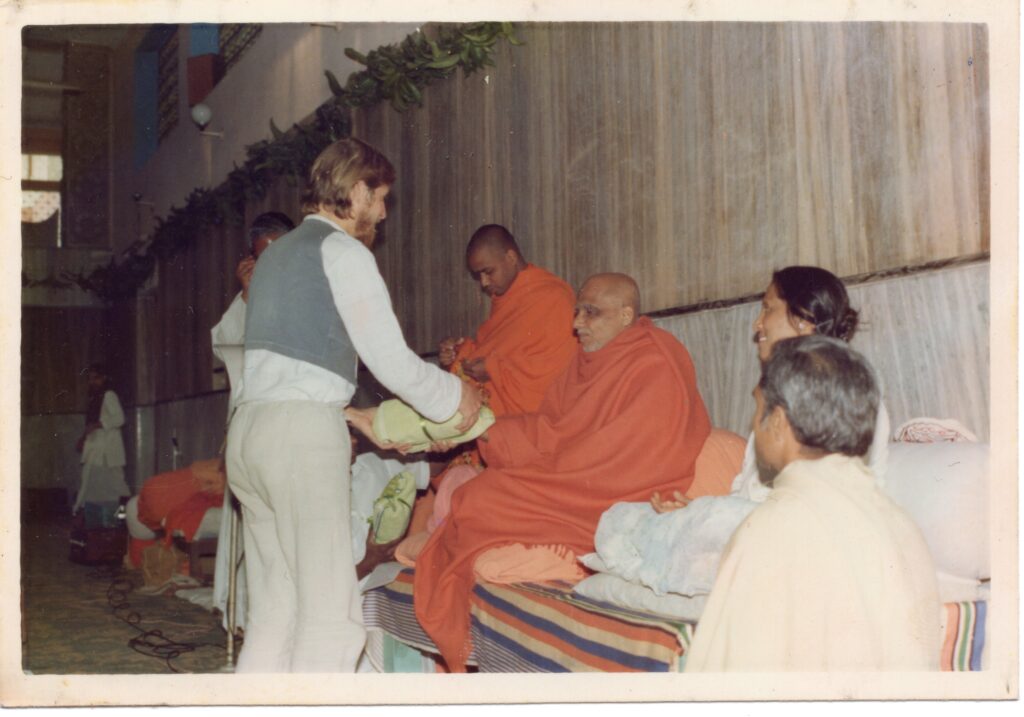
Hope that you are both well. As always it is difficult to know where to start. I successfully completed the course at the Forest Academy. In fact, it was deemed fit to dub me the 2nd best student. I am not exactly sure why it was decided to award prizes (some books) to those considered to be the top 4 students. In my opinion it does not really conform with the spirit of the ashram, still it was good for my ego.
After 3 months in the monastic environment of the ashram, it was with some trepidation that I stepped through the portals once again into the big bad world. I don’t believe that I am cut out to live an ashram lifestyle, but it certainly was a valuable experience, not only in terms of understanding Indian culture a little better, but also gaining a deeper insight into life in general. Anyway, now is not the time to enter into any great philosophical discourse, it will have to wait until we can verbally communicate.
I left Rishikesh with a Canadian friend, who had also been studying at the ashram, and with whom I will be travelling back to Europe with, bound for the holy city of Banaras. A place that I have wanted to visit ever since I was in India for the first time. Another sacred city on the shores of the Ganges, yet so completely different from Rishikesh, which is a place of tranquillity and natural beauty, Banaras is a place of people and frantic activity. How can one even begin to describe this place, that probably more than anywhere epitomises India. Varanasi is a place to be experienced, to sit at sunset at the ghats and watch the constant bustle of pilgrims who come and go from all parts of the subcontinent to bathe at this most sacred spot. I did not go for a dip here as by the time it reaches Banaras it is very dirty, though locals do use the water for drinking apparently with impunity. To wonder at the motley collection of wandering ascetics, some little more than beggars, others strongly spiritually motivated. Some practicing penances like sitting all day in the heat of the sun surrounded by fires of cow dung and straw. At night the river and temples that line the shore glow in the light of the fires at the burning ghat, where those ‘fortunate’ to die in such an auspicious place are cremated.
After 4 or 5 days, after the peace and quiet of Rishikesh, the noisy bustle of Varanasi was a little overwhelming so I decided to go to Bodh Gaya. Yet another sacred place, but again totally different from either Banaras or Rishikesh. Bodh Gaya is where Budda realised the Truth whilst sitting under a Bo tree, and is therefore an important pilgrimage site for Buddhists from all over the world. In fact it is not like being in India at all, it is more like an international Buddhist village, with temples from Thailand, Japan; Burmese and Tibetan monasteries. The climate on the plains is now getting very hot, so it was time either to head up to the mountains or to the sea. After deliberating for a couple of days, I decided to return to Nepal before meeting up with Richard again in Rishikesh. It was good to return to a familiar place for a change and also to reinforce some of the friendships that I had made last year.
I was in Kathmandu to celebrate the festival of Holi. It is a sort of spring festival and also connected with the god Krishna. It is celebrated throughout the subcontinent and is probably one of the craziest festivals. Everyone throws coloured paints and powders at each other, and if you go out on the streets this day, you are more than likely end up being covered head to toe. It was three days before I managed to get all the red out of my hair and clothes.
I spent an enjoyable leisurely albeit somewhat lazy month in Nepal, mostly in Kathmandu but also for some days in Pokhara. If Kathmandu is fascinating because of its vast array of temples and palaces, Pokhara is a place of natural beauty. In some ways it is reminiscent of the Scottish Highlands, a beautiful lake surrounded by mountains. Yet you know that behind the immediate range of mountains loom the awe inspiring snow clad peaks of Annapurna and Machapuchare (Fish Tail) which at this time of year are only occasionally revealed in the early morning. I would like to spend more time in Nepal, but the visa is prohibitively expensive, so it is once again back to India, and to keep my assignation with Richard.
So here I am again. I think that of all the places that I have visited on the subcontinent, Rishikesh is one of, if not the most, favourite places. There is the holy Ganges for swimming, which is still very cold as it is not far from the Himalayan source, libraries and good facilities provided by some of the ashrams. It is within a reasonable distance from Delhi (6 hours by bus). Normally there is a very interesting collection of people passing through. Once again space runs out and my pen does not seem to have adequately conveyed what I wanted to express. I saw [the film] ‘Gandhi’ when I was in Delhi, I enjoyed it very much. Have you read ‘Freedom at Midnight’? I forget the authors’ names. It is about Lord Mountbatten and the gaining of Independence – a fascinating account. I have just started ‘Passage to India’ which I am really enjoying.
By the way I have sent three parcels of books which should arrive at the beginning of next month. They also include all my notes from the Yoga Academy. If you feel so inclined you are welcome to open them and have a squint through any of the books.
Om Shanti.
Letter 4
I am really sorry to have had to ask you to send me so much money, but I seem to have had no other option. One brief moment of laxity on my part and what I thought would never happen to me happened. I was changing buses in a town called Hardwar on my way to Delhi from Rishikesh. As usual in this part of the world there was a great melee of people pushing on and off the bus. I was carrying all my valuables in an inside pocket sewn into my shirt, and it must have been during this crush to board the bus that someone took the opportunity to slit a hole in my shirt and abscond with everything. Unfortunately, at this point I had most of my money in cash, so it is gone for good. The bus was about to leave and when I was going to pay the fare for the journey, I discovered the theft. So I had to get off the bus and reported it to the local police. When I eventually managed to get to Delhi – luckily I had been travelling with a friend and she was able to lend me s little money – I reported the loss of my passport as soon as I could to the Embassy. They tell me that it will take about two weeks to get a replacement passport. So it looks like I will I am here in Delhi until everything gets sorted out. Luckily there is an Aurobindo Ashram here, a little haven of peace and quiet in the middle of an otherwise frantic Delhi, where I can get a room and food, and I can pay them when I receive some money.
As to future plans, they are a little uncertain now. My original plan was to meet a Canadian friend Richard on the 21st of this month, and we were going to travel back to England. We were going to Pakistan and to try and get a boat or a flight from Karachi to Cairo or somewhere in the Middle East, the other side of Iran and then travel through Europe calling on a few people with whom we have made friends on our travels. I have written to Richard, but I am not sure whether or not he will receive my letter. If I don’t hear from him that he is prepared to wait for me and to carry on with our original plan, which would mean us arriving back in England probably in the beginning of September, then I will fly probably back, so I could well arrive back within a month.
Well these mundane matters seem to have taken up well over half the aerogram. Onto more interesting topics. Other than this minor setback I am extremely well. I am not exactly sure at what point I wrote to you last. After leaving [Sivananada] ashram I went to the holy city of Banaras and then to Bodh Gaya where Buddha became enlightened under the Bo tree. Then a quick trip up to Nepal to see some of my friends that I had made on my first visit a year before. Then it was back to Rishikesh to meet Richard. Originally we were only going to stay a few days, but somehow it became extended, for one reason or another, to almost 2 months. In many ways I regard this time as the culmination of my trip, and although outwardly I did not appear to do a great deal during this period, it was a time of great internal as opposed to external wanderings. Sitting quietly for many hours watching the holy Ganges flow swiftly yet serenely by led me to a greater understanding of what these travels and adventures have really meant in my life. It has been a time of assimilation in many ways.
I did manage to get away to Simla for a few days. At this time many people are passing through Rishikesh on pilgrimage to the holy shrines of Badrinath, Kedarnath, Yamnotri and Gangotri. So I have to be different and make my pilgrimage to the summer capital of the British Raj. It is a bit like Blackpool in the sky. In many ways it was as though I spent a weekend away from India. If you need to write, I will be here in Delhi for another two weeks.
Reflection
I did not realise it at the time, but in retrospect this intensive three month course was a really significant period in my life. There are two reasons why I say this. Firstly, it was the first time that I had any substantial encounter with Indian philosophy. It was an encounter that made me realise there were other ways of perceiving the world. Secondly, the course had an academic content. This ultimately inspired me think about applying to university, and eventually give up cooking professionally and embark upon an academic career.
Encountering another way of looking at the world can be very disorienting. I remember that after a couple of weeks, most of us Westerners were fairly bemused by the lectures, and felt we were not really understanding the subject. Consequently, a couple of us approached the swami (monk) who was the head of the Academy, and told him that we were struggling with the course, and asked if it would be possible to explain the topics differently. However, we had not realised that our incomprehension was not just a matter of teaching style, but something far more deep rooted. The swami cursorily replied ‘just wait’ and dismissed us. Of course we were not particularly happy with his response. However, a few weeks later I understood his response and concluded that he was absolutely right.
To rather over simplify things, European thought tends to be linear. Consequently, learning tends to be regarded as a linear process. We learn ‘A’, then ‘B’ and at each point we just build on the concepts that have preceded it. So when we are at point ‘D’ we have knowledge of ‘A,B, C & D’. However, Indian thought tends to be more cyclical. Consequently, we cannot really understand ‘A,B & C’ until we have grasped the concept ‘D’ and then everything falls into place. For example, we cannot understand the concepts of māyā (illusion), karma (action), saṁsāra (the wheel of life, death and rebirth) and mokṣa (liberation) without some understanding of all of these concepts. It does not matter which of the concepts that we start with, we will inevitably be confused until we have completed the cycle of learning about these interlinked concepts. Gradually, as I continued the course, things became clearer.
As things became clearer, the worldview that was being taught seemed to make sense to me. Although I am now more critical, at the time I perceived that we could distinguish three main worldviews. The scientific worldview which conceived that humanity was a freak biological accident, and that we are born and then die – end of story. The Judeo-Christian worldview, seemed to me, conceived human life as a sort of test and if we were good then we would spend eternity after death in heaven and if not we would be condemned to hell. Neither, of these world views resonated with my younger self. Consequently, when I encountered the Indic worldview of a cycle of life, death and rebirth, and that our actions determined our future births, it struck a cord.
I realise now that the analysis of my younger self was rather naïve. However, I do sometimes get asked if I am Hindu. The answer to this is a categorical no. I have never regarded myself as a Hindu. I more often get asked if I am religious. I am still not sure what this question really means. After so long studying religions, the question can mean many different things to different people. I sometimes rather flippantly respond by asking ‘do you have to be a criminal to study criminology?’ If I assume that the question refers to identifying with some form of institutional religion, then the answer again is a categorical no. I sometimes also get asked if I am ‘spiritual’. The concept of spirituality is even more nebulous and contested than religion, so again I am very equivocal about this label. Sometimes, I just reflect that what I believe in is simply belief itself. These beliefs, whether religious or not, are like maps and help us orientate ourselves in the world.
As I have indicated, there was an academic aspect to the course. We even had an exam at the end. Although, I really did not really take to school and dropped out before sitting my A Levels, I found the study of the philosophical aspects of yoga and mediation very rewarding. Although it was some years later, this experience was a major factor in me deciding to go to study religions at the University of Wales in Lampeter.
- I took these photos on a more recent trip (2018) to Rishikesh as I had sold my camera before I wrote these letters (1980/81) ↩︎
What a fascinating and well preserved collection of letters, Steve, which paint such an enriching picture of the journeys you made 45 or more years ago… and the seeds of what became your academic degree and then career can be so easily seen in your account of those days. Wonderful stuff – and of course it appeals to the nostalgia interest I have! So glad you have posted and preserved all of these. They could so easily have been lost.
Thanks Chris.
I really appreciate your feedback. Glad you enjoyed them. I have just a couple more which I will post soon
I truly enjoyed the changing perspective of your younger self, and your reflections. Looking back on the accounts of the journeys, what stands out about those moments that became so insightful? I’m fascinated by all of the places you have visited.
Having letters from such and extraordinary journey, is a treasure.
Thanks Stephanie. I am glad that you found these of interest. I will post a few more of these letters soon