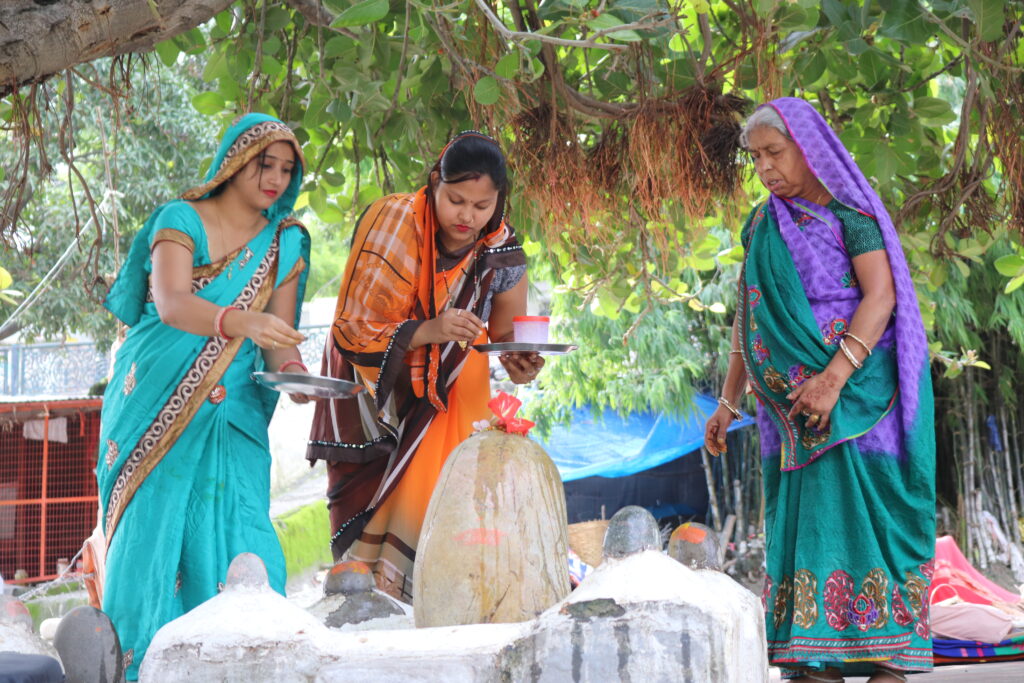
My photograph
Introduction
This discussion is a slightly modified and expanded version of an article that I published in Challenging Religious Issues (20: 2023) – a journal for A-Level students in Religious Studies.
In 2005 Brian K. Pennington published a book with the title Was Hinduism Invented? This seems like a curious title as there are numerous books and websites that include the term ‘Hinduism’ in their titles.1Hinduism is taught as a distinct religious tradition in schools and Religious Studies Departments in Universities across the world. There are approximately 1 billion Hindus worldwide most of whom would acknowledge that they belong to a religion called Hinduism. There are many religious practices, such as pūjā that can be categorised as being distinctly Hindu.To understand why Pennington poses this question we will have to look at a range of issues such as: the etymology of the term ‘Hinduism’, the encounter between Indians and the British colonial period, and the rich diversity of the Hindu traditions.
What is in a term?
There are two problematic terms to consider: ‘religion’ and the term ‘Hinduism’ itself.
Religion
The term ‘religion’ is a much contested and its meaning is endlessly debated by scholars. This debate is in part because there is no unambiguous definition of the term. I will not engage with this convoluted debate here.2 However, it is important to note that there is no word in any of the Indian languages that is synonymous with the English word ‘religion’. Consequently, to define Hinduism as a religion might be to misconstrue the beliefs and practices of Hindus. It is not uncommon to hear Hindus assert that ‘Hinduism is not a religion, but a way of life’. The Sanskrit term dharma perhaps has the closest meaning to our concept of religion. However, religion does not exhaust all the connotations of the term. Dharma in different contexts can signify law, duty, truth, morality as well as religion.
Hinduism: The Origins of a Term
The term ‘Hindu’ derives from the Indo-Iranian word sindhu meaning river. From about 500 BCE the term ‘Hindu’ was used by the Persians as a geographical designation for the land and the people south-east of the river Indus that flows through the north-west of the Indian subcontinent, mostly through present day Pakistan. ‘Hindu’, as far as we know, was not used as a self-designation by the people of India until much later. Audrey Truschke, notes that from about the early 15th century there were a few thinkers who ‘spoke about “Hindus” in a religious sense’ (Trushke, p.8). However, there was no recognition of a distinctive religion called Hinduism until the late 18th century.
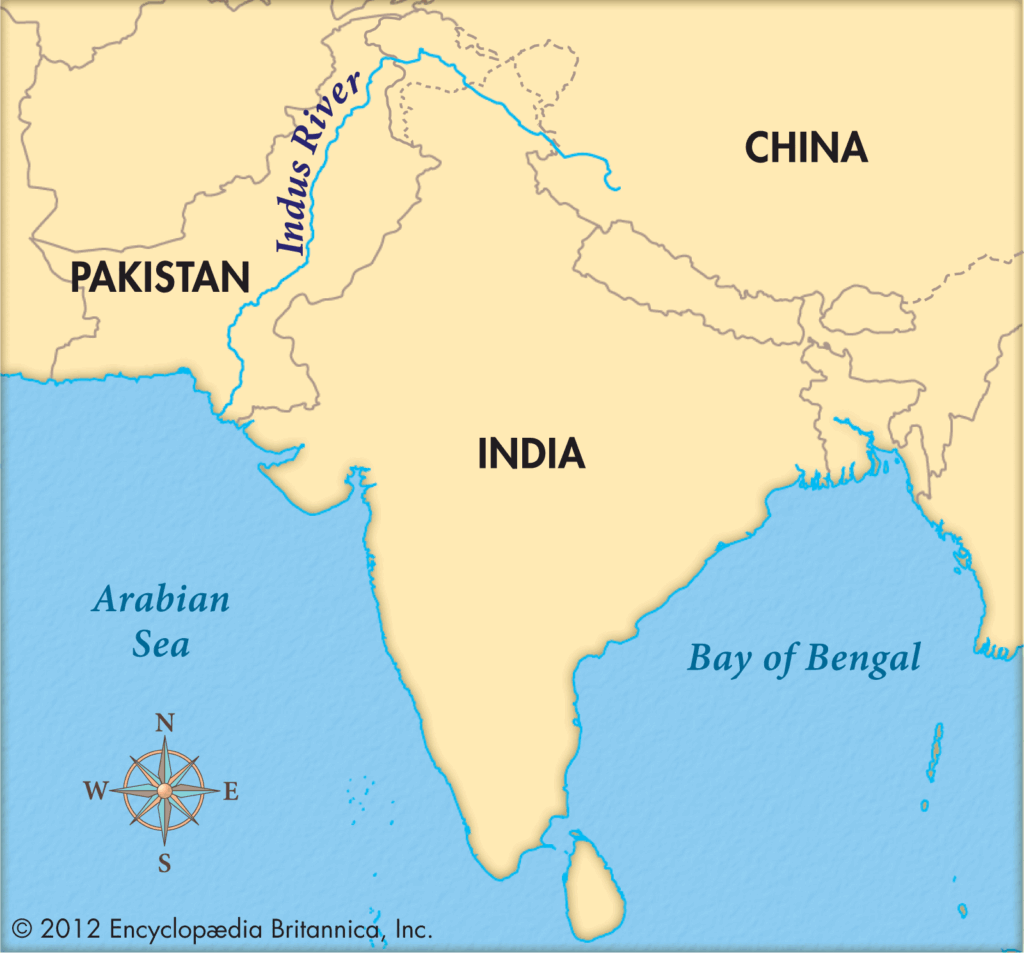
The Indus Valley Civilisation
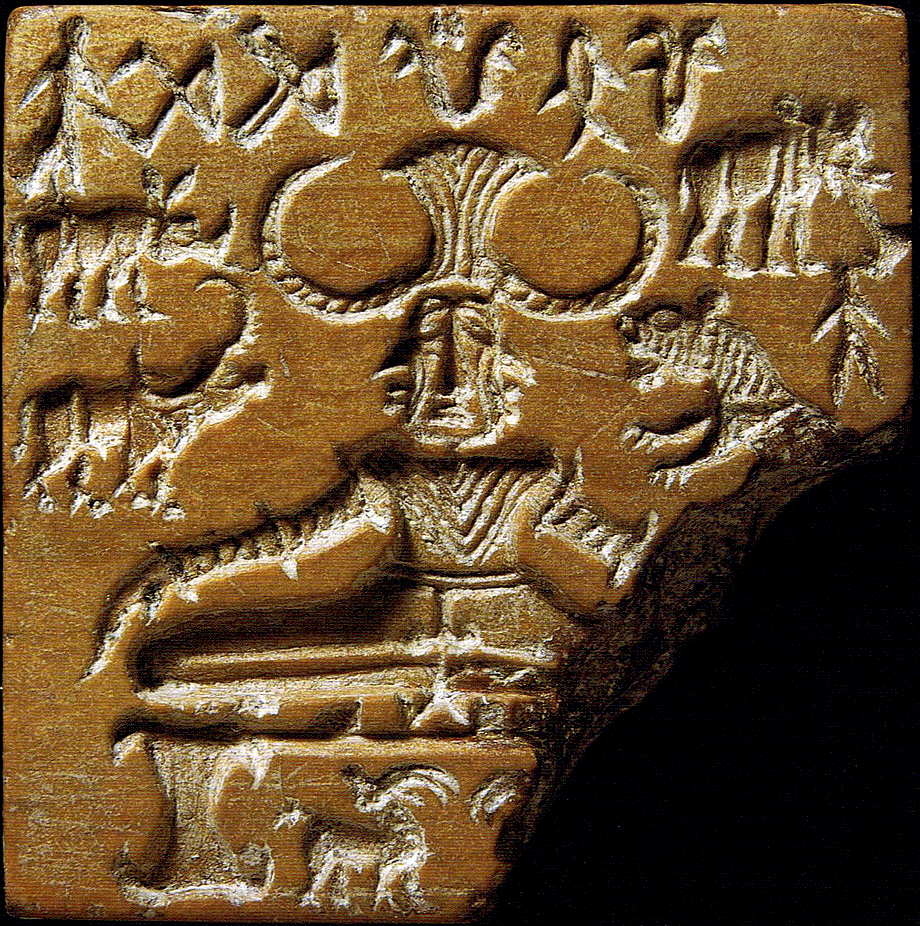
Image from Wikipedia
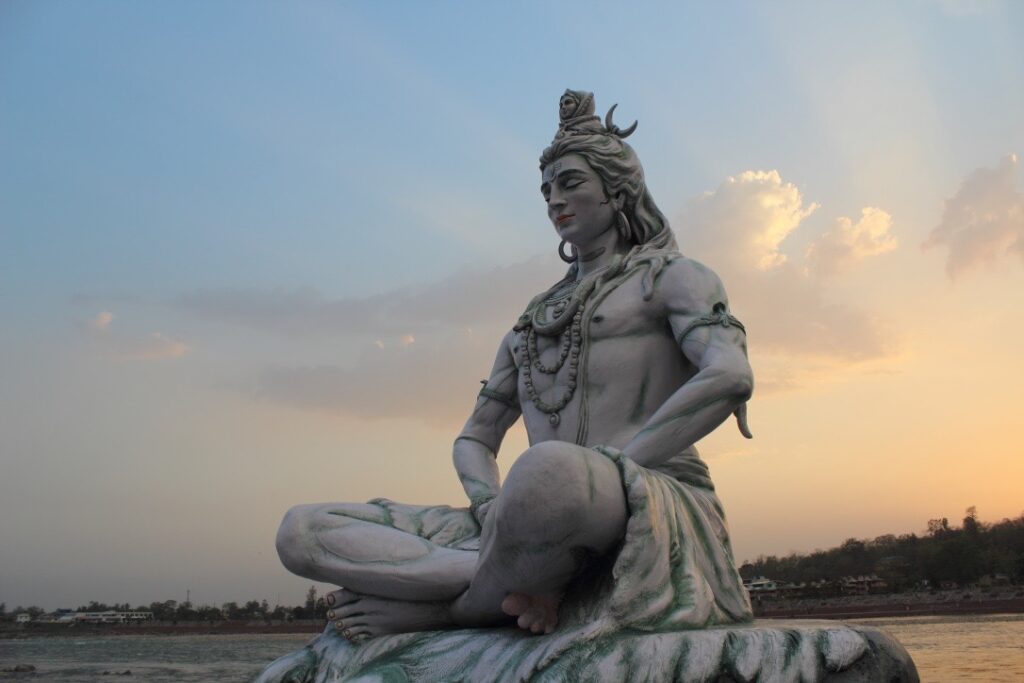
Some argue that the roots of Hinduism can be traced to the Indus Valley Civilisation (c.2500 BCE– 1700 BCE).
The Indus Valley Civilisation refers to the archaeological finds that indicate that there was a flourishing culture in the northwest of the Indian subcontinent. It is called the Indus Valley Civilisation as the archaeological discoveries in the early 20th century CE were located in the Indus Valley, though later archaeological finds indicate that this civilisation was much more extensive.
There is a great deal of speculation about the religion of the Indus Valley Civilisation. Some archaeological finds seem to indicate religious ideas that could be precursors to the religion that we now know as Hinduism. For example, some commentators suggest that the figure on one of the many soap stone seals found at Mohenjo-daro could be a form of the Hindu deity Śiva.
The Vedas
Whilst tracing the Hindu traditions back to the Indus Valley Civilisation is equivocal, many Hindu trace the origins of Hinduism to the Vedic period (c.1500 BCE–500 BCE). This period is named after the Vedas, a vast corpus of compositions. There are three important provisos:
- Most Hindus know very little about the content of the Vedas. Consequently, for many Hindus, the Vedas are more symbolically important than a theological resource.
- The Vedas were composed over a considerable period of time. There is probably about 1,000 years between the earliest compositions and the later parts. Consequently, these compositions reflect very diverse religious and philosophical ideas.
- The religious practices in this foundational period were very different to most contemporary forms of Hindu traditions. Vedic ritual tended to be focused on fire, and not on the images that we associate with more recent forms of Hindu traditions.
The Colonial Context
The first use of the term ‘Hinduism’ to designate a religion is generally attributed to the Christian missionary Charles Grant in a letter he wrote in 1786. Although, he spelt the term ‘Hindooism’. It is the suggestion that because Europeans were the first to use the term, ‘Hinduism’ to designate a single religious tradition, that Hinduism was somehow a fabrication by outsiders. However, it soon became a designation that was accepted by many Hindus themselves. It is generally agreed that the Bengali reformer Raja Rammohun Roy (1772–1833) was the first Indian to use the term ‘Hinduism’ to designate a unified religion.
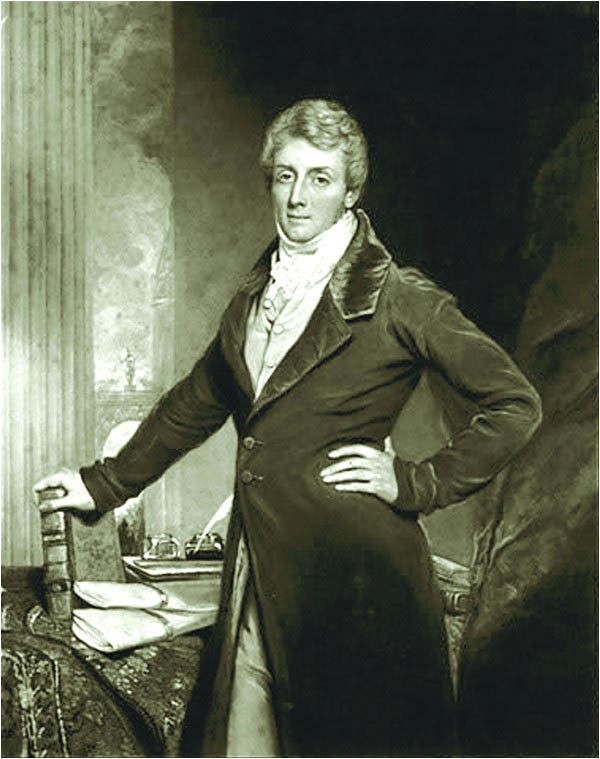
The arrival of Europeans in India created what Wilhelm Halbfass (1988) has called a new ‘hermeneutic situation’. Halbfass argues that the European presence in India created a totally new context: ‘
In which India and Europe, the traditional and the contemporary, self-understanding and awareness of the other were linked together in new and peculiar ways.
Halbfass 1988, p.203.
This new hermeneutic situation was characterised by several interacting and contesting discourses that all suggested that the term ‘Hinduism’ signified a coherent religious tradition that could be contrasted with other religions.
Missionaries, Scholars and Romantics
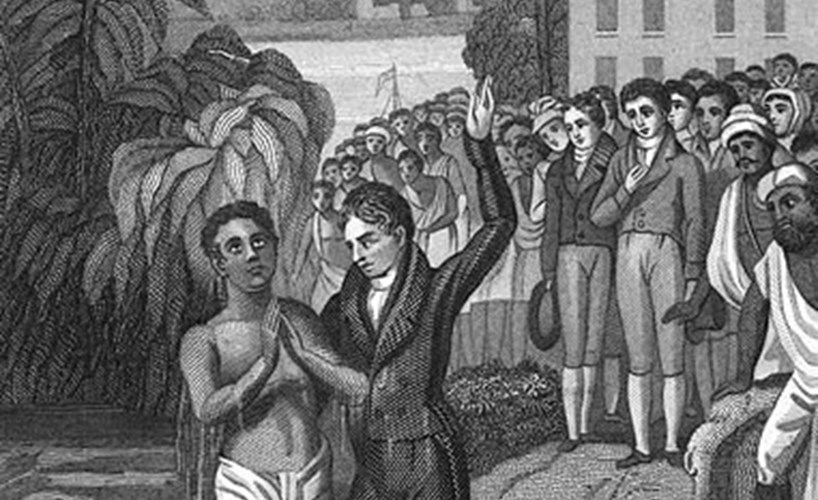
Image from Church Times
Many Christian missionaries believed that they had to understand the religion of India to have any chance of bringing the message of Christ to the local population. Some Christian missionaries were also concerned with communicating their perception of Indian religion to congregations back in Britain. For example, the Baptist missionary William Ward published a two-volume account in 1815 entitled A View of the History, Literature and Mythology of the Hindoos. Ward and many other missionaries in India dismissed Hinduism as being mere superstition and suggested that it was irredeemably polytheistic and idolatrous, and therefore inherently inferior to Christianity.
The Christian missionary evaluation of the Hindu traditions is a form of what the Palestinian scholar Edward Said calls ‘Orientalism’. Said argues that Orientalism is a discourse that divides the world into two unequal parts – ‘the Orient’ and the West. Said observes that ‘Orientalism is the discipline by which the Orient was (and is) approached systematically, as a topic of discovery, learning and practice’ (Said 1991, p.73).
Whilst the missionary discourse tended to disparage Hindu beliefs and practices, the colonial period was also the context for a growing academic interest in the Hinduism. For example, William Jones, who was a judge for the Indian Supreme Court, founded the Asiatic Society of Bengal in 1784 as a forum for scholarly research on Indian culture, religion, history and geography. Although Jones suggested that the culture had degenerated, ‘in some early age [Hindus] were splendid in arts and arms, happy in government, wise in legislation, and eminent in various knowledge’ (Jones 1786 cited in Marshall 2008, p.251).

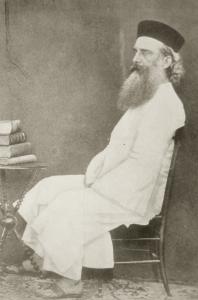
Image from Patheos
Other Europeans, disillusioned with Christianity and scientism, identified Hinduism as a source of esoteric wisdom. There were numerous groups and individuals from the late 18th century onwards who can be identified as seeking a spiritual truth in Indian religion. This evaluation of Hinduism can be called Romantic Orientalism. These seekers ‘projected onto India a more fully realised human existence and a more holistic and spiritually driven culture’ (Clarke 1997, p. 60).
One of the most significant examples of Romantic Orientalism was Theosophy. Many Theosophists regarded Hinduism as the oldest surviving manifestation of a perennial wisdom, that they believed was the source of all religions. Because the Theosophists had a positive view of Indian traditions, it motivated some Indians to re-evaluate their own religion. Madam Blavatsky’s book Key to Theosophy inspired a young Mohandas (Mahatma) Gandhi ‘to read books on Hinduism, and disabused me of the notion that Hinduism was rife with superstition’ (Gandhi 1982, p.77).
Reformers and Traditionalists
At around the same time we can identify two styles of Indian discourses, the reformist and the traditionalist, which also proposed that Hinduism is a religion.
Raja Rammohun Roy best represents the reformist discourse. In 1828 Roy founded the Brahmo Sabha, which was later changed its name to the Brahmo Samaj:
For the worship and adoration of the Eternal Unsearchable and Immutable Being who is the Author and Preserver of the Universe.
cited in Sastri 1974, p.552.
Although the content of the Brahma Samaj service was drawn from the Hindu traditions, for example chanting from the Vedas, the style was very similar to Christian congregational worship.
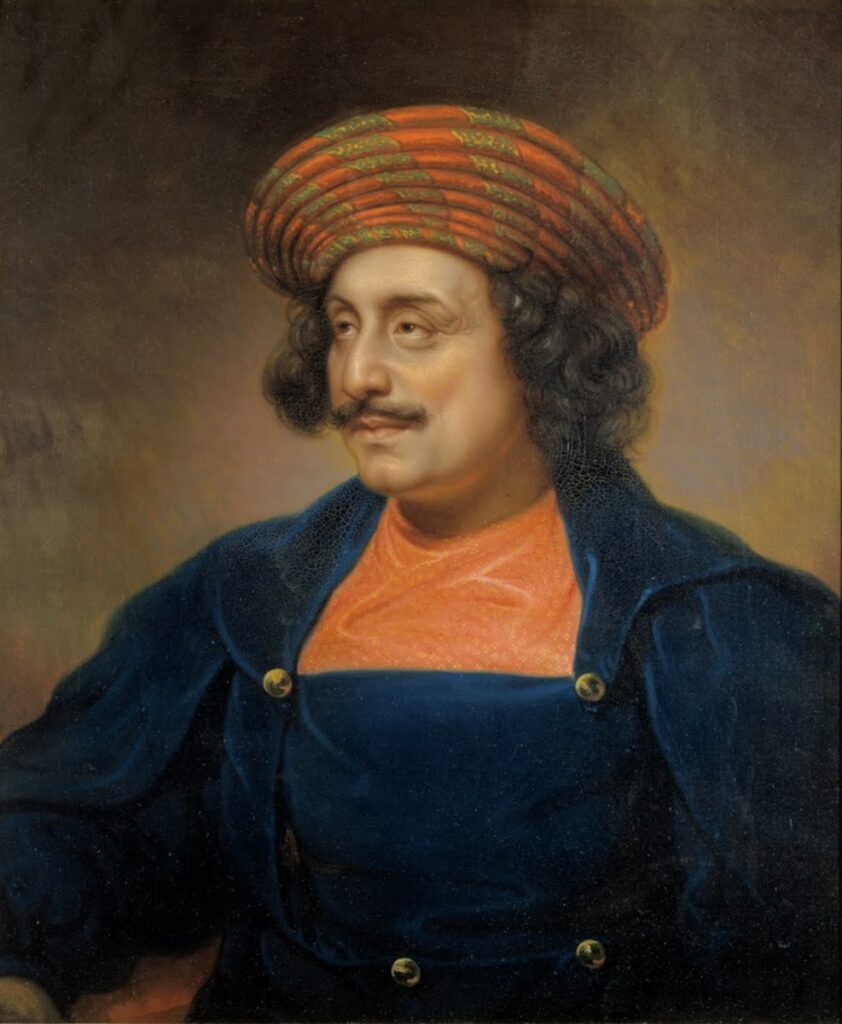
Image from Wikipedia
Roy’s agenda was two-fold. Firstly, to awaken Hindus from what he calls ‘their dream of error’ (Roy 1901, p.5). The second aspect of his agenda was to counter the criticism of Hinduism by Christian missionaries. Roy’s argument centred on the misperception that Hinduism was polytheistic and entailed idol worship. He suggested that the multiplicity of deities referred to in the ancient Hindu compositions known as the Vedas are allegorical, and concluded that Hinduism is in fact monotheistic. However, the literal interpretation of the Vedas had led to the belief ‘in the real existence of innumerable gods and goddesses’, which in turn entailed the practice of ‘injurious rites’ and ultimately ‘destroys the texture of society’ (Roy 1901, p.5). Roy was not alone and is often represented as the precursor of what is sometimes referred to as the Hindu Renaissance later in the 19th century.3 The Hindu Renaissance was characterised by an array of individuals and groups engaged in what Agenhananda Bharati identifies as an ‘enthusiastic redefinition of religion’ (Bharati 1970, p.268).
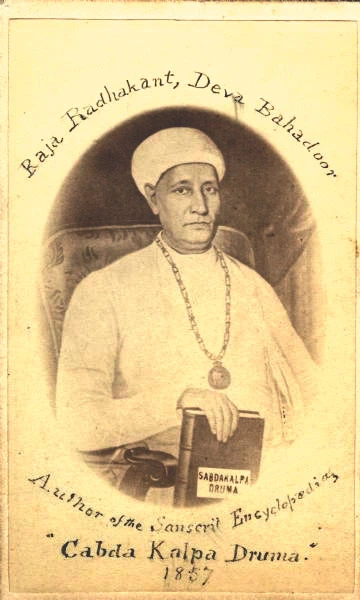
Image from Puronokolkata
Roy’s proposal that Hinduism had degenerated from its monotheistic Vedic origins, whilst having some appeal to the Bengali intelligentsia, had little impact on most Hindus. Furthermore, there was a backlash against Roy’s rejection of the use of images. Several individuals and groups, who might be called ‘traditionalists’ argued that images are integral to the religious life of Hindus. For example, the Dharma Sabha (The Society of Religion) founded in 1830 sought to promote a ‘Hindu unity and identity’ (Pennington 2005, p.143). While the Dharma Sabha vehemently opposed the Christian denigration of Hindu religious practices and Roy’s reformation of tradition, it shared with both these discourses the idea that there was a unified religion that could be called Hinduism.
Diversity
One of the major problems in trying to define Hinduism is that it is incredibly diverse. Robert Frykenberg for example argues, ‘There has never been any such thing as a single “Hinduism” or any single “Hindu community”’ (Frykenberg 2001, p. 82). The reason why commentators, like Frykenberg, suggest that there is no unified religious tradition that can be called Hinduism is that there is no single reference point that is universally accepted by all Hindus. Hinduism has no single founder, no canon of texts, no creedal statement, no agreed theology, and no overarching institutional organisation. Hindu religious ideas and practices are divided by caste, region and lineage.
In the Shri Swaminarayan Temple in North London there is an exhibition called ‘What is Hinduism’. This exhibition acknowledges that ‘Hinduism, in fact, is a ‘family’ of many diverse traditions, or sampradayas, each with its own distinct theology, philosophy, rituals, code of practices, and value system’. Nonetheless, it does suggest that, whilst very diverse, there are ‘some common elements’ such as accepting ‘the ‘authority of the Vedas’ (BAPS Swaminarayan Sanstha 2023).
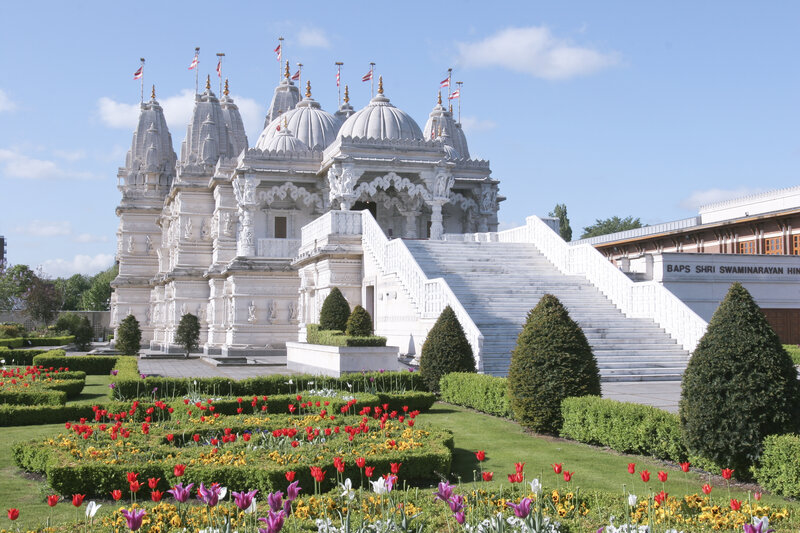
Image from Open House Festival
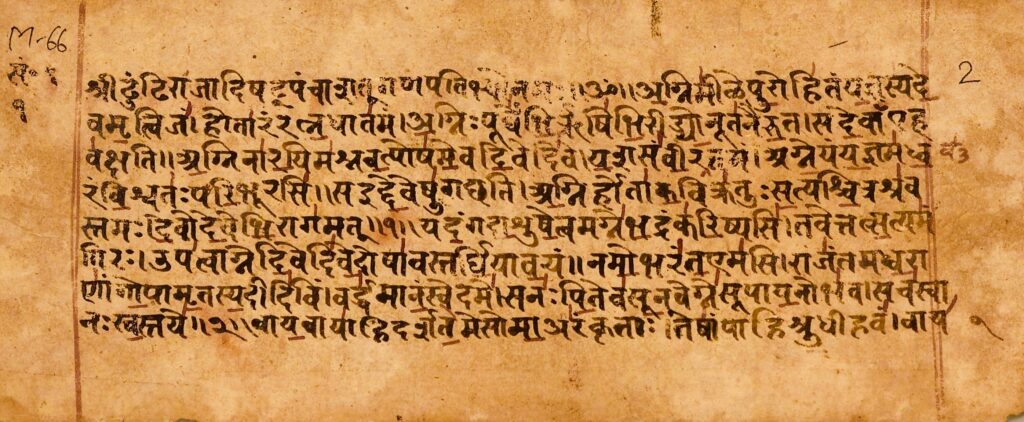
Image from Wikipedia
The idea that all Hindus accept the authority of the Vedas can be challenged. The Vedas were originally oral compositions, and as such it is very difficult to date them, but probably the earliest parts, known as the Saṃhitās, were composed between 1500 BCE and 1000 BCE although some date these compositions much earlier. There was about 1,000 years before these oral compositions were written down, and there is a significant period between the earliest parts and the later parts of this vast corpus.4 Consequently, the Vedas are an incredibly diverse, and the meaning of these compositions is often very obscure. They are also composed in Sanskrit which, although the basis of the northern Indian languages, is no longer spoken. While most Hindus are aware of the Vedas, many have very little knowledge of their contents and these obscure compositions play often play little or no part in the religious lives of many Hindus. Furthermore, other texts such as the epic the Ramāyāna, are more widely known.
Conclusion
By naming something, you are not simply identifying that thing, but you are creating it. Categories do not simply exist as some sort of objective reality that are unified by some essential essence that distinguishes a particular category of things from all other categories of things. Categories are created through discourses. The idea that religion is a distinctive category of human activity, that can be clearly distinguished from all other types of human activities is a cultural construct. Similarly, the conceptualisation that Hinduism, Christianity, Islam and so on are clearly defined and distinct religious traditions is also a product of cultural discourses. Consequently, as the term ‘Hinduism’ was first used in the colonial period, it has been argued that the idea of ‘Hinduism’ as a distinct religion was an invention of the orientalist discourses of the missionaries, scholars, and romantics.
However, to suggest that Hinduism is simply an invention of orientalist discourses is to deny Hindus agency. It is the colonial milieu and the interaction between Europeans and Indians that created the conditions for the idea of Hinduism as a religion to materialise. Many of the diverse aspects of what is now identified as Hinduism have existed for centuries, if not millennia, although some features are much more recent. Whilst there is no essential and defining feature that unifies all Hindus, I agree with Wendy Doniger that Hinduism is best understood as a sort of Venn diagram a ‘set of intersecting circles of concepts and beliefs’ (Doniger 1991, p.36).
Notes
- Including my textbook Hinduism Today (Continuum 2010) ↩︎
- See Fiona Bowie (2000) The Anthroplogy of Religion pp. 21–28 for a good overview of this debate ↩︎
- Although this was a much used expression in the first half to the 20th century, the idea of a Hindu Renaissance is criticised and generally not accepted by more recent scholars. ↩︎
- See Jacobs (2010) Hinduism Today, pp.12–14 for more detail about the Vedas ↩︎
Sources
BAPS Swaminarayan Sanstha. (2023). What is Hinduism? Available at: https://londonmandir.baps.org/what-is-hinduism
Bharati, A. (1970). The Hindu Renaissance and Its Apologetic Patterns. The Journal of Asian Studies, 29(2), 267–287.
Bowie, F. (2000) The Anthropology of Religion. Oxford: Blackwell.
Clarke, J.J. (1997). Oriental Enlightenment: The Encounter Between Asian and Western Thought. London: Routledge.
Doniger, W. (1991). Hinduism by Any Other Name. The Wilson Quarterly, 15(3),35–41
Frykenberg, R.E. (2001). The Emergence of Modern ‘Hinduism’ as a Concept and as an Institution. In Hinduism Reconsidered.
(pp.82–107). Eds. G.Sontheimer, G. & H.Kulke, Delhi: Manohar.
Gandhi, M.K. (1982). An Autobiography: The Story of My Experiments with the Truth. London: Penguin
Halbfass, W. (1988). India and Europe: An Essay in Understanding. Albany: State University of New York Press.
Jacobs, S. (2010) Hinduism Today. London: Continuum.
Jones, W. (2008). On the Hindus. In The British Discovery of Hinduism in the 18th Century. (pp.246–261). Ed. P.J.Marshall, Cambridge:
Cambridge University Press.
Pennington, B.K. (2005). Was Hinduism Invented? Britons Indians and the Colonial Construction of Religion. Oxford: Oxford University
Press.
Roy, R.(1901). An Abridgement of the Vedant. In The English Works of Raja Rammohun Roy (pp. 1–17). Ed. J.C Ghose, Allahabad:
Panini Office,. Available at: https://indianculture.gov.in/rarebooks/english-works-raja-rammohun-roy
Said, E. (1991). Orientalism. London: Penguin.
Sastri, S. (1974). History of the Brahmo Samaj. Calcutta: Brahmo Mission Press.
Trushke, A. (2023). Hindu: A History. Comparative Studies in Society and History,65(2)1–26,