In this post I will be looking at two opposing views about the relationship between art and religion – people who believe that images are an inimical to the religious life – sometimes referred to as iconoclasts, and people who believe that images are integral to the religious life – sometimes called iconodules or iconophiles. Both positions are underpinned by the belief that images have power which I talked about in a previous post Is it Religious Art?
Iconoclasm
The term iconoclasm derives from the Greek ‘eikon’ – image and ‘klân’ – to break. Iconoclasm suggests that images are such an anathema that they must be destroyed. The most prominent and recent example of iconoclasm is the destruction by the Taliban of the two large Buddha statues in Bamiyan in 2001.
Iconoclasts suggests that images are at best a distraction from the religious life and at worst idolatrous – i.e., worshiping something profane as if it were sacred. Iconoclasm is a general attitude towards the use of images and is not simply an antipathy towards a specific image. However, iconoclasm is itself a visual act. There is no point in the iconoclastic act if there is no one around to witness the destruction. It is well documented that the Taliban invited journalists to be present for the demolition of the Bamiyan Buddhas.
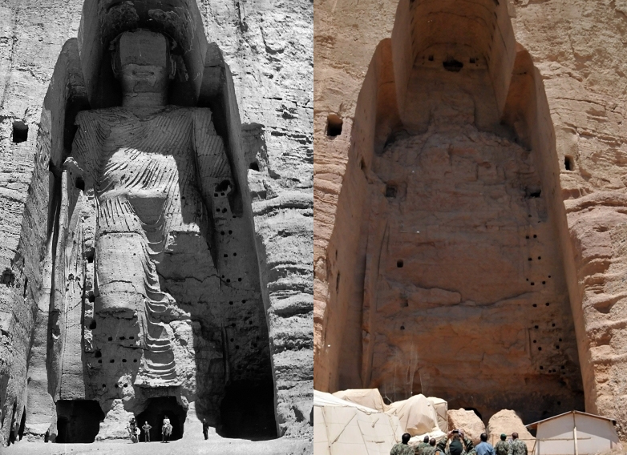
https://commons.wikimedia.org/wiki/File:Taller-Buddha-of-Bamiyan-before-and-after-destruction-2.jpg

Iconoclasm in Christianity
There has been an ongoing debate about the use of images in the Christian traditions. The evaluation of images is in part determined by theology. The understanding of images is very different in Orthodox, Catholic and Protestant forms of Christianity.
There have been two periods in the history of Christianity where iconoclasm has been particularly prevalent: during the Byzantine Period (8th–9th centuries) and the Reformation (16th century). The proscription of images is frequently validated by referring to the Second Commandment in the Book of Exodus.
You shall not make for yourself a sculptured image, or any likeness of what is in the heavens above, or the earth below, or in the waters under the earth
Exodus 20:4
This seems an unequivocal prohibition on the production of images, and yet Christianity has a very rich iconographic tradition. The Exodus verse continues: “You shall not bow down to them or serve them’ (Exodus 20:4). This suggests that it is not so much the production of images that is prohibited, but only that venerating images is forbidden.
The narrative of the Golden Calf informs a Christian and Jewish iconoclasm. This story, also found in the book of Exodus, tells that during the escape of the Jewish people from slavery in Egypt, Moses climbed Mount Sinai to receive God’s commandments. However, whilst waiting for Moses to return, the people get impatient and persuade Aaron, the brother of Moses, to make a golden calf from their molten jewellery. On his return with the Commandments, Moses discovers the people dancing and worshipping the image of the calf. He is so furious that he breaks the tablets on which the Commandments are inscribed. Interestingly, this narrative became a popular theme in European art.
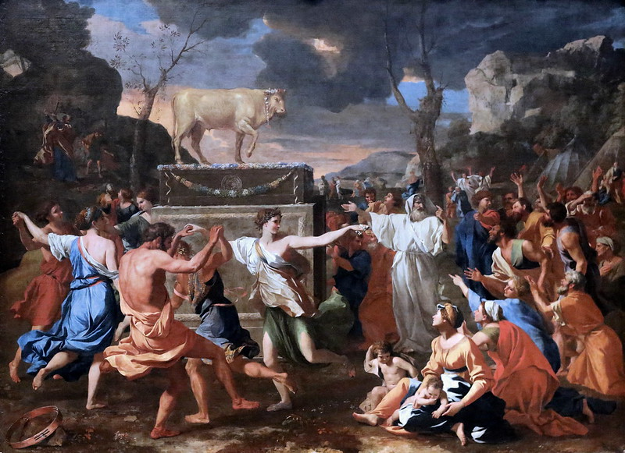
“IMG_9575K Nicolas Poussin. 1594-1665. Rome. L’adoration du veau d’or. The Adoration of the Golden Calf. 1634. Londres National Gallery.” by jean louis mazieres is licensed under CC BY-NC-SA 2.0.
The image that is being worshiped by the Jewish people in Poussin’s painting is obviously a bull and not a calf. The bull is associated with the Egyptian god Apis. The worship of an image associated with Egyptian religiousness can be conceived as retrogressive. The people waiting for Moses were looking to the past, represented by polytheism of Egyptian religion, and not to the future of Jewish monotheism. The link back to Egypt also suggests that Moses opposition was as much a political as religious objection.
Poussin also depicts the worshippers in a frenzied dance, which suggests that the worship of ‘false idols’ is linked to debauched behaviour. In other words, idolatry is conceived in antinomian terms.
Iconoclasm in the Byzantium Period
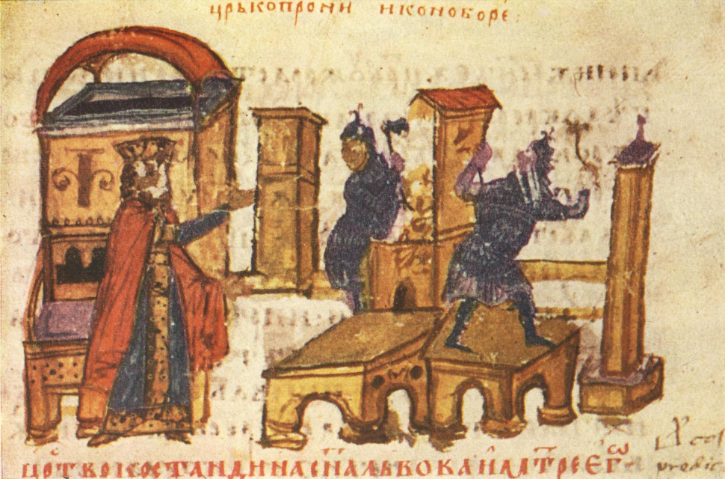
https://commons.wikimedia.org/wiki/File:48-manasses-chronicle.jpg
In the 8th century there was a considerable debate about the use of images. This led to the emperor Constantine calling a council in 754 CE with leading members of the Church to discuss the issue. This council was held in the Heiria near what was then called Constantinople (now Istanbul). This meeting often referred to as the Iconoclastic Council condemned the use of images.
After we had carefully examined their decrees under the guidance of the Holy Spirit, we found that the unlawful art of painting living creatures blasphemed the fundamental doctrine of our salvation.
The Iconoclastic Council
Iconoclasm in the Reformation
The Reformation in the 16th Century is the period that marks the break between Protestant forms of Christianity and the Catholic Church. Protestant reformers like Martin Luther (1483–1586) and John Calvin (1509-1564) tended to emphasis the Word of God and were either ambivalent or hostile to the use of images.
Seeing this brutish stupidity has overspread the globe, men longing after visible forms of God, and so forming deities of wood and stone, silver and gold, or any other dead and corruptible matter, we must hold it, as a first principle, that as often as any form is assigned to God, his glory is corrupted by an impious lie.
John Calvin cited in Noyes 2013: 23
In this quote Calvin suggests that God is transcendent and therefore cannot be represented in any finite medium. He also indicates that the use of images in worship leads people to venerate the empirical form and not God, who is inherently formless.
For the reformers the proliferation of images was regarded as signifying the corruption of the Church. Whilst the leaders of the Reformation were nor directly involved in any destruction, there were violent outbreaks of iconoclasm in northern Europe in this period
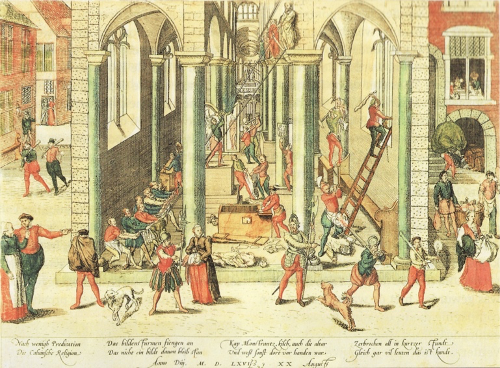
https://commons.wikimedia.org/wiki/File:Frans_Hogenberg_Bildersturm_1566.jpg

Iconoclasm in Islam
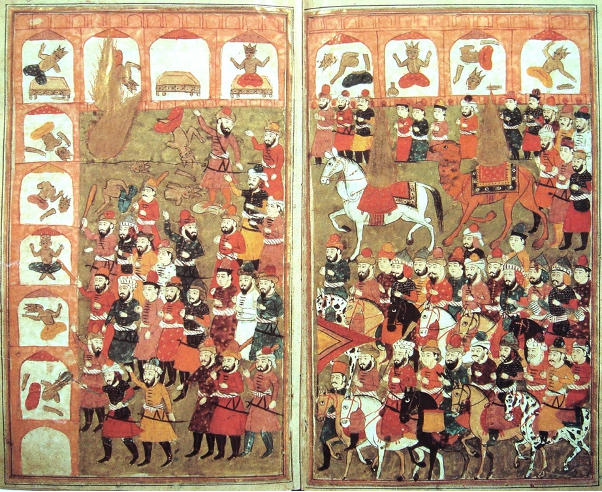
https://commons.wikimedia.org/wiki/File:Muhammad_destroying_idols_-_L%27Histoire_Merveilleuse_en_Vers_de_Mahomet_BNF.jpg

While Islam is frequently associated with iconoclasm, it is important to stress that this perception is linked to Islamophobic and stereotypical view of Islam. There is an iconoclastic element in Islam, but it is mostly associated with groups such as the Taliban and ISIS, who have engaged in spectacular acts such as destroying the Bamiyan Buddhas. Different parts of the Islamic world have developed their own distinctive visual cultures.
Iconoclasm in Islam is most often associated with the dominant form of Islam found in Saudi Arabia known as Wahhabism, named after the 18th century reformer Muhammad Ibn Abd al-Wahhab. Wahhabi Islam legitimates its iconoclastic tendency by referring to the Qur’anic verse (4:36).
Worship Allah and do not associate anything with him
Qur’an 4:36
This verse indicates the uniqueness and oneness of Allah (tahwid) – and the worship of images is a form of associating something that is not sacred with Allah (shirk) and is therefore considered to be idolatrous.
As well as the concept of shirk, Islamic iconoclasts also refer to the life of the Prophet. The Ka’bah in Mecca was a sacred place in pre-Islamic Arabia. It is believed that it was constructed by Ibrahim (Abraham) and his son Ismael (Ishmael). However, at the time of Muhammad it was thought to house images of a variety of different deities. It is recorded in Islamic narratives that the Prophet Muhammad had all these images and destroyed.
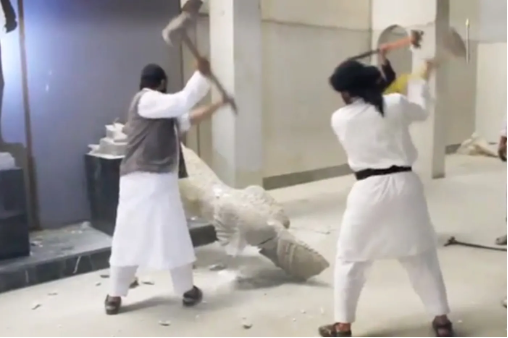
In the ISIS publication Daqib it suggests:
The actions of the mujahidin (holy warriors) had not only emulated Ibrāhīm’s … destruction of the idols of his people and Prophet Muhammad’s destruction of the idols present around the Ka’bah when he conquered Makkah, but it also served to enrage the kuffār, a deed that in itself is beloved of Allah
Cited in Isakhan and Zarandona
Iconoclasm in the Hindu Traditions
Hinduism has a very rich and diverse visual culture. Images are often installed in temples and shrines and are significant aspects of Hindu devotionalism. Nonetheless we can still identify ambivalence and hostility towards images in the Hindu traditions.
During the colonial period there were several Hindu reformers, who reinterpreted various aspects of Hinduism. One of the most prominent of these reformers was Swami Dayananda Saraswati (1824-1883) who founded an organisation called the Arya Samaj.
Dayananda argued that the various deities in the Hindu pantheon were not distinct gods and goddesses, as many Hindus thought but were in fact different aspects of one almighty and omnipotent God.
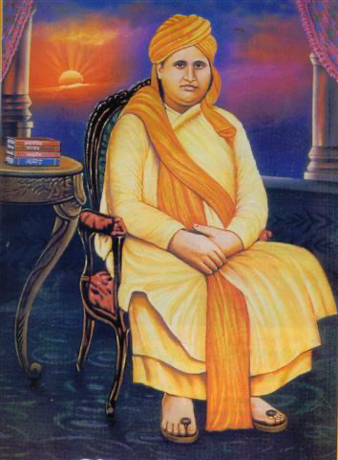
https://commons.wikimedia.org/wiki/File:Swami_Dayanand.jpg

Dayananda recounts that as a child he once observed a mouse crawling over the shrine to Shiva and eating the offerings.
I feel it impossible …. To reconcile to the idea of an omnipotent, living god, with this idol which allows the mice to run over his body and thus suffer his image to be polluted without the slightest protest
Dayananda cited in Richards 1985: 52
Like other iconoclasts Dayananda distinguishes between authentic and inauthentic forms of religiousness. There is, according to Dayananda and the Arya Samaj, no place for images in genuine religious practice. In a more recent article on theArya Samaj web site Dr Vivek Arya indicates that the use of images in worship is inherently idolatry.
An idol worshipper remains an idol worshiper all his life and does not rise an inch above …. When god is invisible, how can he represented by visible objects? Visibility means grossness; grossness means limitations. The form you see is not gods but of the idol.
Arya 2015
Iconodules
However, others have argued that images are integral to the religious life. People who perceive a role for images in religion are sometimes referred to as iconodules or iconophiles. For example, John of Damascus (born c675 CE) was a strong advocate of the importance of images.
When He who is bodiless and without form … is found in a body of flesh, then you may draw his image and show it to anyone willing to gaze upon it … I do not worship matter: I worship the Creator of matter, who became matter for my sake … Images reveal and make perceptible those things which are hidden
John of damascus cited in Elsner 2012
What John of Damascus is suggesting here is that because God is incarnated in the human form of Christ it becomes possible to depict him in a visual form. The challenge for visual representations of Christ is how the artists depict the divine aspect of Christ. For example in the 4th century CE, the convention of portraying Christ with a halo to indicate his divine nature became common practice.
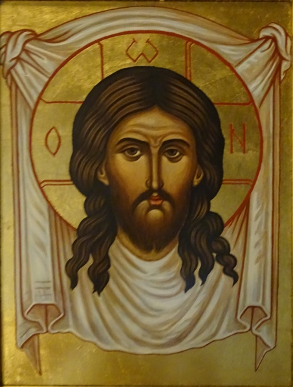
https://commons.wikimedia.org/wiki/File:Sofia_Alexander_Nevsky_Cathedral_Icon_Chirst.jpg

John, then goes on to emphasise that the veneration of images is not the adoration of the image itself, but a sacred hidden reality that is revealed through the visual representation. In this sense, images can be understood as sort of windows that have the potential to make the sacred visible. This idea is particularly important in Orthodox forms of Christianity.
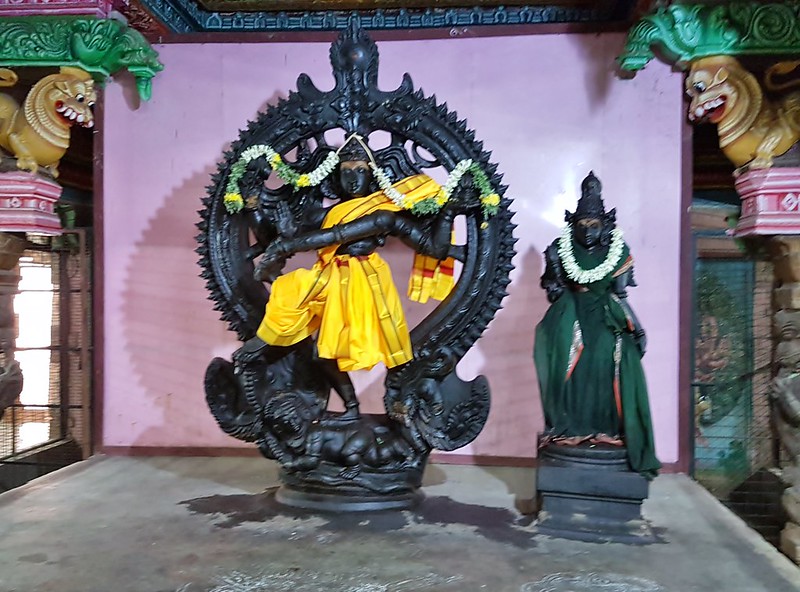
The idea of icons being a windows onto the sacred is very different to the Hindu perception of images. In many forms of Hindu devotionalism the image is regarded as a form (mūrti) of the deity. As Diana Eck indicates ‘the mūrti is more than a likeness: it is the deity itself taken “form”’ (Eck 1985:38). However, there are two significant aspects to transforming a visual representation into a form of the deity. Firstly, the image itself must be made according to certain prescriptions found in the sacred texts that give details of proportions of the body, number of arms, what objects should be held and so on. The second aspect is that there are rituals that consecrate the image, transforming a mere object into the sacred.
Conclusion
“holy virgin mary ofili” by Jennifer Mei is licensed under CC BY 2.0.
https://quod.lib.umich.edu/m/mqrimage/x-02206-und-07/02206_07. University of Michigan Library Digital Collections
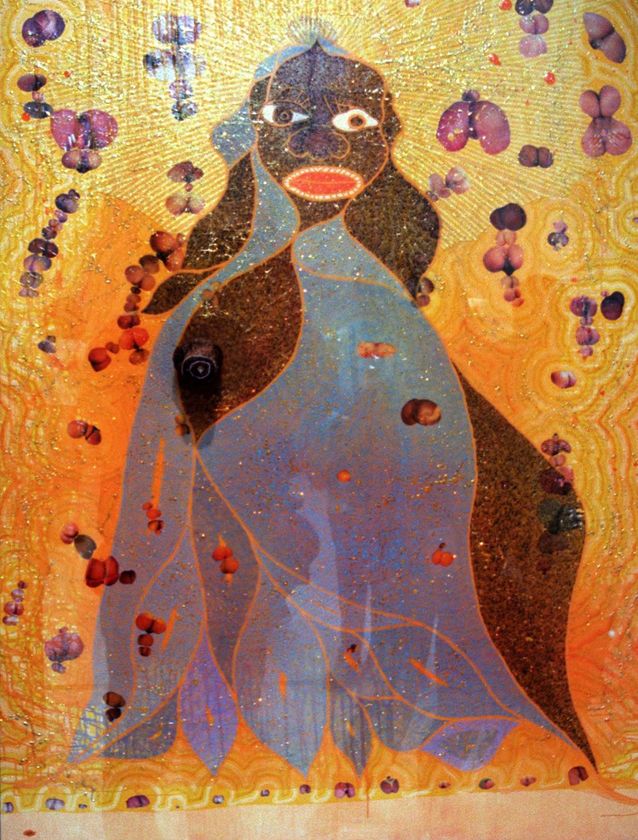
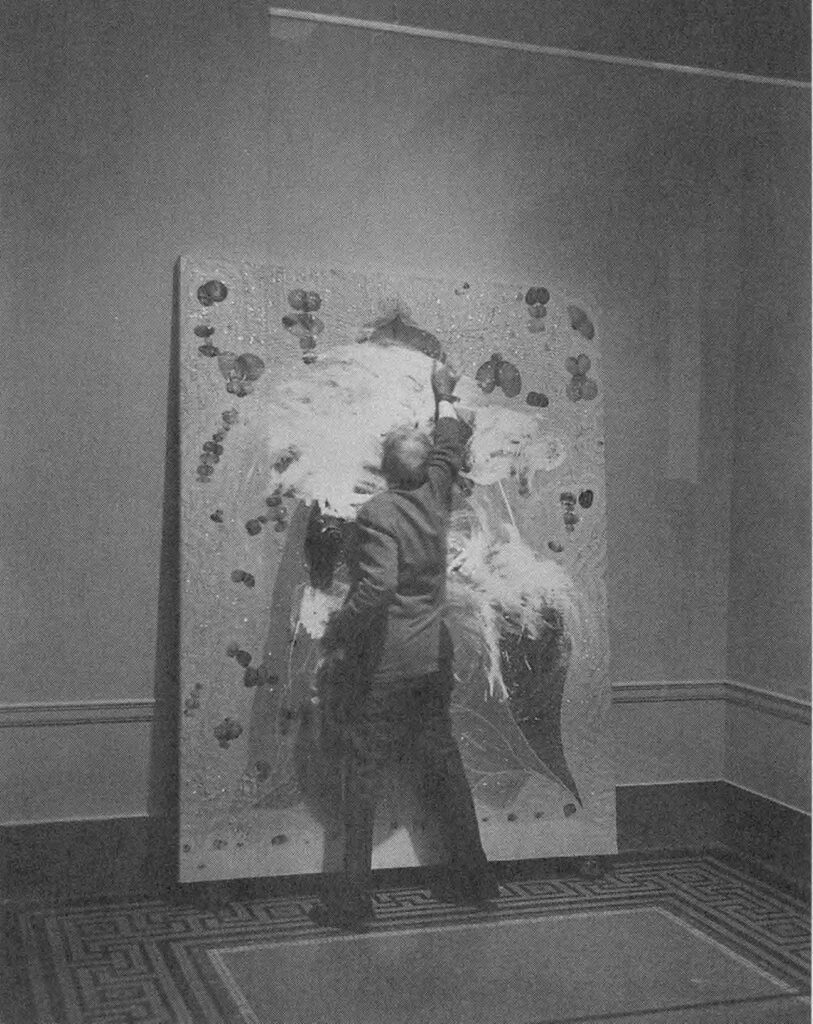
Images are not in themselves offensive or worthy of veneration but are a matter of attribution. Just as it is sometimes suggested that ‘beauty is in the eye of the beholder’, so too is sacrality or sacrilege. The perception of images and their significance for the religious life is determined by a multiplicity of factors including theology, culture and individual disposition. Consequently, images can provoke a wide range of different responses from veneration to hostility. These attitudes can apply to specific images. For example, Denis Heiner was so offended by Chris Ofili’s painting The Holy Virgin Mary, that was displayed in the Brooklyn Museum of Art in 1999, that he smeared it with white paint. He was heard to mutter that the picture was ‘blasphemous’. Presumably Heiner would not take offence at a Renaissance representation of Mary. Iconoclasts, however, object to the use of all visual representation . Nonetheless as David Freedberg suggests ‘image destruction’ can stimulate ‘an inventive new iconography’ (Freedberg 1991: 387).
Terminology
Arya Samaj: A Hindu reform movement founded in 1875 by Swami Dayananda Saraswati. The Arya Samaj suggests that
the sacred is ineffable, and therefore can never be represented visually. They therefore deplore the use of images
(mūrti) in worship.
Ka’bah: The square building located in the centre of the Grand Mosque in Mecca. This is the most sacred place for all
Muslims. The Ka’bah was built before the time of the Prophet, and it is believed that Muhammad destroyed the images
that were installed there. Many Islamic iconoclasts, such as ISIS refer to this narrative as a justification for the
destruction of images.
Mūrti: This Sanskrit term literally translates as ‘form’, and refers to images installed in Hindu temples. It suggests that
these images are actually manifestations of the deity and not simply a visual representation.
The Reformation: The period in 16th century Europe that saw Protestant forms of Christianity split from the Catholic
Church. Many of the reformers such as Martin Luther and John Calvin were opposed to the religious use of images.
Iconoclast: Literally ‘breaker of images’. While iconoclasm specifically refers to the destruction of images, it is also
sometimes used in a more general sense indicating an abhorrence of visual images.
Iconodule: Someone who venerates images. Also sometimes referred to as an iconophile – ‘lover of images’.
Idolotary: The worship of images. This is a is a derogatory term to indicate worshiping a visual representation as if it
were something sacred, rather than simply a material object.
ISIS: Islamic State of Iraq and Syria. Sometimes simply referred to as Islamic State (IS) or more recently referred to as
Daesh. This group is perceived by the Western world as a terrorist organisation. ISIS has been involved in some of the
most spectacular and destructive acts of iconoclasm in recent history.
Shirk: An Arabic term denoting associating something of this world with Allah. In other words regarding a person or an
object as divine is regarded as idolatrous and a complete anathema to most forms of Islam.
Wahhabism: The form of Islam associated with the 18th century cleric Muhammad ibn Abd al-Wahhab, and the
dominant form of Islam in Saudi Arabia. Al-Wahhab developed a coherent theology of iconoclasm that informs the
ideology of many Muslim iconoclasts such as ISIS.
Useful Links
The Middle East Institution (2018) The Death of the Buddhas of Bamiyan https://www.mei.edu/publications/death-
buddhas-bamiyan A useful short article on the destruction of the Bamiyan Buddhas.
The National Gallery (2019) Poussin’s Golden Calf. https://www.youtube.com/watch?v=LLvAWndN_WE An interesting
talk by one of the National Gallery’s curators about Poussin’s painting The Adoration of the Golden Calf.
The National Gallery The Audacity of Christian Art: The Problem with Christ: https://www.youtube.com/watch?
v=XKg7YILYBkc A talk on the challenges that artists have in depicting Christ, who is believed to be both fully human and
fully divine.
South China Morning Post Afghans Still Reeling 20 Years after the Taliban Blew Up the Bamiyan Buddhas
https://www.youtube.com/watch?v=dBk5-zRUuNQ A short video in which local Afghans reflect on the destruction of the
Bamiyan Buddhas.
References and Other Useful Sources
Arya, V (2015) Idol Worship. The Arya Samaj. Available at https://www.thearyasamaj.org/articles?=529_Idol_Worship_:_25_Arguments_Examined.
Freedberg, D. (1991) The Power of Images: Studies in the History and Theory of Response. Chicago: University of Chicago
Press
Isakhan, B. and Zarandona, J. (2018) Layers of Religious and Political Iconoclasm under Islamic State. International Journal
of Heritage Studies 24(1) 1–16.
Kruse, C. (2018) Offending Pictures: What Makes Images Powerful. In Meyer, B., Kruse, C., & Korte, A-M. (eds.) Taking Offence: Religion, Art, and Visual Culture in Plural Configurations. Leiden: Brill. 17–58. Available at
https://brill.com/edcollbook-oa/title/53193?language=en&contents=toc-50344
Medieval Sourcebook (1996) Iconoclastic Council 754. https://sourcebooks.fordham.edu/halsall/source/icono-
cncl754.asp
Noyes, J. (2013) The Politics of Iconoclasm. London: I.B.Tauris.
Richards, G. (1985) A Source-Book of Modern Hinduism. London: Curzon Press.