In this post I will start to address the question of what makes a work of art religious. Is it possible to clearly distinguish religious art from secular art? I will also address the question of whether or not we can identify Christian art, Buddhist art and so on.
Subject matter
Intuitively we would classify the 16th century painting by Ridolfo Ghirlandaio Procession to Calvary, as a religious painting. On the other hand, we probably would not consider Paul Cezanne’s painting Basket of Apples as being religious.
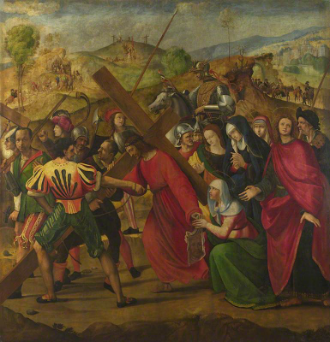
The Procession to Calvary” by DJANDYW.COM is licensed under CC BY-SA 2.0.

https://commons.wikimedia.org/wiki/File:Le_panier_de_pommes,_par_Paul_C%C3%A9zanne.jpg

This categorisation is based on the subject matter of the painting – the Ghirlandaio painting depicts one of the most significant episodes in the Christian gospels, whilst the Cezanne’s painting is a still life.
Viewer’s Response
However, the ‘religiousness’ of art is more than simply the composition of the image. Someone, who is not a Christian and is not familiar with the gospel narrative might not recognise the Ghirlandaio painting as being religious. Furthermore, while I might recognise the subject matter of Procession to Calvary, I might respond to it more in terms of its aesthetic merit (see blog post What is Art) rather than its religious content.
Some art which seems not to depict any religious theme might be perceived as being religious in some way. The theologian Paul Tillich (1886–1965), considered Pablo Picasso’s famous painting Guernica to be a religious painting. Specifically, Tillich (1964:68) suggests that Guernica is ‘a great Protestant image’. However, there are no obvious religious elements in Picasso’s painting. Picasso painted this as a response to the bombing of the small town of Guernica during the Spanish Civil War. Guernica is frequently regarded as one of the most powerful anti-war paintings of all time but is not often considered to be a religious painting. Tillich suggests that Picasso’s painting poses ‘the question of man in a world of guilt, anxiety, and despair is put before us with tremendous power’. Tillich continues, that it not the subject matter – the destruction and trauma caused by the bombing of Guernica – that is significant, but the style of the painting that is a powerful expression of ‘the human situation as Christianity sees it’ (Tillich 1964:69).
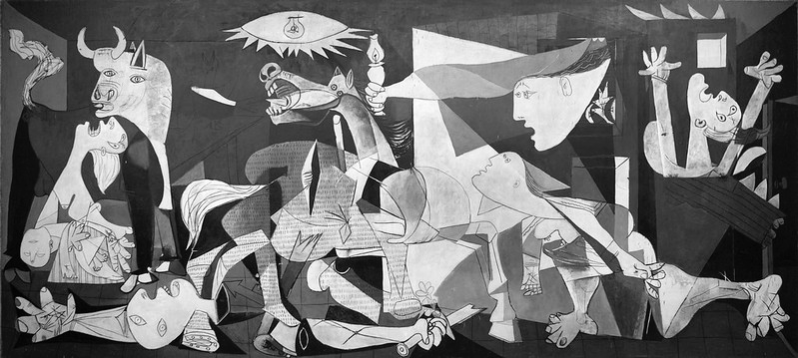
Museo Reina Sofía, Madrid, Spain
Picasso – «Guernica»” by magal (Manuel Galrinho) is licensed under CC BY-NC-ND 2.0.
As Tillich perceives the expressive quality (see blog post What is Art) in the style of the painting rather than the subject matter, he suggests that some paintings that clearly depict Christian ideas are purely sentimental. Although, Tillich does not discuss Warner Sallman’s painting The Head of Christ, I would imagine that he would dismiss it as being kitsch and rather mawkish. Sallman’s painting has been reproduced over 500 million times and is possibly the most widely distributed Christian image of all times. For Tillich, Guernica is intrinsically a Christian painting, whereas The Head of Christ would not be. This suggests that the religiousness of an image resides more in the viewer’s response than in the subject matter.
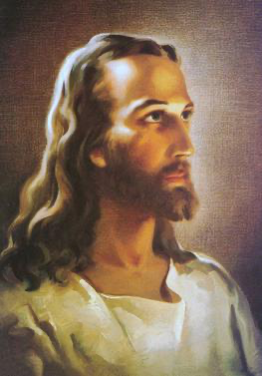
https://en.wikipedia.org/wiki/File:The_Head_of_Christ_by_Warner_Sallman_1941.jpg

Artist’s Intent
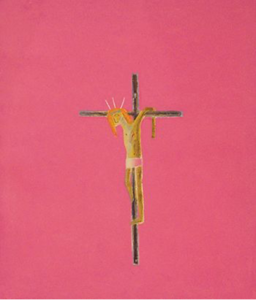
https://www.pinterest.co.uk/pin/230809549641898096
When considering whether a painting is religious, we also have to consider the intent of the artist. The Scottish artist Craigie Aitchison (1926-2009) painted the crucifixion throughout his career. Yet, by all accounts he was not a regular church goer, did not identify as a Christian nor was particularly religious. He remained vague about his use of the crucifixion as a recurring motif in his art.
Dance, music, poetry, literature and the visual arts have the potential to be expressions of religious belief. Across the ages and across cultures artists have utilised their art to give expression to their religious or spiritual beliefs. The renowned sculptor Jacob Epstein suggests that most great art is religious.
My tendency has always been religious – it may not be known … but in fact most great sculpture is occasioned by faith. Even the African sculpture, which we don’t understand, is full of faith.
(Epstein cited in Harries 2016:21)
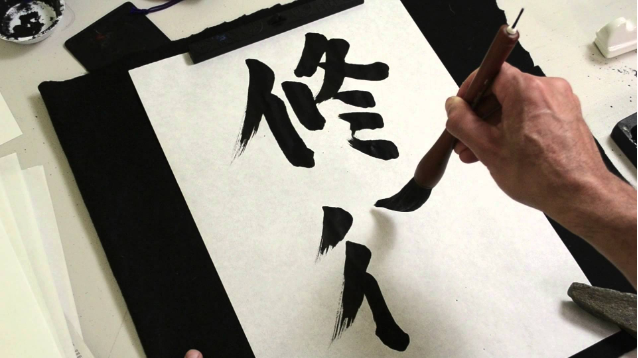
Not only can an artwork be considered to be an expression of religious belief, but the very process of producing art can be a form of ritual. Producing the beautiful illuminations of the Lindisfarne Gospel can be considered a devotional activity. The carving of the icons of the Hindu deities Jagannath, Balbhadra and Subhadra, which are replaced every twelve to nineteen years in the temple at Puri is a highly ritualised activity. Calligraphy in Zen Buddhism – shodo (the way of beautiful writing) can be thought of as a type of meditation. Many spiritualists in the 19th century, such as Georgiana Houghton (1814 –1884), regarded painting as being guided by the spirits of the deceased, and revealed something of the nature of the spirit world.
https://commons.wikimedia.org/wiki/File:Japanese-Calligraphy-art.jpg

The Context of Viewing
We also have to consider the context of viewing. One of Craigie Aitchison’s paintings of the Crucifixion was commissioned by the Dean of Liverpool Cathedral and is displayed in the Chapter House of the Cathedral. Another of his paintings of the Crucifixion is held by the Tate Modern. We normally categorise a cathedral as sacred space and an art gallery as secular space. Does this suggest that the painting in Liverpool Cathedral is religious, but the one at the Tate is not? Certainly, the context where a painting is displayed will tend to encourage a certain type of response. However, whilst context is important it is not an absolute in determining how a viewer will respond to an image. Places of worship for example are often major tourist attractions, and tourists do not necessarily engage with paintings in a religious way.
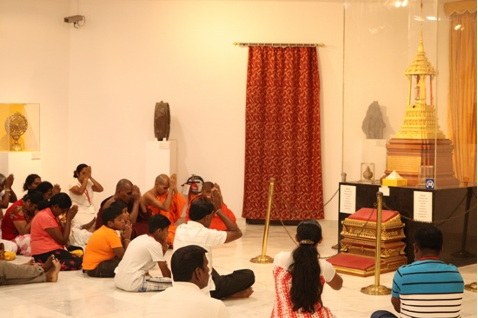
On the other hand, the religiousness of an image is not necessarily nullified by being displayed in a secular space. When I was at the National Museum in Delhi a group of people dashed passed me at great speed as I was admiring a miniature painting. I wrongly assumed that their guide was eager to hurry around the museum so he would have more time to take them to the bazaar. However, as I approached the Buddhist gallery I heard some chanting. The National Museum holds some bone fragments that are said to be the Buddha’s. It transpired that this was a group of Sri Lankan Buddhists who had specifically come to the museum to venerate these relics Consequently, their response was religious and was very different to my engagement with the exhibit which I viewed as another fascinating historical object
The Power of Images
The arts have the potential to play a number of different roles in religious traditions. David Freedberg in his important book The Power of Images persuasively argues that images have power.
People are sexually aroused by pictures and sculptures; they break pictures and sculptures; they mutilate them, kiss them, cry before them, and go on journeys to them; they are calmed by them, stirred by them, and incited to revolt. They give thanks by means of them, expect to be elevated by them, and are moved to the highest levels of empathy and fear.
(Freedberg 1991:1)
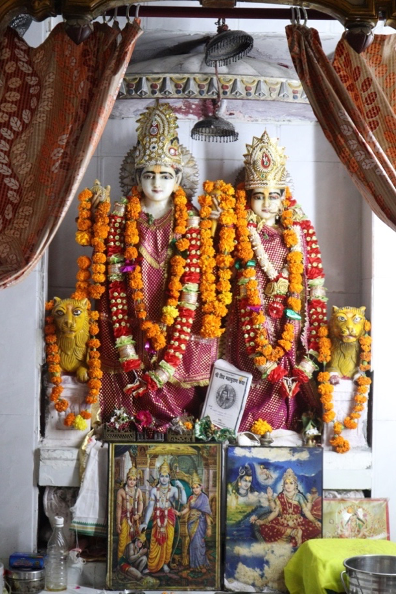
Religious images can have the power to evoke the sacred. For example, in the Hindu traditions a sculpture of a deity installed in temples is referred to as a mūrti. This Sanskrit term literally means ‘form’ and indicates that the image is regarded not simply as a symbol of the sacred but is actually a manifestation of the deity. Consequently, when Hindus go to a temple they describe it as darśan, which translates as ‘sight’. The implication of this is that standing in front of the murti, the devotee both sees and is seen by the deity. This emphasises the importance of vision in many forms of Hindu devotionalism.
Not only do images have the power to evoke the sacred, they also have the power to provoke anger and disgust. This has led some to regard certain images to be perceived as an anathema to their religious beliefs. I will be discussing this further in a future post.
The Didactic Role of Religious Art
Art can be a source of information about religious beliefs – a visible reminder of religious narratives and theological ideas. Bonaventure a 13th century Franciscan monk suggested images can be perceived as scripture made visible through painting. Pope Gregory the Great (590–604) suggested that ‘the illiterate can see in pictures what they are unable to see in books’ (cited in Viladesau 2014:33).

Images can be representations of complex metaphysical ideas. For example, the geometric diagrams in the Buddhist and Hindu traditions, often called mandalas, represent ideas about the creation of the cosmos. See my post on Representing the Sacred II: Metaphysical Diagrams)
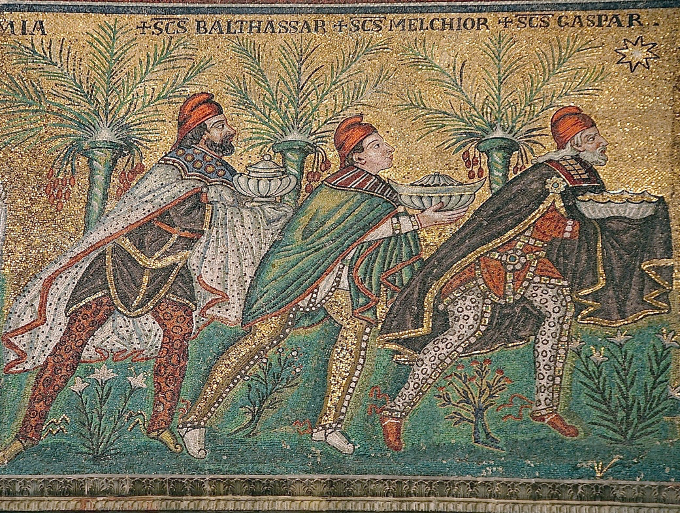
Metaphysical and theological ideas are often depicted in symbolic ways, that require a certain insider knowledge to decipher. Colours can have symbolic meaning. For example, Neil Maggregor (2000) observes that in early Christian art the three Magi who present gifts to the new born Jesus are commonly dressed in green, red and white. Green representing the return to life after death, red suggesting sacrifice and white indicating purity.
https://commons.wikimedia.org/wiki/File:Magi_(1).jpghttps://commons.wikimedia.org/wiki/File:Magi_(1).jpg
.jpg)
Religious Art and Culture
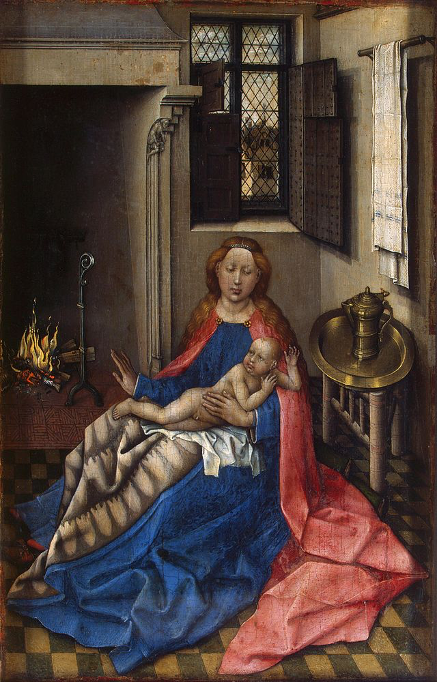
Religion can be a source of artistic inspiration, for both believers and non-believers. Religion is a significant aspect of all cultures, and therefore it makes sense that religious themes are prevalent in art. However, it is sometimes suggested that we live in an increasingly secular world, where religion has become less significant. Until recently, Christianity was the dominant worldview in the UK, and most people would have been familiar with the Christian narrative and symbols. Furthermore, the Church used to be a major patron of the arts in Europe, and this is no longer the case. Consequently, until the end of the 19th century most Christian religious art tended to be fairly straightforward depictions of Biblical events. This style is sometimes referred to as figurative art as it portrays human figures in as lifelike way as possible.
https://commons.wikimedia.org/wiki/File:Robert_Campin_009.jpg
This is not to say that figurative art is historically accurate. Much Renaissance art depicts events recorded in the Gospel in a way that is more consistent with the time of the artist than how it would have appeared at the time of Jesus. The Flemish artist Robert Campin depicts Mary’s dress and the interior space in the style of early 15th Century Europe, and does not represent the clothing style or interior design of the Middle East as it would have actually been in the first years of the Christ’s life.
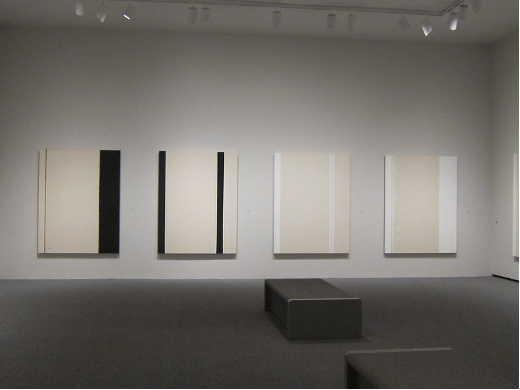
By the end of the 19th century, artists such as Wassily Kandinsky (see What is Art) had begun to experiment with abstraction and other forms of non-representational art. This development led many artists to try and express religious and/or spiritual themes in new ways. For example, Barnett Newman depicts the stations of the cross – 14 events on the last day of Jesus’s life – as vertical lines. This is a far cry from the Ghirlandaio painting which depicts the Sixth Station of the cross – when Veronica wipes Christ’s face with her veil. This is sometimes referred to as a break with more traditional figurative art, and the development of what might be called ‘modern art’.
National Gallery, Washington” by jaycross is licensed under CC BY 2.0.
Creative Commons Licence: The Walters Art Museum. https://art.thewalters.org/detail/84294/mary-and-jesus/
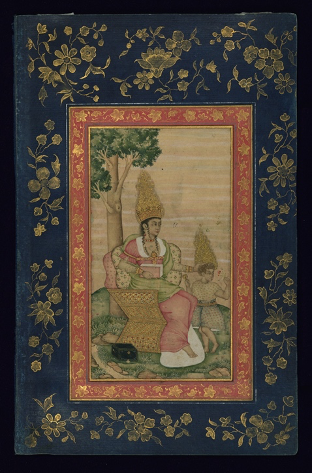
Religious art is also informed by culture. So this 17th Century painting which is attributed to Shaykh Abbassi is clearly influenced by Persian miniature art, and is very different to European depictions of Mary and Jesus, such as that by Robert Campin.
Theological ideas will also influence religious art. For example, there is a clear difference of approach to art between Orthodox, Catholic and Protestant forms of Christianity. Art in the Hindu, Sikh and other religious traditions also use different sets of artistic conventions.
Can we identify distinctive Hindu art, Buddhist art, Jewish art or Islamic art etc.?
This diversity of approach across time, cultures theology and religious traditions raises the question of whether we can identify a distinctive Christian art, Hindu art, Buddhist art etc.
There is an assumption that if an image depicts Christ, it must be Christian; or an image of the elephant headed deity Ganesh must be Hindu art and so on. Once again this raises a series of questions:
- Do Christians produce Christian art and Hindus make Hindu art?
- If the image represents an aspect of the Christian narrative or theology is it Christian?
- How significant is the context?
- How significant is the viewer?
- Can we identify a particular Christian style of art?
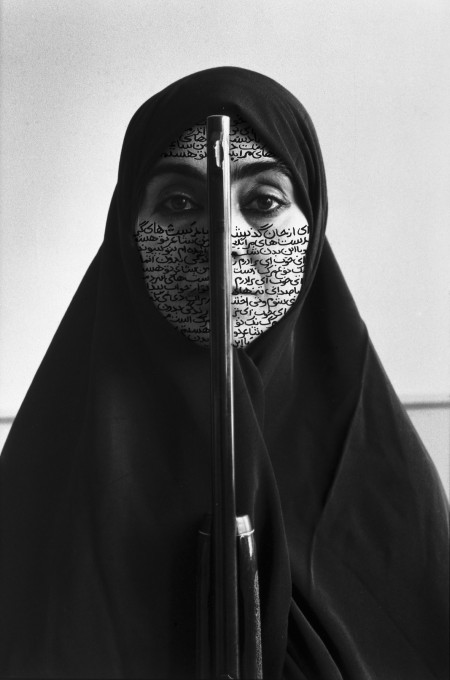
The Iranian/American photographer and film maker Shirin Neshat begins her address to a symposium on Islamic art by asking a number of rhetorical questions.
How do we define contemporary Islamic art? Is it possible to generalize and package all artists born in Islamic countries into one group? … Can we try to understand Islamic cultures as a whole without considering each country’s unique cultural and political history?
Neshat in in Bloom and Blair 2015: 23
Neshat suggests that much her art is informed by both her Iranian heritage and Islam, and in particular Sufism.
My aesthetic emphasis on beauty, abstraction, incorporating text with image, repetition, symmetry and harmony seems to be rooted in the principles of Islamic art, architecture and design. Equally the poetic content of my work is a direct reference to the history of mysticism – Sufism and spiritual Islam, such an important part of Iranian culture
Neshat in Bloom and Blair 2015: 24
https://commons.wikimedia.org/wiki/File:Neshat-full-e1349924887975.jpg

No clear distinction can be made between religious and non-religious art. The subject matter of an image is not sufficient to determine whether a painting can be construed as being religious. Reception of the image can be considered more significant in determining whether an image is religious. This means that an image can be interpreted in diverse ways. For example, Neshat’s images from her Women of Allah series, can be understood as being Islamic, Iranian or Sufi; as aesthetically pleasing or offensive depending on the standpoint of the viewer. However, the context of viewing and the intent of the artist can also influence the way in which an image is interpreted.
Terminology
Abstraction:
Literally means ‘to separate’. Abstract art refers to the way in which an artist attempts to separate out the essential aspect of something – a person, a landscape, an object – and depict it in a simplified and schematised way.
Figurative Art:
Art that depicts the world, especially the human form, in as realistic a way as possible.
Mūrti:
A Sanskrit term that literally means ‘form’. It refers to images of Hindu deities, primarily installed in temples, that are believed to be a manifestation of the sacred.
The Renaissance:
A period of European history which marks the end of the Middle Ages. generally thought to be 15th–16th century. Art developed in this period. Particularly significant was the discovery of the use of perspective in paintings – how to represent three dimensions in two dimensions. This led to an increasing focus on art being as realistic as possible.
Sufism:
Often thought of as being the mystical/heterodox forms of Islam, Sufism defies any clear cut definition. There are many different orders of Sufism that have developed in different cultural contexts.
References
Bloom, G. & Blair, S (eds) (2015) God is the Light of the Heavens and the Earth. London: Yale University Press
Eck, D. (1985) Darśan: Seeing the Divine Image in India. Chambersburg: Anima Book.
Freedberg, D. (1991) The Power of Images: Studies in the History and Theory of Response. Chicago: University of Chicago
Press.
Harries, R. (2016) The Image of Christ in Modern Art. London: Routledge.
Maggregor, N. (2000) Seeing Salvation: Images of Christ in Art. London: BBC.
Tillich, P. (1964) Theology of Culture. Oxford: Oxford University Press.
Viladedeau, R. (2014) Aesthetics and Religion. In Brown, F.B. (Ed.) The Oxford Handbook of Religion and Art. Oxford: Oxford
University Press. 33–43.
Useful Links
Barnett Newman The Stations of the Cross: https://mavcor.yale.edu/conversations/object-narratives/barnett-newman-stations-cross-lema-sabachtani.
Georgiana Houghton https://georgianahoughton.com
Shirin Neshat Dreams Are Where Our Fears Live https://www.youtube.com/watch?v=M43QgkbOEv8