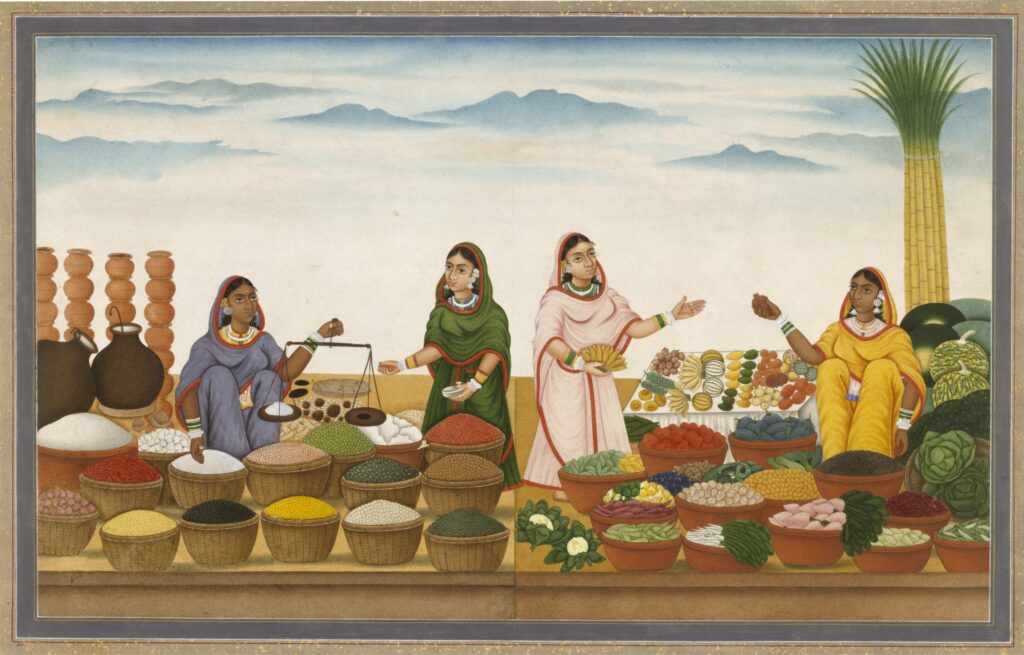
Many people associate Indian food with the generic curry. However, India has a rich and varied cuisine. One of the very first things I noted, when visiting India for the first time in the early 1980s, is that it is incredibly culturally diverse and this applies as much to its cuisine as to other aspects of culture. I also discovered that the food in India bears little resemblance to what you are served in a typical Indian restaurant in the UK.
- There is a sharp distinction between northern Indian cuisines and southern Indian cuisines.
- The different states in India have developed distinctive cuisines. For example, the food in the southern state of Kerala is quite different to the food found in the next-door state of Tamil Nadu, and very different to the cuisine of the northern state of Kashmir.
- Not only is the food different, but also styles of eating. In India, the tradition is to eat with one’s right hand. In Kerala you eat only with your fingertips, and it is considered uncouth to get food on your palms. However, Tamils tend to mash food and rice together using their whole hand and then pushing the mix into the mouth using their thumb.
- Many cities, towns and small regions are famous for their cuisine or specific dishes. For example, Jodhpur, a town in Rajasthan, is renowned for its makhaniya lassi. While you can get lassi, a yoghurt-based drink, in most places in India in Jodhpur it is flavoured with saffron and rosewater.
- Religion and caste influence Indian foodways. Most, albeit not all, Hindus are vegetarian, and most Muslims avoid eating pork. (To be discussed in future post).
- Wealth and status are also factors in determining foodways. The diet of the majority of the population was very different to the menus found in the courts of the Mughal Emperors or Maharajas. In post-Independence India, class can also have an impact on what is eaten.
- Like all other cuisines, Indian foodways did not develop in isolation. Indian cuisine has been influenced by many different invaders and traders – including Persians, Portuguese and British. Consequently, Indian foodways are not static, but have developed over time
What is in a Term?
The origins of the term ‘curry’ is disputed. Most commentators suggest that the term derived from the Tamil word kari, which is generally translated as ‘sauce’, although it can also mean black pepper. Lizzie Collingham suggests that the term became caril in Portuguese. This term was probably first used in the early 16th century, and then the Portuguese term was anglicised into ‘curry’. No matter what the precise etymology of the word, curry became used by the British as a generic term to describe any meat or vegetable dish in a spicy sauce.
The idea of curry is, in fact, a concept that the Europeans imposed on India’s food culture
(Collingham 2005: 115).
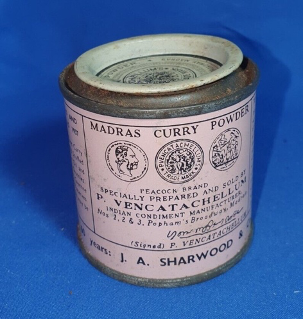
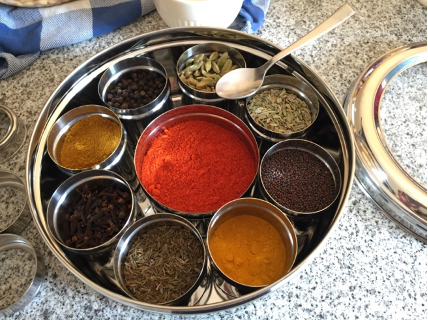
The idea of a generic curry becomes fixed with the development of curry powder. Most Indian cooks, domestic and professional, will have a variety of spices such as cumin, coriander, fenugreek, mostly in seed form, which are often slightly toasted and ground when required for a particular dish. Spices are also added at different stages of the cooking process to build up layers of flavour. For example, garam masala is a mix spices that is added at the end of cooking. Consequently, most cooks and chefs have a spice box next to the stove.
The idea of a generic mix of ground spices that could be added to a dish would be regarded as an anathema to most Indian cooks. The actress Madhur Jaffrey, who wrote a number of recipe books suggested in her first publication An Invitation to Indian Cooking (1973) that the word ‘curry’ was degrading to India’s great cuisines. Interestingly though her 2003 publication is titled Madhur Jaffrey’s Ultimate Curry Bible, and the back cover calls her ‘the undisputed queen of curries’.
By the end of the 18th century commercial curry powders were being sold and soon became a fixture in many British households. There were several interrelated reasons why curry powders became popular. First, although there is a tradition of using spices in British cuisine, much British cooking had become quite bland. An occasional dish, that could simply be made by adding some curry powder and did not require storing and knowing how to use an array of spices, could liven up the British diet. Many returnees from colonial India yearned for the spicier foods that they had become accustomed to. Soon curry powder became an essential item in English middle-class pantries. I recall my mother, who otherwise was a great cook, occasionally making what she would call a curry, that was stewing steak and onions, flavoured with some generic curry powder and bizarrely apples and sultanas.
The Mughals
Many people associate Indian food with what has come to be referred to as Mughlai cuisine. This was the cuisine that developed under the Mughals, a Muslim dynasty that ruled much of India in between the 15th and 18th centuries. The Mughal Empire was founded by Babur in 1526. Babur was originally a ruler of a small province in present day Uzbekistan. However, when he lost his kingdom, he turned his attention south and defeated the Delhi Sultanate at the battle of Panipat. The Mughal Empire gradually expanded through the sub-continent, particularly under the rule of Babar’s grandson Akbar – who reigned from 1556 to 1605.
The Mughal Empire was incredibly influential on all aspects of Indian culture, not least on Indian cuisine. Babur, who was by all accounts very sophisticated, was not at all impressed by the food that he encountered in India. He lamented that the land that he had just conquered had:
No grapes, musk-melons or first-rate fruits, no ice or cold water, no bread or cooked food in the bazaars (cited in Achaya 1994: 158)
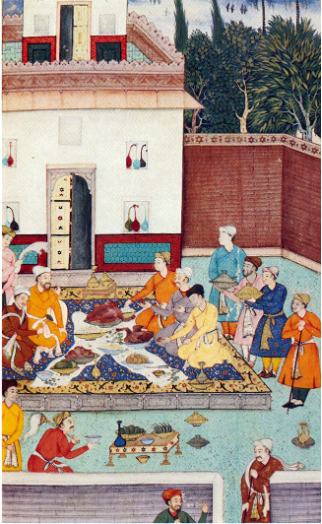
https://commons.wikimedia.org/wiki/File:A_banquet_for_Babur.jpg
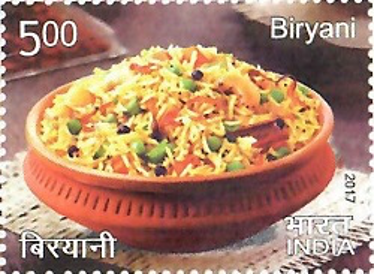
https://commons.wikimedia.org/wiki/File:Indian_Cuisine_-_Biryani_on_2017_stamp_of_India.jpg
Mughlai food is a blend of northern Indian, central Asia, and Persian cuisines. Humayun, Babur’s son, who spent a short while in Persia, introduced a Persian dimension to Indian foodways. This fusion cuisine is best epitomised by the biriyani, which probably originated with the Persian dish pilaf. While there is no definitive biriyani recipe and certain places, such as Hyderabad, have developed specialist versions, it is basically a rice dish cooked with aromatics and meat or vegetables, and often includes nuts and dried fruits. There is a great debate as to which type of rice is best for a biriyani, but an aged basmati is commonly thought to be the ideal rice. Most biryanis also call for the use of saffron. Variations of this rice-based dish can be found right across the Muslim world. It develops into paella in Spain and risotto in Italy – although these European versions use a short-grained rice rather than basmati. The Indian biriyani tends to use more cumin and coriander, rather than nutmeg and cinnamon which tend to be the dominant spices used in the Middle Eastern pilaf. Biriyani is a staple on most UK Indian restaurant menus.
The biryani was primarily associated with the Mughal court, as it included many expensive ingredients. There is also simpler and more economic version –khichri, which is rice and lentils cooked together. There is some evidence that this simple dish was Indian in origin and eaten prior to the Mughals. It also was adapted by the British into kedgeree, who added smoked haddock and hardboiled eggs. Kedgeree became a popular breakfast dish, not only in colonial India, but also for the Victorian and Edwardian aristocracy back in the UK.
European Colonialism
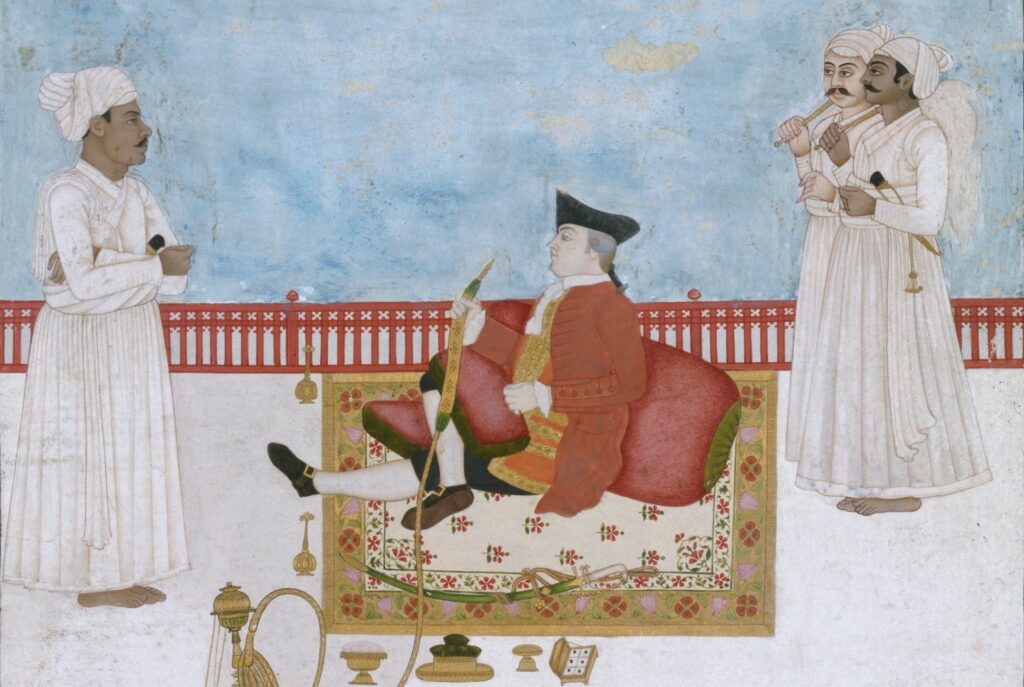
https://www.atlasobscura.com/articles/potato-history-india
The arrival of the European colonial powers also had an incredible impact on Indian cuisine. However, it must be emphasised that this influence was two-way, European cuisines were as much influenced by Indian cuisines as vice versa.
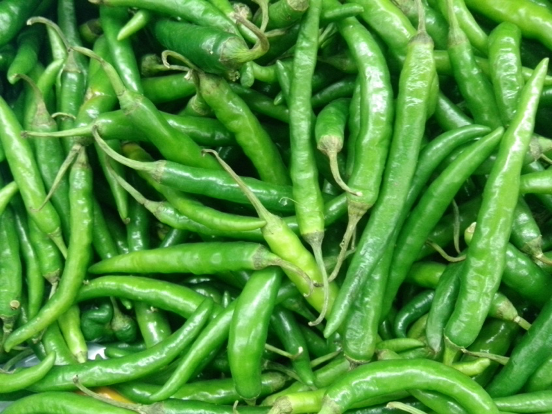
The chilli was avidly received in India. It could be grown all over the country, unlike pepper, and in every backyard, with a pungency much greater than that of pepper … Here was a classic case of a new product eminently meeting a felt need.
Achaya 1994: 228
Perhaps the biggest influence that the European colonial powers had on Indian cuisine was the introduction of chillies. Spices have been used for millennia in Indian cuisine. However, chilli is a relatively new addition to the array of spices utilised by Indian cooks. Ironically, it was primarily the spice trade that was the stimulus for the Europeans to make the perilous voyages east. Vast profits could be made from shipping spices, particularly pepper, from South Asia and Indonesia to Europe in the 16th century. Also, somewhat ironically, Christopher Columbus set off to find a new route to India and discovered the Americas. Subsequently a trade route was opened with this ‘new world’. Chillies are indigenous to Central and South America. The Portuguese, with colonial bases in Americas and in India, introduced chillies into India in the 16th century. Prior to the introduction of chillies, most Indian cuisines utilised either black pepper or long pepper to create heat in dishes. However, the chilli grew well in India, and very quickly was incorporated into recipes. Chilli is now regarded along with ginger and garlic as the holy trinity of spices in Indian cuisines, and most curry dishes use a paste of these three spices at some point in the cooking process.
The Portuguese were also responsible for introducing the potato and tomato, now staples of Indian cuisine.
The Portuguese primary base was in Goa on the West Coast of India – and they influenced the local cuisine. For example, one of the dishes that is commonly found on most high street Indian restaurants Vindaloo is actually a Portuguese dish in origin, which was meat cooked with wine, vinegar and garlic. When it was transposed to India, it was spiced up – and in particular large amounts of chilli was added making it both very spicy and sour dish.
The British also influenced Indian cuisine. The British introduced vegetables such as cauliflower, cabbage and carrots to India. Consequently, alu gobi (cauliflower and potato),one of the most popular vegetable dishes, commonly served in both north India and in UK Indian restaurants is a product of colonialism. However, although Europeans introduced many new vegetables, they were prepared in a very distinctly Indian style.
Curry Comes West
Indian food has made an enormous impact in the UK. Almost every high street has an Indian restaurant. Most Indian restaurants in the UK are actually run by Bangladeshis from the region known as Syhlet. This is primarily because many Syhletis were employed as seamen, known as lascars, by the East India Company. Conditions at sea were appalling, and many remained in the UK and started small restaurants and cafes.
The first Indian restaurant in the UK was the Hindoostanee Coffee House, which opened in London in 1809. It did not last very long and mostly catered to colonial officers who had become accustomed to spicy food whilst in India. Veeraswamy, near Piccadilly Circus in London, opened in 1926 is still serving.
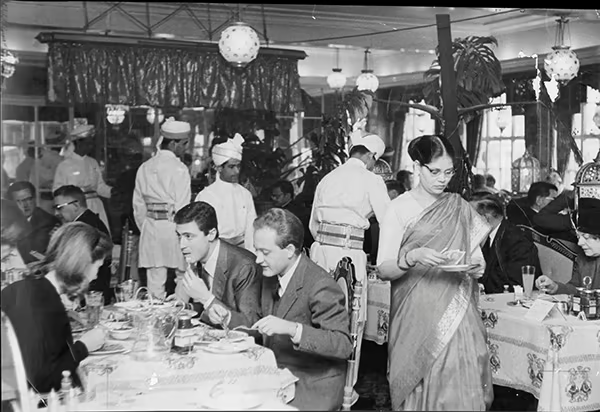
From the Financial Times Malcolm Moore ‘The Great British Curry Crisis’. 8 January 2016
https://www.ft.com/content/2165379e-b4b2-11e5-8358-9a82b43f6b2f
It is quite a common expression to say that you are ‘going for an Indian’. It became a sort of custom to ‘go for an Indian’ after a night’s drinking at the pub. Indian food was regarded as ‘exotic’ and therefore alluring. For the counterculture generation Indian food was also seen as an expression of rebellion against the cultural mores of the time.
Like a lot of young people you always wanted to try something that your parents won’t give you, so I started to go out for curries … It was a bit of fun in that you’d try the hottest curry, even if it was so fiery it blew the roof of your mouth off .
Cited in Buettner 2012,:153
This bravado to try the hottest dish on the menu is wonderfully lampooned by the Goodness Gracious Me sketch – ‘Going for an English’.
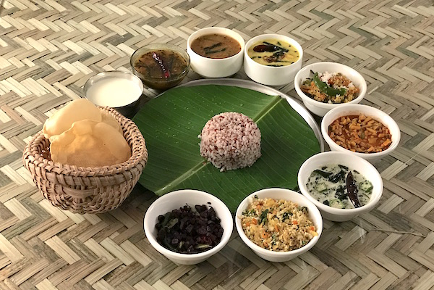
Rasa began as an authentic South Indian restaurant in the UK
Bringing the taste of authentic, home-cooked southern Indian food
At Rasa, our food is inspired by the authentic home cooking of beautiful, spice-rich Kerala, where all our chefs are trained
http://www.rasaindia.in/about.html
In the 1960s most ‘Indian restaurants’ tended to serve very similar standardised menus, with more or less the same range of dishes. This led to the accusation that these restaurants were not serving authentic Indian cuisine. Now there are increasing numbers of restaurants in the UK who aspire to serve authentic regional cuisines. In particular South Indian cuisine has become popular. For example the London restaurant Rasa offers authentic Keralan cuisine. Interestingly, although started in London, Rasa now has branches in India
Curries in all their rich diversity has now been well incorporated into the British foodscape. The pub chain Wetherspoons is now the largest seller of curries. There are now several Michelin starred Indian restaurants in the UK. The balti and the notorious chicken tikka masala are both invented in the UK. Indeed Robin Cook, who was the Foreign Secretary in Tony Blair’s government, suggested that chicken tikka masala was now Britain’s national dish.
Conclusion
There is no such thing as a curry. Despite the availability of generic curry powders, the term refers to a very wide range of diverse dishes. Each of these dishes emerge in a particular time and place and have their own histories. Many of these dishes originate in other parts of the world become transformed into something different and new in the Indian context.
The idea of curry seems to be extraordinarily compelling and Indian cuisine has had an impact on many different cuisines across the globe. The British for example, took the multiplicity of spices used in many Indian dishes and created curry powder. The British then introduced curry powder into Japan, where it became katsu curry. This has now been re-imported back into the UK, and is served in restaurant chains such as Wagamama. It is now possible to buy a Wagamama Katsu meal kit from the quintessentially British retailer Waitrose.

References and Other Sources
Achaya, K.T. (1994) Indian Food: A Historical Companion. Delhi: Oxford University Press.
A useful reference book that traces the history of Indian foodways.
Atlas Obscura (2019) In India, the British Hyped Potatoes to Justify Colonialism. Available at
https://www.atlasobscura.com/articles/potato-history-india
A short essay on how the British promoted the potato as part of the colonial project
Buettner, E. (2012) “Going for an Indian”: South Asian Restaurants and the Limits of Multiculturalism in Britain:
In Ray, K. & Srinivas, T.(eds) Curried Cultures: Globalization, Food and South Asia. Berkley: University of California
Press.
An interesting essay on Indian restaurants in the UK . Other chapters in this volume about globalisation and food are also
worth reading
Burton, D. (1993) The Raj at Table. London: Faber & Faber.
A delightful account of the sometimes unbelievable culinary choices of the British in India. Includes some recipes.
Collingham, L. (2005) Curry: A Biography. London: Chatto & Windus.
A fascinating account of the story of Indian cuisine from the Mughals to the globalisation of curry. Also published by Vintage
‘Curry: A Tale of Cooks and Conquerors. Includes recipes.
Nabhan, G.P (2014) Cumin, Camels, and Caravans: A Spice Odyssey. Berkley: University of California Press.
A brilliant history of the global spice trade.
Panyani, P. (2008) Spicing Up Britain. London: Reaktion Books
Details the impact of immigration, from Italians to Indians, on British food.
Sen,C.T. (2015) Feasts and Fasts: A History of Food in India. London: Reaktion Books.
A comprehensive history of Indian foods from prehistory to the present. Wonderfully illustrated and includes some
recipes
Madhur Jaffrey
Madhur Jaffrey came to study drama at RADA in the mid 1950s. Whilst she was in London, she missed the food that she grew up with in Delhi. Her mother sent her recipes from home, but Jaffrey found these very difficult to replicate in the UK, so she adapted these recipes for a British kitchen. This led to the publication of her first cook book An Invitation to Indian Cooking, and ultimately to a series on BBC. There is no doubt that Jaffrey changed British attitudes towards Indian food, and inspired home cooks to abandon the ubiquitous curry powder and to experiment with spices.
While some of the books listed above do include recipes, these are mostly of historical interest. Jaffrey’s recipes are easy to follow and produce excellent results. Her 1983 publication Eastern Vegetarian Cooking is one of the very few recipe books that I use. I will be posting some of my recipes in the not too distant future.