

Introduction
On our back deck we have a pot in the shape of a Buddha’s head in which we grow some ornamental grasses. We had a very good friend staying who has a Buddhist background. Although she was far too polite to say anything, I sensed that she was uncomfortable with our garden ornament. In this post I will reflect on why Buddha garden ornaments might be considered to be a form of cultural appropriation.
Cultures are not isolated and they influence each other in a variety of ways. The availability of Buddha images as garden and home ornaments is simply one example of this cultural borrowing. Cultures have always taken and assimilated aspects of other cultures, many of which are positive. Consequently, there is a necessity to distinguish benign cultural borrowing from exploitative uses of other cultures.
Exploitative taking from other cultures is generally referred to as cultural appropriation. This much contested concept has no unchallenged definition. However, I will start with an early definition from the art critic Kenneth Coutts-Smith who argued that cultural appropriation occurs:
Whenever a dominant group steals or borrows icons, ideas, or other beliefs from a weaker group without understanding the cultural significance.
Cited in Kawamura and de Jong 2022: xii
Coutts-Smith makes three important points. Cultural appropriation:
- Always involves relationships of power.
- Includes both tangible and intangible phenomena.
- Involves a failure of understanding of different cultures
To Coutts-Smith’s three aspects we must add a fourth characteristic. As James O. Young and Conrad, G. Brunk observe cultural appropriation causes ‘unjustifiable harm or is a source of profound offence’ (Young and Brunk 2012: 5).
Buddha’s Head
I have always been puzzled by the number of Buddha heads that can be found for sale in the UK not only as flowerpots, but also as ornaments for mantlepieces. As I have indicated above, I too have succumbed to the allure of the Buddha’s head as a decorative object in our garden.
Whilst you can also find standing Buddhas and seated Buddhas you very rarely see other Buddhist images, such as Bodhisattvas, or Hindu images sold as garden and home ornaments. I have never, for example, seen garden statues of the Kṛṣṇa playing the flute or Śiva as Lord of Yoga seated in meditation, yet I find these images equally aesthetically pleasing.
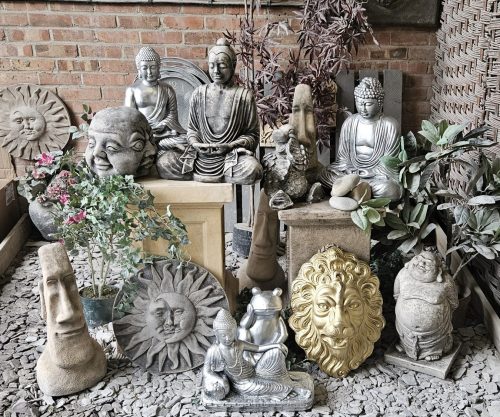
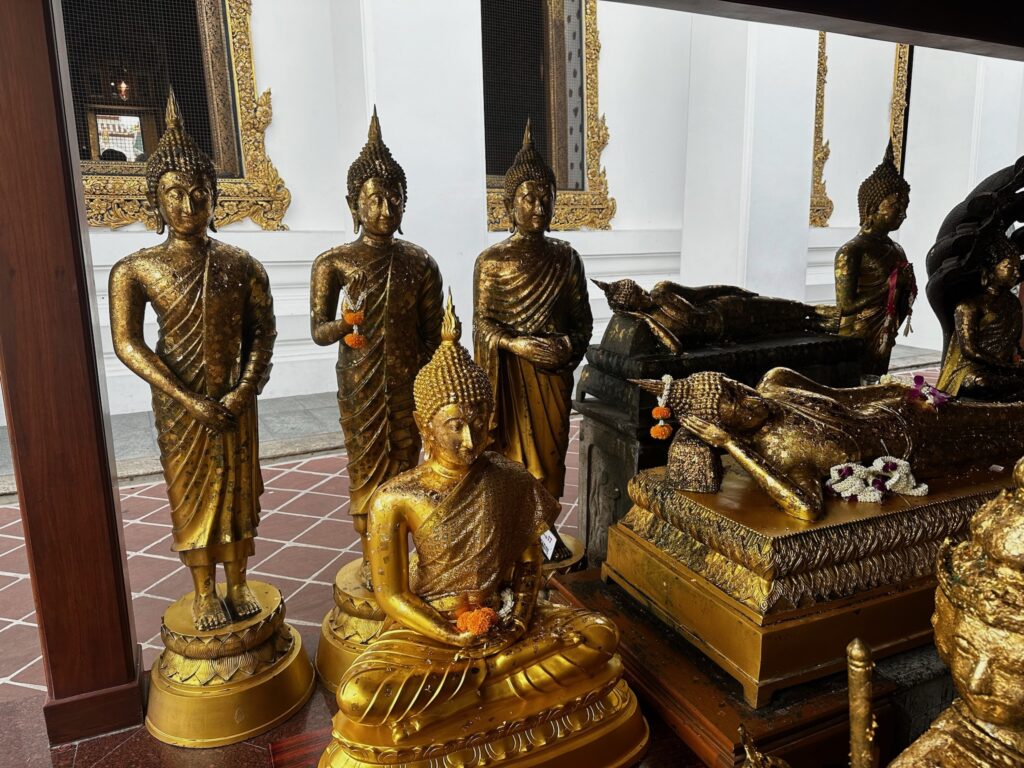
Traditional representations of the Buddha depict him in variations of three poses – standing, lying or seated. All Buddhist cultures – from Thailand to Tibet to Japan and China – have a rich iconography. The images of Buddhas are replete with meaning. Different elements of the Buddha image, such as the way in which the hands are represented, often have a symbolic meaning.1
I have never come across, either in my travels or in illustrations of Buddhist art, an image of just the Buddha’s head. I think that there are three possible explanations, other than aesthetic appeal, why the head of the Buddha is popular in Western representations:
- There is a tradition in both western painting and sculpture that depicts the head and shoulder of a person. This emphasises the idea that the head , as the location of the brain, is considered the most significant part of the human body.
- Early Western ideas of Buddhism tended to emphasise meditation and suggested that Buddhism was inherently a world denying tradition. Consequently, Western preconceptions often exaggerate the significance of stilling the mind and therefore the head is regarded as preeminent, and the rest of the body is judged to be a distraction2.
- The representation of only the Buddha’s head represents the continuation of a colonial attitude. Bhumika Patel on her blog argues that:
The decapitation of the Buddha then becomes more than a symbol of appropriation – it becomes neo-colonialism that seeks to destroy a culture and religion while siphoning it of what is seen as valuable by the Anglophonic eye
Patel 2015
Causing Offence
Clearly Patel finds images of Buddha’s head offensive. The philosopher Joel Feinberg makes a distinction between ordinary offence and what he calls profound offence. Mundane offence might be, for example, being aggravated by someone jumping a queue. However, ‘profound offence strikes at a person’s core values and sense of self’ (Young and Brunk 2012: 5).
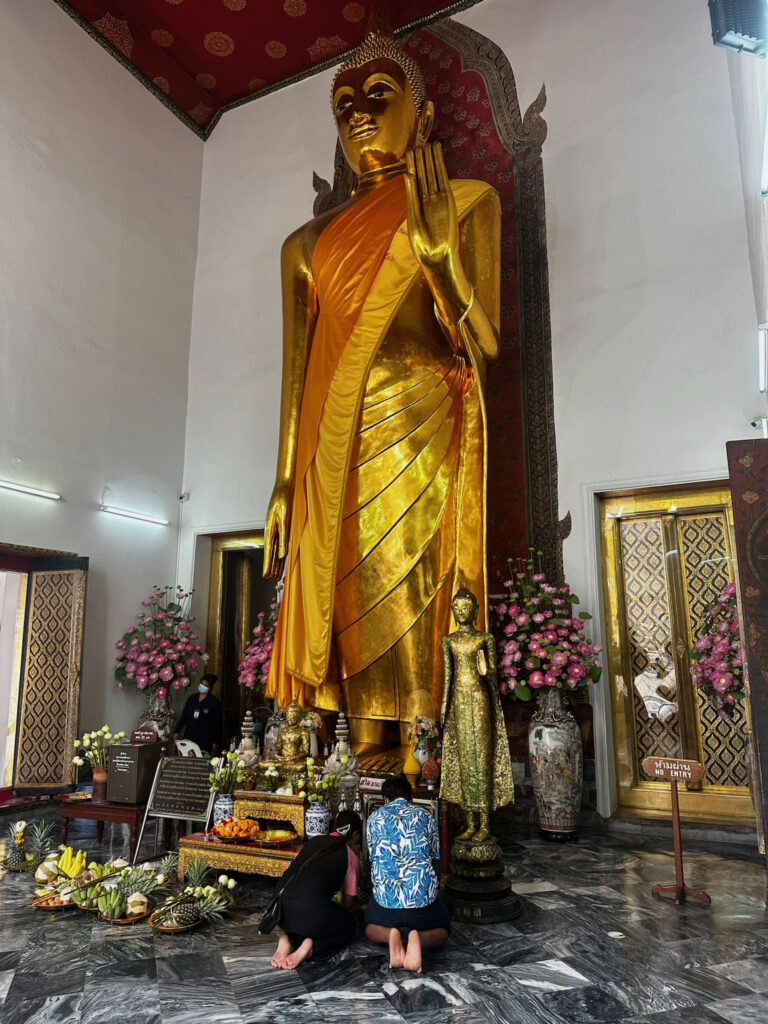
For Buddhists, Buddha images are the focus for meditation, devotion and ritual, and are not merely ornamental or decorative. Consequently, the Buddha image is deeply implicated with personal values and senses of self, and therefore appropriation risks the possibility of causing profound offence.
Whilst Patel is profoundly offended, many other Buddhists might be indifferent or only mildly offended by Buddha head garden ornaments. Cultural and religious groups are diverse, and consequently responses to cultural assimilation will be varied. If only a small handful of Buddhists find my garden ornament profoundly offensive, but the majority are not particularly disturbed by it, am I still ethically obliged to get respond to the outrage of a few?
The other issue that is relevant here is the distinction between ‘insiders’ and ‘outsiders’. Cultural appropriation involves members of one culture taking something that originates in a different cultural context.
The Kumazawa Brewing Company in Japan uses an image of a Buddha head on one of its beers. Is this less offensive, as Japan is predominantly a Buddhist culture, than my use of a Buddha head as a garden ornament?

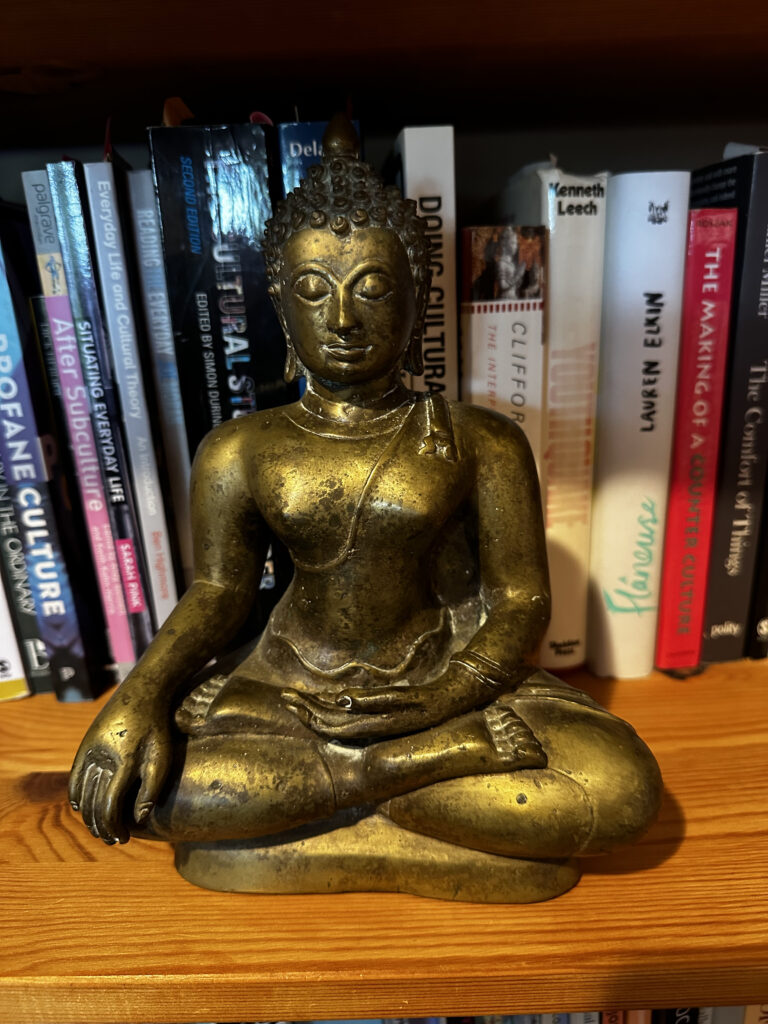
Context is also a significant aspect when considering cultural appropriation and the risk of causing profound offence. Obviously, Buddha images are appropriate in temples and shrines, but are less appropriate in other contexts. On my first trip to Thailand, when I was in my early twenties, I bought a small brass seated Buddha statue from a small shop outside a temple in Chiang Mai. It is not an antique, it was one of many in this shop and similar statues can be bought in other shops throughout Thailand. These shops, as Jocuns et al (2015), indicate are primarily for Buddhists and are not intended as gift shops for tourists. They observe that there are signs near many Buddhist temples that indicate “Buddha is not for decoration”; “Stop buying Buddha” (Jocuns et al 2015: 131)
I was informed by a local that it was not possible to take a Buddha image out of Thailand without an export licence. They indicated that the image of the Buddha is very significant for Thai people but did not have the same meaning for people from the West. Thai Buddhists are concerned that Westerners might not treat these images with the requisite respect, for example placing Buddha images in bathrooms. As I did not want this statue to be confiscated when leaving Thailand, I spent a few days getting the export licence. At customs at Bangkok airport, I proudly showed my export licence to the officer, who looked rather bemused that I had gone to so much trouble for a relatively inexpensive statue that clearly was not an antique.
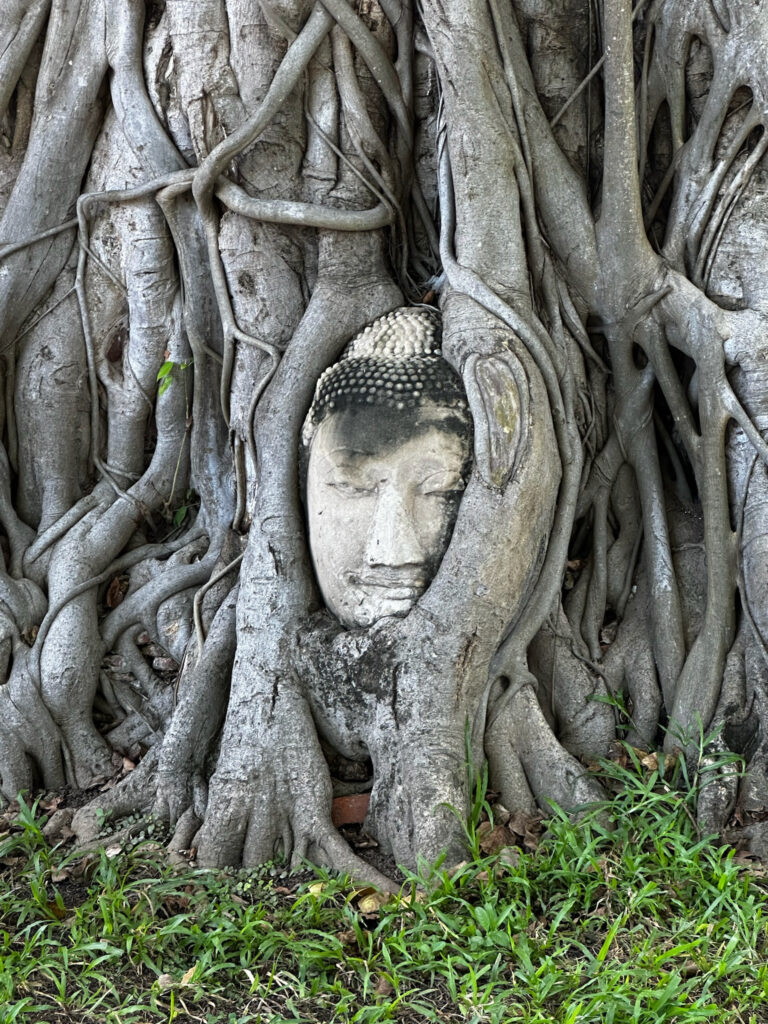
The other context that is significant is the placement of my Buddha’s head, which rests on the ground. The only time I have ever encountered images of the Buddha’s head separated from his body is in Ayutthaya the ancient Siamese capital not far from present day Bangkok. The city was sacked in the 18th century by the Burmese, who decapitated many of the Buddha images. Most of the Buddha heads have been moved from the site, however there is one particularly famous head that is almost totally encased in the roots of a banyan tree. Nearby is a sign that requests visitors “not to stand over the Buddha’s head”. Feet are regarded as being impure, and in both Hindu and Buddhist temples it is very important not to point one’s feet at images.
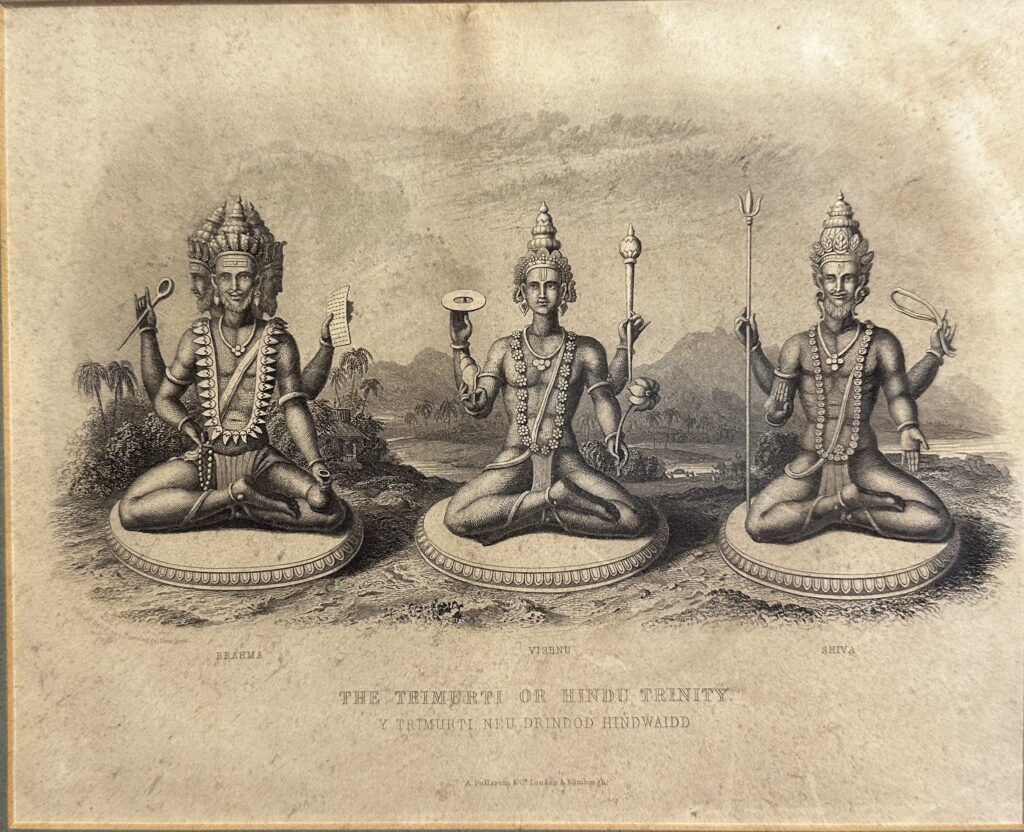
Iconographical accuracy is also a consideration when thinking about cultural appropriation. Inaccurate representations of Hindu and Buddhist iconography is clearly problematic.
However, in an interesting essay about how the lingerie company Victoria’s Secret produced a bikini with an image of the Buddha, which was iconographically accurate James Mark Shields speculates that the ‘verisimilitude of these images might be part of the problem’. Shields suggests that ‘“correct” images are more prone to being “defiled” by the way in which they are being reproduced and employed’(Shields 2011: 82). When several Buddhist groups objected, Victoria’s Secret did discontinue the line.3
Orientalism
Cultural appropriation is linked to what the Palestinian scholar Edward Said calls Orientalism. In this theory Said suggests that the world has been imaginatively divided into two regions, that he calls the Occident and the Orient – broadly this refers to the representation of the world that makes a distinction between European cultures4 and the rest of the world. The relationship between these regions, primarily because of the experience of colonialism, is not one of parity. Said argues:
The relationship between the Occident and Orient is a relationship of power, of domination, of varying degrees of a complex hegemony.
Said 1991: 5
Orientalism represents the rest of the world as the contrasting image to European cultures. For example, the British statesman Lord Cromer who served as the British Controller-General in Egypt in 1879 stated:
I content myself with noting the fact that somehow or other the Oriental generally acts speaks and thinks in a manner directly opposite to the European.
Said 1991: 39
This dichotomy frequently involved a value judgement – for example the essential nature of Europeans was often described in terms of being rational, virtuous, civilised and mature whereas the Oriental was essentially depicted as irrational, depraved, barbaric and childlike. The clearest example of this is the stereotyping of Muslims as barbaric, that can be identified not only in colonial representations of Islam, but also in contemporary Islamophobia.
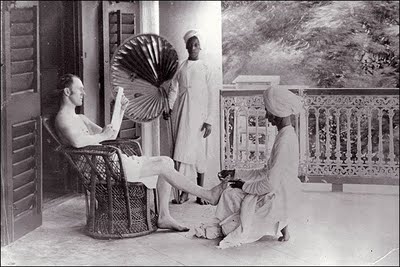
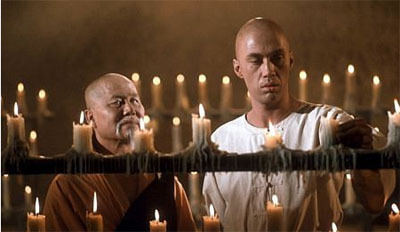
Image from Wikipedia
Whilst there is an orientalist discourse that is contemptuous of non-European cultures there is also what might be called a romantic orientalism, which finds something of value in oriental cultures. J. J. Clarke suggests that Eastern cultures have been regarded as:
A source of inspiration, fount of an ancient wisdom, a culturally rich civilisation which is far superior to, and can be used to reflect on the inadequacies of, our own.
Clarke 1997: 3
For example, in the popular 1970s TV show Kung Fu, the main character Kwia Chang Caine, who has had to flee from China to the USA. When confronted with a dilemma Caine remembers his time as a novice Shaolin monk. In these scenes Caine recalls the word of wisdom from his blind mentor Master Po, which are often Zen like sayings, that help Caine resolve his dilemma. Jane Naomi Iwamura argues that these representations of what she calls the ‘Oriental Monk’ are a form of Orientalist discourse:
In which the American imaginary once again re-created its Asian spiritual “other”
Iwamura 2011: 115
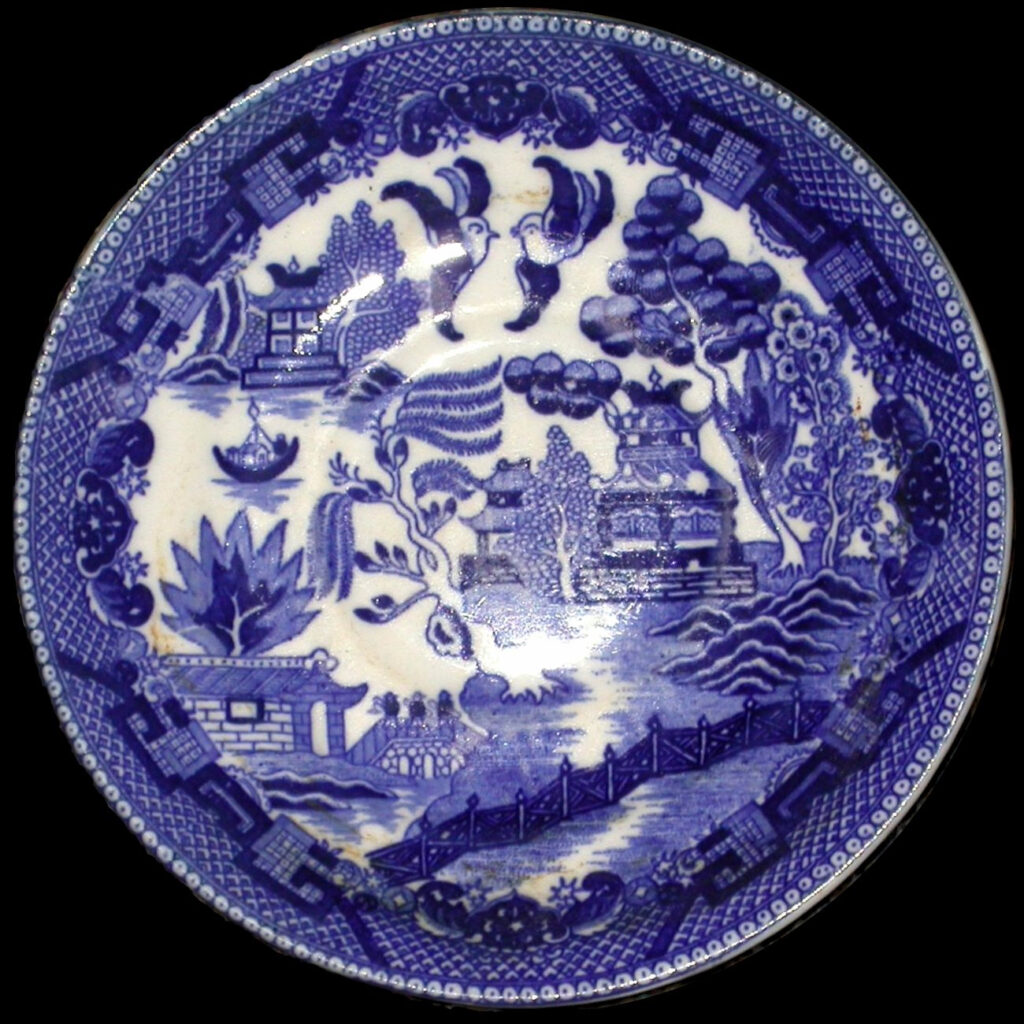
Europeans have looked to non-European art for inspiration. For example, there was a fashion for what is known as chinoiserie in the seventeenth and eighteenth century. This is a mode of European art that imitated and appropriated Chinese styles and motifs, perhaps best exemplified by willow patterns decoration on ceramics. Whilst inspired by Chinese designs willow pattern decoration is a European invention.
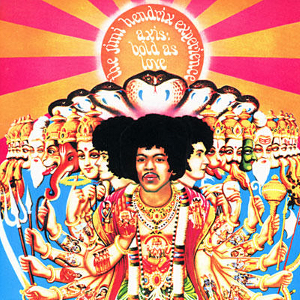
The influence of Indian art – both music and in the visual arts is perhaps most evident in the aesthetics of the counterculture. George Harrison’s incorporated the Hare Krishna Mantra in his song My Sweet Lord. The cover design to the album Axis Bold as Love by the Jimi Hendrix Experience, imposed the features of Hendrix and the other band members onto the Hindu image of Viśvarūpa.
Not only art, but ideas from Eastern cultures were also held an appeal to certain sectors of European society. From the 19th century onwards, many Europeans have been inspired by Buddhist ideas – this ranges from Theosophy to the current obsession with mindfulness. J.J Clarke suggests that this fascination with Buddhism is not ‘merely a “discovery” … [but is] in some respects a European construct shaped by European agendas’ (Clarke 1997: 80).
Orientalism is clearly implicated in the colonial project, and the colonised cultures were perceived to be a vast archive of ideas and artefacts to be appropriated. Nonetheless, I agree with J.J Clarke, that interest in other cultures is not always implicated in relationships of power and the assertion of European superiority. Interactions with different cultures can also ‘provide a conceptual framework that allows much fertile cross-referencing’ (Clarke 1997: 27). This cross-referencing enables a critical reflection of one’s own culture. When I returned from my first travels from India (see my post on Journeys to Exotic Places), I realised that I not only had learnt a great deal about Indian culture, but that I had also gained a deeper insight into my own culture.
Conclusion
We have always lived in a world where cultural interactions take place. For example, some of the earliest examples of anthropomorphic Buddha images seem to have been influenced by the art of classical Greece. However, we can identify different degrees of cultural acquisition.
- At the extreme end we have cultural theft. This tends to involve tangible objects that were looted in the colonial period, and can now be found in museums throughout Europe.
- Images and iconography has also inspired European art and decoration, such as Buddha image garden ornaments. This is not simply a one way process. For example, the 19th century artist Ravi Varma used Western art conventions to depict Hindu deities. (see my post on religious imagery in folk and popular art)
- Ideas have also been appropriated. For example, the idea of ‘mindfulness’ is clearly Buddhist in origin, but can now be found in Western therapeutic discourses.
What these cultural borrowings all have in common is that the context is different, and consequently the meaning of these objects and ideas are transformed. A Buddha image in a temple, in a museum and as a garden ornament all signify different things. The relocation from one cultural context to another is deeply implicated in questions of ownership and respect. To what extent can the Buddhist community be said to own the visual representations of the Buddha, and to what extent do Buddhists have the authority to determine how and where these images can be used?
Clearly, some uses of the Buddha image , such as the Buddha bikini are inappropriate and show a lack of understanding and respect for visual representations of the Buddha. Is my Buddha head flower pot appropriate? I think that, whilst this is a grey area, representations of just the Buddha’s head are not acceptable as they are not in accord with Buddhist ideas about Buddha images. Had I written this blog post and reflected more deeply before purchasing this Buddha ornament, I would not have bought it. My little bronze Buddha is perhaps more acceptable – as long as I keep it on my bookshelf and not in the bathroom.
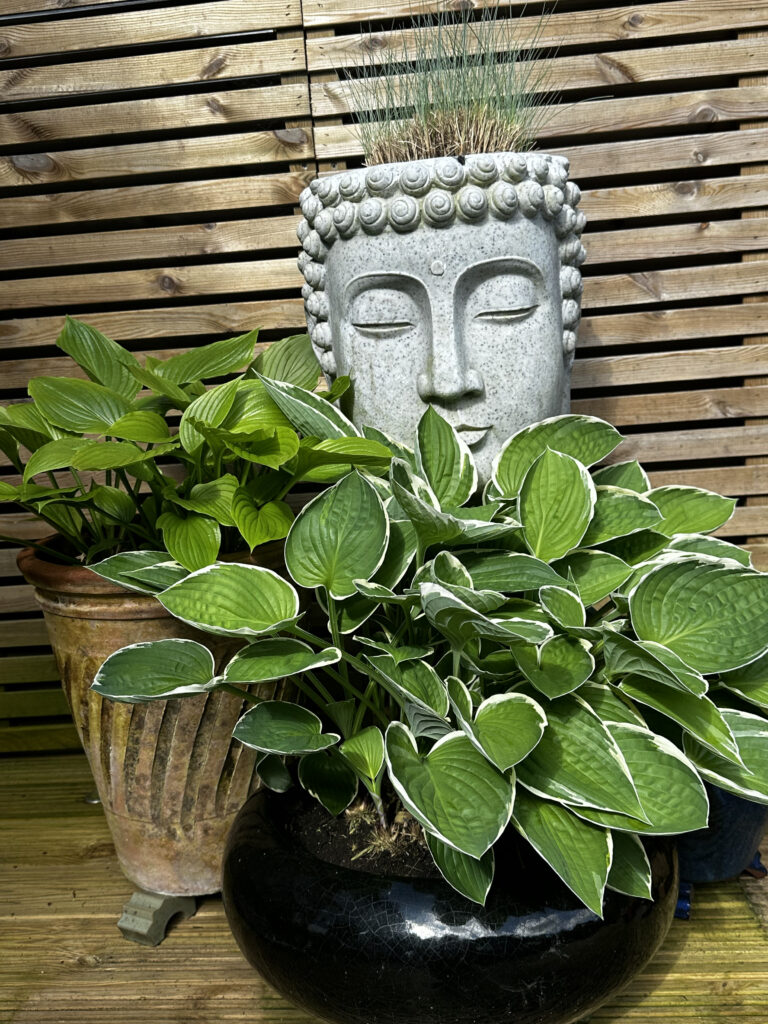
Is this more acceptable, now that I have raised my Buddha’s head plant pot off the ground?
If it is still unacceptable and has the potential to cause profound offence, should I somehow dispose of it?
If you have any ideas about this, I would be grateful for any comments.
Notes
- These symbolic hand gestures are called mudras. For example, the gesture that shows the Buddha holding his upraised right palm facing the viewer is called Abhaya Mudra – “approach without fear'”. ↩︎
- The identification of meditation with only the head is a misconception. The Buddha is said to have had 32 marks on the body to signify that he is fully awake. The image of the body as a whole is replete with meaning, not just the head. Sarah Shaw observes that the Buddha image ‘represents the fully awake mind and the potential the human body has for transformation and wisdom’ (Shaw 2021: 30) ↩︎
- For a discussion on the use of Hindu iconography on swimwear see Arya 2020 ↩︎
- This includes European derived cultures such as that of the USA. ↩︎
Sources
Arya, R. (2020) Debasing the Deity: The Material Culture of Hinduism. Religion and the Arts 24: 588–603.
Clarke, J.J. (1997) Oriental Enlightenment: The Encounter Between Asian and Western Thought. London: Routledge.
Jocuns,A., de Saint-Georges, I., Chonmahatrakul, N. & Angkapanichkit, J. (2015) Please Do Not Stand Over the Buddha’s
Head (Pay Respect): Mediations of Tourist and Researcher Experience in Thailand. Language, Cultures, Mediation 2.
Iwamura, J.N. (2011) Virtual Orientalism: Asian Religions and American Popular Culture. Oxford: Oxford University Press.
Kawamura, Y. & de Jong, J.W.M. (2021) Cultural Appropriation in Fashion and Entertainment. London: Bloomsbury.
Patel, B (2015) The Decapitation of the Buddha. Available at: https://wellnessbybhumika.com/blog/decapitation-of-the-
buddha.
Said, E. (1991) Orientalism: Western Concepts of the Orient. London: Penguin.
Shaw,S. (2021) What is the Place of Images in Buddhism. In Buddhism in Five Minutes, Harris, E.J. (ed.) Sheffield: Equinox.
Shields, J.M. (2011) Sexuality, Blasphemy and Iconoclasm in the Media Age: The Strange Case of the Buddha Bikini. In Mazur, E.M. & McCarthy, K. (eds.) God in the Details: American Religion in Popular Culture. London: Routledge.
Young, J.O. & Brunk, C.G. (2012) Introduction in Young & Brunk (eds.) The Ethics of Cultural Appropriation. Oxford: Wiley
Blackwell.

As a gardener and a practising Buddhist, I have to stop myself from asking my clients to not put the image of enlightenment on the floor near dirt and feet, nor as a doorstop, reminding myself that these garden furniture items are not consecrated or viewed as meditation tools, never mind the Hindu Buddhist view that a statue / murti is imbued with Buddhahood / godhead and that darshan/ gazing on the eyes of the divine brings positive energy/spiritual nourishment. Aum Shakyamuni hung 🙏🏼
My good friend Penny posted this response on my FB page.
In the Thai Forest lineage it seems OK to use images of the Buddha’s head or face. But Buddha images are treated with respect, not used for utilitarian purposes and generally placed well off the ground. People often stoop or duck down to keep their head below the image . What you have in your own garden is up to you, but many Buddhist s might well feel that using the image to promote something for sale, especially alcohol ,would be very inappropriate. I guess non Buddhists like the image as at represents being at peace……so personally I am happy for non Buddhists to have the image but would prefer not to see it on a beer label… or a cocktail bar (in Lanzarote)
My good friend Geoff, who is a composer, musician and senior lecturer in music commented on my FB page:
The religious aspect complicates things but I have dealt quite a bit with the issue of cultural appropriation in the music field. The bottom line for me is know what you are using, research it, understand it, don’t use stuff inappropriately (e.g. a hymn or song divorced from its very serious subject matter). Otherwise? Go ahead, with care and attention.
But I have an issue with Coutts-Smith’s definition:
‘Whenever a dominant group steals or borrows icons, ideas, or other beliefs from a weaker group without understanding the cultural significance.’
Appropriation is not a pejorative term. It means to take something and make it one’s own. Borrowing suggests somehow you will give it back which makes little sense if you have just quoted music from a different culture so really, it is all appropriation. The colloquial and euphemistic use of appropriate to mean ‘steal’ confuses the issue. He also elides borrow and steal which mean totally different things so are not comparable. And who decides what is the weaker group? Weaker in what context and on what / whose terms?
Interesting you quote James O’ Young as in another article he defends cultural appropriation as long as it is done knowingly and with understanding. He also makes some strong arguments about the problematic relationship between ethnicity and art production (Young, J.O. (2006). Art, authenticity and appropriation. Frontiers of Philosophy in China, 1(3), 455 – 476.)