Introduction
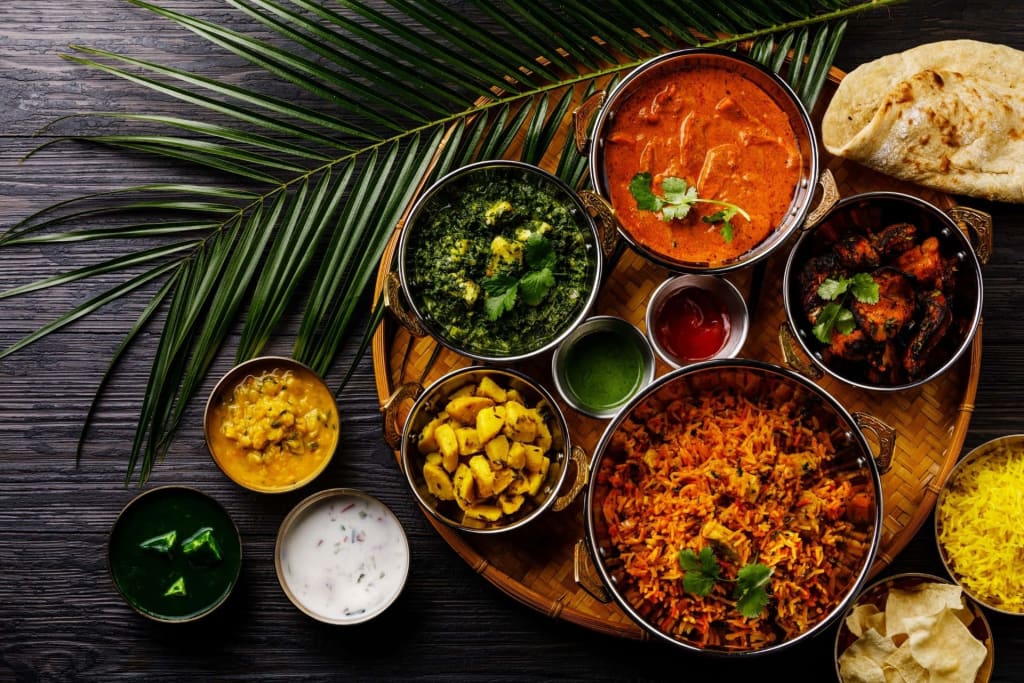
In my last post I discussed the environmental and ethical reasons for adopting a vegetarian diet. In this post, I will look at religious reasons for excluding meat from one’s diet. All religions have prescriptions and prohibitions about food. However, whilst Christians, Muslims might incidentally be vegetarian, it is often assumed that the Indian traditions definitively proscribe eating meat. By the Indian Traditions I include Buddhism, Hinduism, Jainism and Sikhism, as these traditions all started in India. However, none of these traditions unequivocally prescribe a vegetarian diet. In this post, I will primarily focus on the Hindu traditions.
The Vedic Period
Whilst it is true that many Hindus are vegetarian today, and almost all eschew eating beef, this has not always been the case. Although some aspects of the Hindu traditions might possibly have originated in the Indus Valley Civilisation (c 2,500 – 1,700 BCE), it is generally accepted that its roots can be traced back to the Vedic period. The dates of this period are much contested, but the Vedic period roughly lasts from 1,500 to 500 BCE. The period is named after a vast corpus of compositions known as the Vedas – a Sanskrit word meaning ‘knowledge’. Most Hindus, even if they do not know much about the content of the Vedas, acknowledge these compositions as foundational.
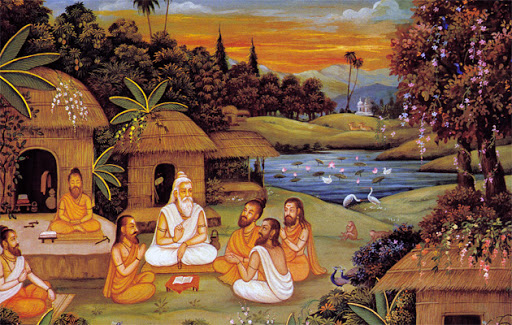
As there is about a millennium between the earliest compositions and the more recent parts of the Vedas, considerable differences can be identified in both the religious life and foodways in these texts.
What we can say is that food was an element of the religious life of the Vedic period. In one of the later parts of the Vedic corpus it suggests that food is integral to creation.
From food, verily creatures are produced
Taitreya Upanishad cited in Sen 2015: 51
Whatsoever creatures dwell on the earth.
Moreover, by food, in truth, they live
Moreover, into it also they finally pass
For truly, food is the chief of beings
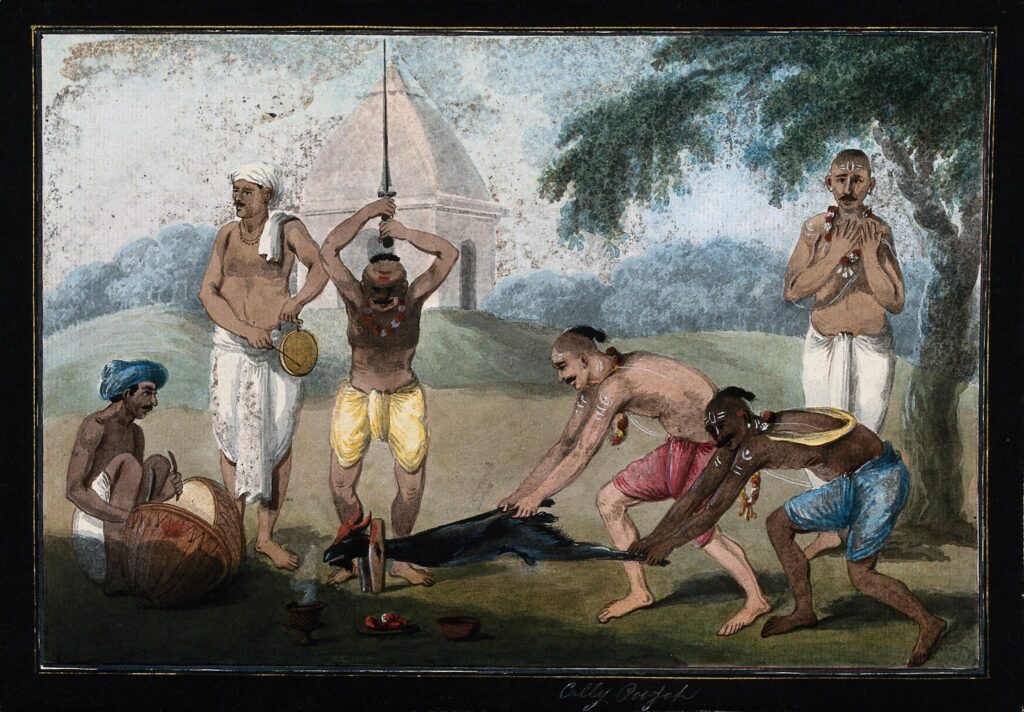
Image from Wikipedia

Ritual sacrifice was the central element of the Vedic religion, and this often involved killing animals. K.T. Achaya indicates:
No less than 250 animals are referred to in the Vedas, and 50 of these were deemed fit for sacrifice, and by inference eating.
Achaya 1994: 53
Whilst it is apparent that meat from ritual sacrifice was both offered to the deities and consumed by people, it is less clear whether animals were butchered purely for consumption.
In a later text The Laws of Manu1 (henceforth I will simply refer to this text as Manu) there is a comprehensive list of forbidden foods, for example mushrooms, garlic and onions are proscribed. Some types of meat such as carnivorous birds and wild animals are also regarded as taboo, but some types of meats are permitted.
In a much-cited passage from Manu it suggests that:
Everything moving and stationary is the food of the breath of life.
Those that do not move are food for those that move,
and those that have no fangs are food for those with fangs;
Those that have no hands are food for those with hands ….
The eater who eats creatures with the breath of life who are to be eaten does nothing bad even if he does it day after day; for the Ordainer himself created creatures with the breath of life, some to be eaten and some to be eaters.
Manu 5: 28–30
In other words, Manu suggests that it is natural for humans to consume meat.
There are two qualifications to Manu’s permission to eat certain types of meat.
- Dietary prescriptions and proscriptions only apply to the higher caste Hindus
- Meat consumption is restricted to animals ritually slaughtered.
Eating meat is (right) for the sacrifice:
This is traditionally known as a rule of the gods.
But doing so on occasions other than this is said to be the rule of ogres
Manu 5:31.
Varṇa
Dietary prescriptions and proscriptions in Manu only apply to ‘the twice born’. There is a hierarchical division that classifies Hindu society into four distinct castes (varṇa).2 ‘Twice born’ refers to the three highest castes.
- Brahmins – the priests, who study the Vedas and officiate the rituals
- Kṣatriyas – the warriors who protect society
- Vaiśyas – the merchants who create wealth.
4. Śūdras – labourers who serve.
Below, these four castes are those who are regarded as being outside caste, who undertake tasks, such as laundry that are considered ritually polluting. These socially excluded groups are now generally referred to as dalits. It is obvious that The Laws of Manu is a Brahminical text, and the restrictions of food rules exclude śūdras and dalits.
In about the 6th to 5th century BCE attitudes toward both the Vedic ritual and the sacrifice of animals changes. However, before discussing this paradigm shift, I will briefly discuss the significance of cows in the Hindu traditions.
Sacred Cows
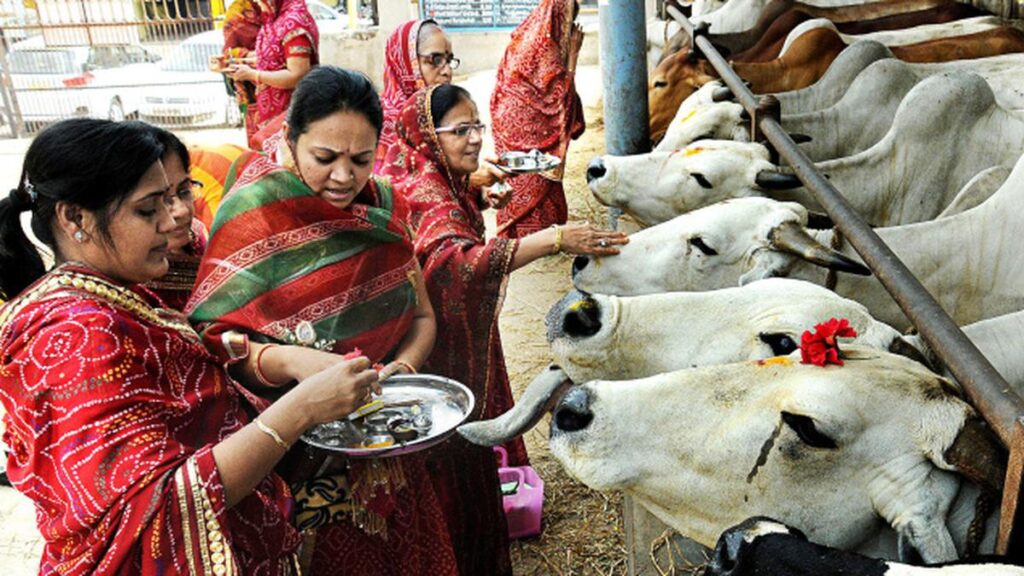
The early Vedic people were semi-nomadic pastoralists. The cow (Sankrit gau) is mentioned many times in the early parts of the Vedic compositions, and cows were regarded as valuable possessions and indicators of status. This has led to the contention that cows were venerated from this very early period. For example, S.M Batra indicates that various passages of the Vedas ‘equate cows with God’ and ‘cows were held in great veneration’ (Batra 1986:165). However, in his controversial book The Myth of the Holy Cow, D.N. Jhaargues that the sanctity of the cow cannot be traced back to the Vedas (Jah 2002: ix). Whilst cows were indicators of wealth and status in the Vedic society, it is clear from the Vedas that cows were also ritually sacrificed. Jha suggests that offering guests beef was also a common practice: ‘killing of the kine to honour guests seems to have been prevalent from early times’ (Jha 2002: 33)
Cows have always played a special place in the Hindu traditions. Perhaps, most noticeably in the iconography and narratives of the important deity Kṛṣṇa, who is represented as a cowherd and protector of cattle. However, it is not really until the 19th century that veneration of cattle becomes a significant feature of the Hindu traditions. There was a growing perception of the sacredness of cows in the context of escalating tensions between Hindus and Muslims in the colonial period.
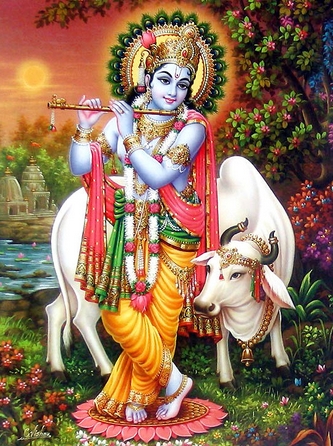
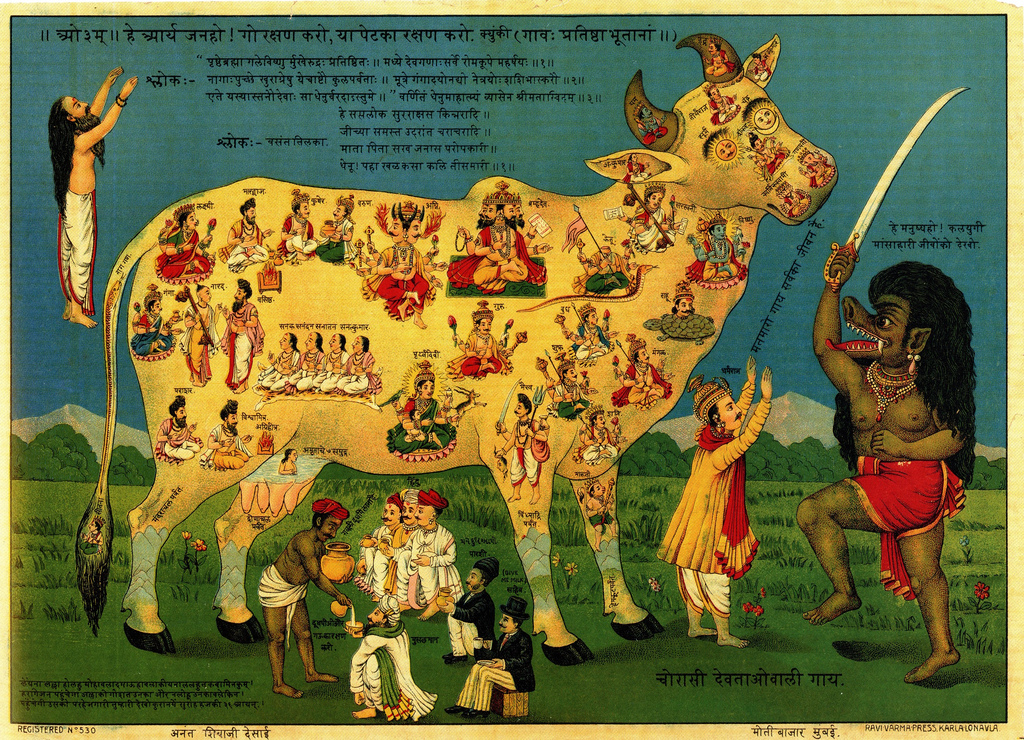
In the late 19th century the cow came to symbolise Hindu identity and the idea of a Hindu nation. The important Hindu reformer Swami Dayananda Saraswati (1824 – 1883) founded a cow protection society (Garaukshini Sabha) in 1881. He suggested that ‘during the rule of the Aryans, no slaughter was allowed of cows’ (cited in Gundimeda & Ashwin 2018: 158)
The symbolic discourse that linked the cow to Hindu identity contributed to the reification of the distinction between Muslims and Hindus. Muslims were represented as foreign invaders who threatened the sanctity of the Hindu nation because they killed cows and ate beef. This often led to outbreaks of communal violence. Article 48 of the Indian Constitution prohibits the slaughter of cows.
All Change: The Renouncer Traditions
The renouncer traditions include Buddhism and Jainism, which develop outside of the Vedic culture, and also developments within the Vedic mileu, which can be identified in the latter part of the Vedas known as the Upaniṣads.
If in the Vedic era animals were ritually sacrificed and twice born Hindus ate meat, what changed? Animals are still occasionally sacrificed. For example, at the Kali temple Kalighat in Kolkata, goats are sacrificed daily. However, ritual killing of animals is no longer a significant part of the Hindu tradition.
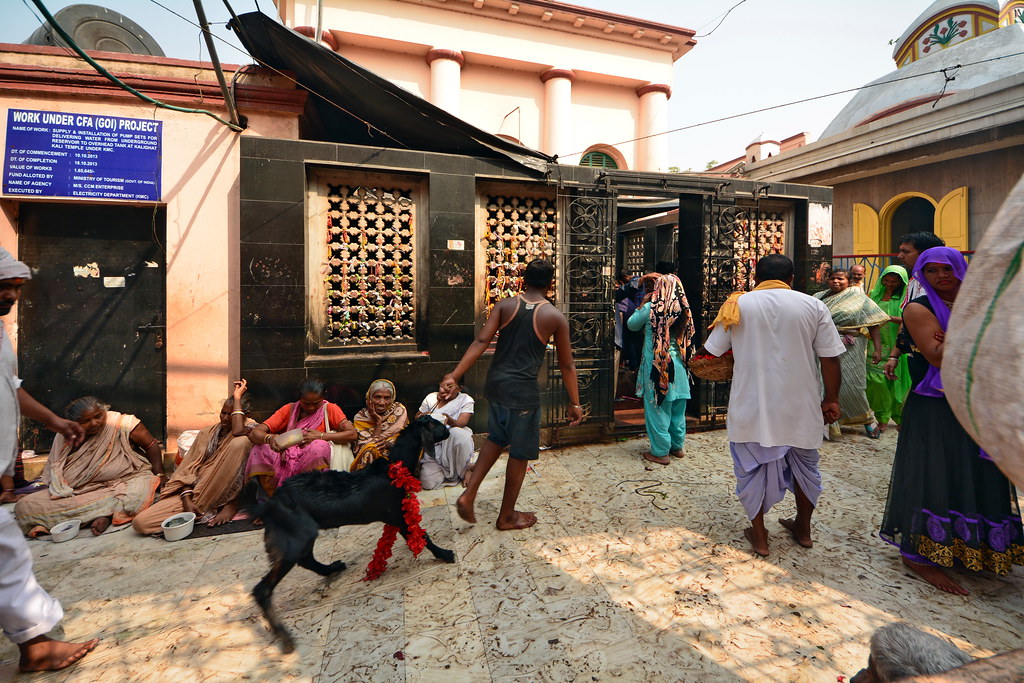
Image from Flikr
Attitudes towards killing animals and eating meat changed around the 6th to 5th centuries BCE. Indian society underwent some significant changes in this period. There was increased urbanisation, development of roads, the first use of money, and the emergence of political states. In this new context the complex Vedic rituals and the monopoly of brahmins on religious life seemed anachronistic, and new religious ideas began to emerge.
Several interconnected ideas, that were very different to the earlier Vedic metaphysical perception of the cosmos, developed during this era. Whilst it is impossible to precisely pinpoint the origins of these ideas, they did become increasingly prevalent in this period. These new ideas had a direct impact on attitudes towards sacrificing animals and eating meat. These interconnected concepts included:
- Saṁsāra – the belief in a cycle of life, death and rebirth.
- Karma – the idea that one’s present life has been determined by the actions of previous lives, and that one’s actions will impact on future lives.
- Mokṣa – the view that the ultimate goal of life is to escape the wheel of transmigration.
Variations on these ideas can be found in Buddhism and Jainism, both religious traditions that originated in this period. These traditions are often referred to as heterodox, as they do not consider the Vedas as a source of authority. Both were founded by kṣatriyas and challenged the religious hegemony of the brahmins. However, even within the Vedic purview, one can identify these concepts, particularly in the latter sections of the Vedic corpus, known as the Upaniṣads.
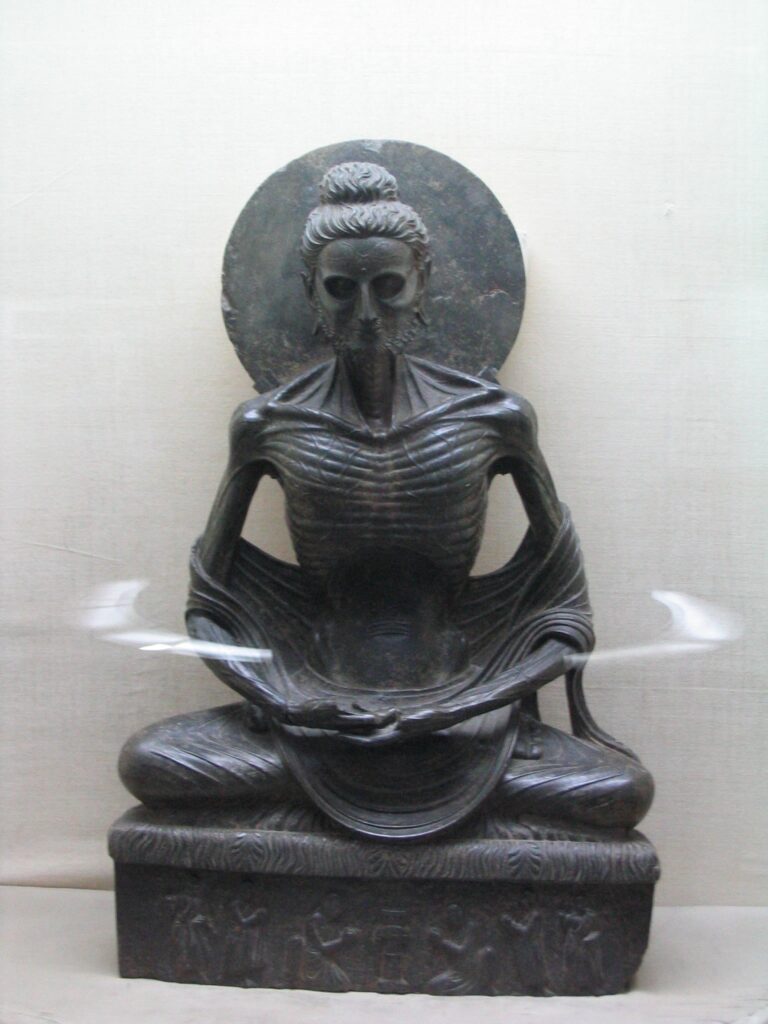

These traditions are sometimes referred to as the renouncer traditions. In this worldview the corporeal world was regarded as inherently unsatisfactory and it was thought necessary to renounce worldly desires to escape the cycle of transmigration.
Initially, the orthodox Vedic tradition incorporated the idea of renunciation into a scheme that suggested a fourfold division of life – the student, the householder, the forest dweller and at the end of life one should renounce the material world and become an ascetic. During this last phase of life Manu suggests that the renouncer:
Should eat vegetables that grow on the land or in water, flowers, roots, and fruits.
He should not eat honey, meat, mushrooms or vegetables that grow in the ground.
Manu 6 : 13–14 in Doniger 1991.
However, renunciation in the Hindu traditions is not now necessarily restricted to the last years of life
Ahiṃsā
One important concept associated with the renouncer worldview was ahiṃsā, which means non-violence. It is unclear where this idea originated. Christopher Key Chappel (1993) conjectures that the concept originated with Jainism3 and possibly can be traced back to the Indus Valley Civilisation. However, what is significant is that, in the classical period (circa 8th century BCE – 1,000 CE) nonviolence becomes an increasingly significant concept within the Hindu traditions.
The concept of ahiṃsa suggests that any violent action will accrue bad karma and therefore is a major factor in perpetuating the cycle of life, death and rebirth. Violence in this life will accrue bad karma and therefore have a deleterious impact on future births. Furthermore, as transmigration includes the possibility of being reborn as an animal, there is a danger that by eating meat you might effectively be consuming one of your ancestors or a deceased relative. It was also suggested that if you killed and ate meat it would accrue karma that would entail that you would be reborn as that animal. There is a well-known Buddhist tale of a goat who is being led to a temple by a brahmin to be ritually sacrificed. Much to his surprise, the goat speaks and tells the brahmin:
500 births ago I was a Brahman, leading a goat to the sacrifice. After killing the goat, I was condemned to 500 births as a goat. If you kill me, you will suffer the same fate. (cited in Chapple 1993:24)
Ahiṃsā is applied not only to humans, but also to non-human beings. The sage Vyāsa defined ahiṃsa as ‘the absence of injuriousness towards all living beings’ (cited in Chapple 1993:17). Gradually many of the twice born castes adopted a vegetarian diet, and meat eating became associated with sūdras, dalits and non-Hindus, particularly Muslims.
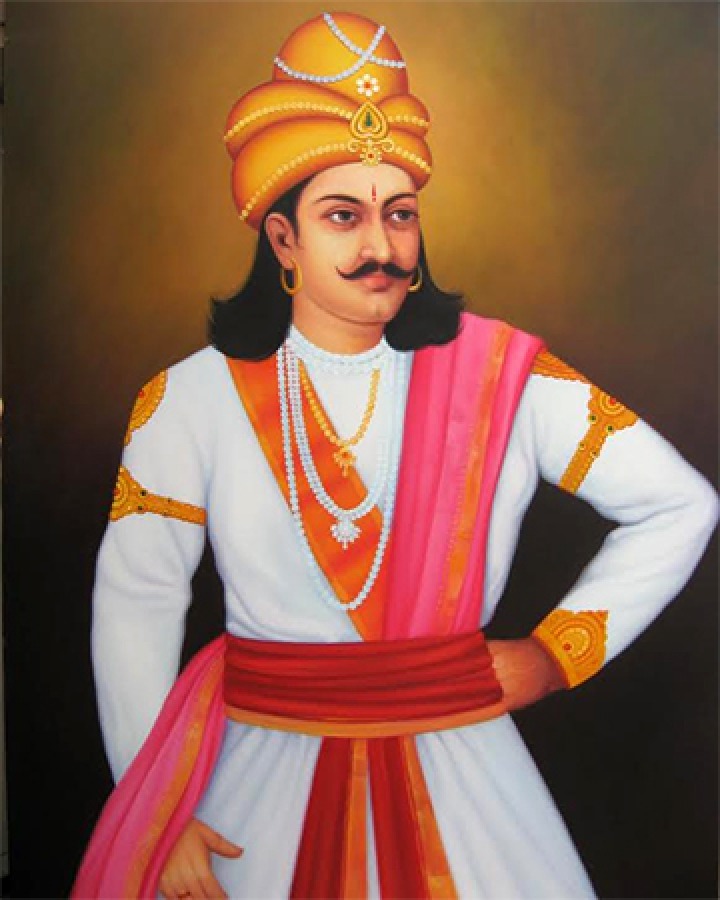
Emperor Aśoka (274–232 BCE)
Perhaps it was the Emperor Aśoka who did more than anyone to normalise vegetarianism in India. The legend of Aśoka suggests that he was so appalled with the slaughter of battle that he converted to Buddhism, became a pacifist and passed laws that demanded better treatment of animals. A much-cited rock inscription from the time of Aśoka states:
Formerly, in the kitchen of the Beloved of the gods, King Pryadarśin (Emperor Aśoka), many hundred thousand of animals were killed everyday for the sake of curry. But now when this Dharma-rescript is written, only three animals are being killed (every day) for the sake of curry (viz) two peacocks (and) one deer (and) the deer again, not always. Even these three animals shall not be killed in the future. (cited in Chapple 1993: 25)
Whilst this inscription indicates that Aśoka and his court were not exclusively vegetarian, it does however represent a paradigm shift in attitudes towards animals and eating meat.
Food and the Yoga Traditions
Whilst it is difficult to precisely identify the origins of yoga, it probably began within the renouncer traditions but is gradually incorporated into the Vedic milieu. There are two significant aspects to understanding yoga:
- Yoga is not simply a physical practice but is a philosophy. It is sometimes classified as one of the six schools of orthodox Hindu philosophy.
- There are many different forms and types of yoga, and consequently there are diverse attitudes towards eating meat.
In the most influential treatise on yoga the Yoga Sūtras of Patañjali, ahiṃsā is an important concept. Patañjali suggests that:
In the presence of one who is established in nonviolence (ahiṃsā), enmity is abandoned
(Yoga Sūtras 2:35 in Bryant 2011: 45).
Another important idea that develops within the yoga traditions is the concept of sattva, that can be translated as ‘balance/harmony’. The importance of ahiṃsa is that it helps the yogi develop a sattvic mind. According to yoga philosophy matter is comprised of three qualities – known as the guṇas:
- Sattva – light, harmony, balance
- Rajas – activity, passion
- Tamas – inertia, ignorance.
Mind is considered to be matter. Consequently, Mircea Eliade summarising yoga psychology states:
When sattva predominates, consciousness [mind] is calm clear, comprehensible, virtuous; dominated by rajas, it is agitated, uncertain, unstable; overwhelmed by tamas, it is dark confused, passionate, bestial (cited in Jacobs 2019).
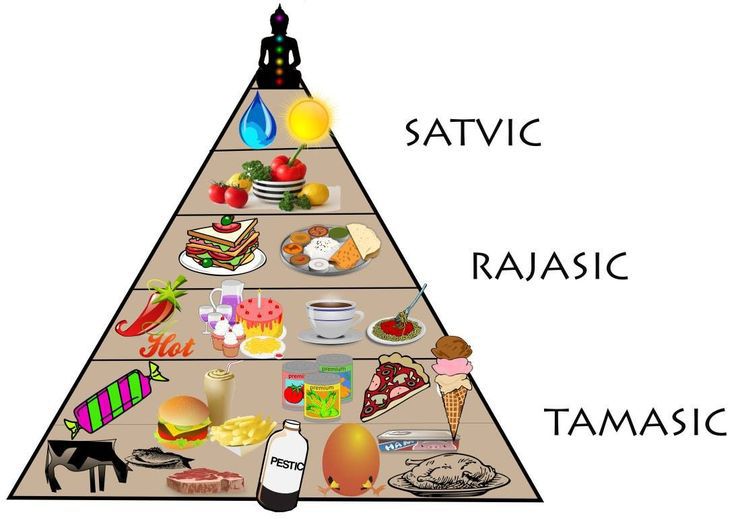
Yoga suggests that it is only through developing a sattvic mind that the yogi escape the wheel of transmigration. The yogi primarily achieves a sattvic mind through various meditation techniques. However, food is also categorised as being sattvic, rajasic or tamasic, and consequently what one eats can have a direct impact on one’s state of mind. Therefore, many forms of yoga prescribe a sattvic diet. This excludes meat, which is considered as rajasic; onions and garlic, also considered to be rajasic; and mushrooms which are classified as being tamasic. The contemporary guru Sri Sri Ravi Shankar who founded the important global meditation movement the Art of Living Foundation stated:
Rajasic food creates restlessness in the body and too many desires and ambitions come out. Then you go yo-yo—either you become very happy or you go right down.
Sattvic food brings equanimity, happiness, creativity, a sense of serenity and calmness (cited in Jacobs 2019)
Both the concepts of ahiṃsa and sattva are referred to by many Hindus as rationale for avoiding meat.
Vegetarianism and the Hindu Traditions Today.
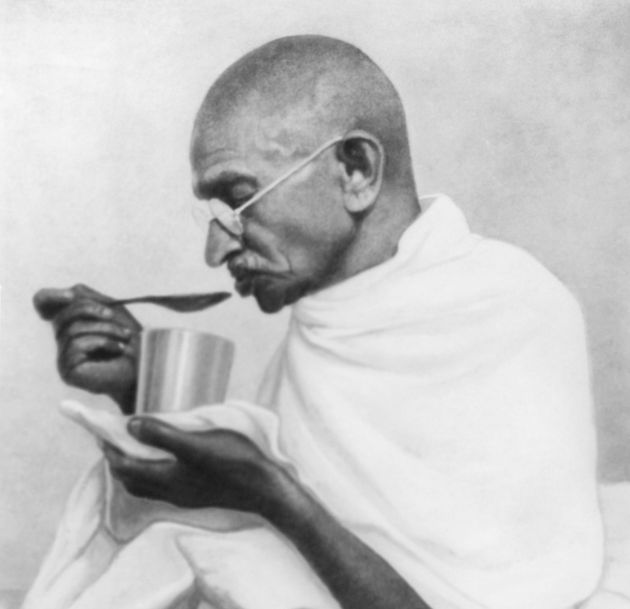
Whilst many contemporary Hindu gurus like Sri Sri Ravi Shankar (See Jacobs 2015 & Jacobs 2019) advocate a vegetarian diet to their followers, it is Mahatma Gandhi that epitomised the centrality of vegetarianism for Hindus. Gandhi’s family, particularly his mother, were devout Hindus and maintained a vegetarian household. However, in his autobiography Gandhi recounts that he was persuaded to eat meat by one of his friends. However, he states that deceiving his parents made him deeply uncomfortable and ‘I abjured meat out of the purity of my desire not to lie to my parents’ (Gandhi 1982: 37). However, as he develops his ideas, particularly around the concept of ahiṃsa, vegetarianism became an integral aspect of his lifestyle, politics and moral philosophy. As Parama Roy observes:
Vegetarian dietetics was to constitute Gandhi’s earliest and perhaps most sustained mode of public performance (Roy 2022: 71)
Whilst many Hindus are vegetarian and maintain that nor eating meat, especially beef, is integral to Hinduism, this is by no means universal. In a 2021 Pew Research Centre Report, it indicated that only 44% of Hindus identify as vegetarian. Although a further 29% abstain from eating meat on certain days and avoid certain meat (Corichi,2021).4
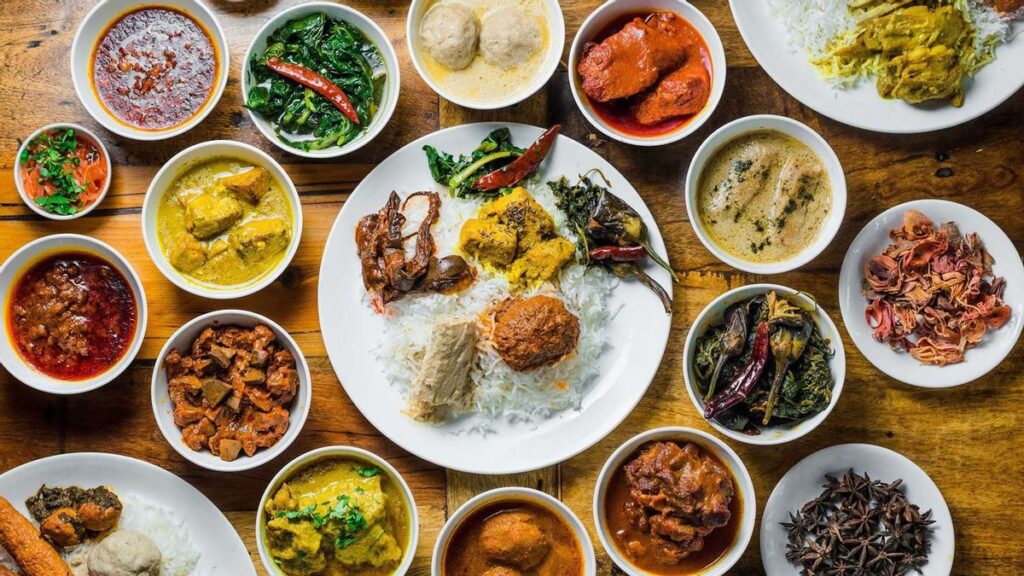
Image from Zeezest
In her memoir on growing up in a Hindu household in Kashmir, Sudha Koul recalls a sumptuous banquet that included ‘a tray of shoulder lamb chops cooked in milk, saffron and herbs, then deep-fried in clarified butter (Koul 2004: 43). She also states that some Muslim homes near a Hindu temple ‘have always been vegetarian’ (Koul 2004: 47). Whilst it is fairly common for Kashmiri Hindus to eat meat, it is much less likely in other states such as Gujarat.
Vegetarianism is an important aspect of Hindu nationalism espoused by current Indian prime minister Narendra Modi and the government of the Bharat Janata Party(BJP).
Johan Fischer observes:
Even if statistics in India show that most Hindus eat meat, the national ideology that India is, or should be, a vegetarian nation is promoted and upheld (Fischer 2019: 3)
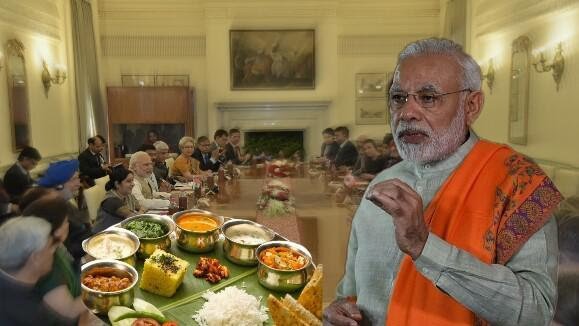
There are three factors that in recent times that have also had an impact on dietary choices in India.
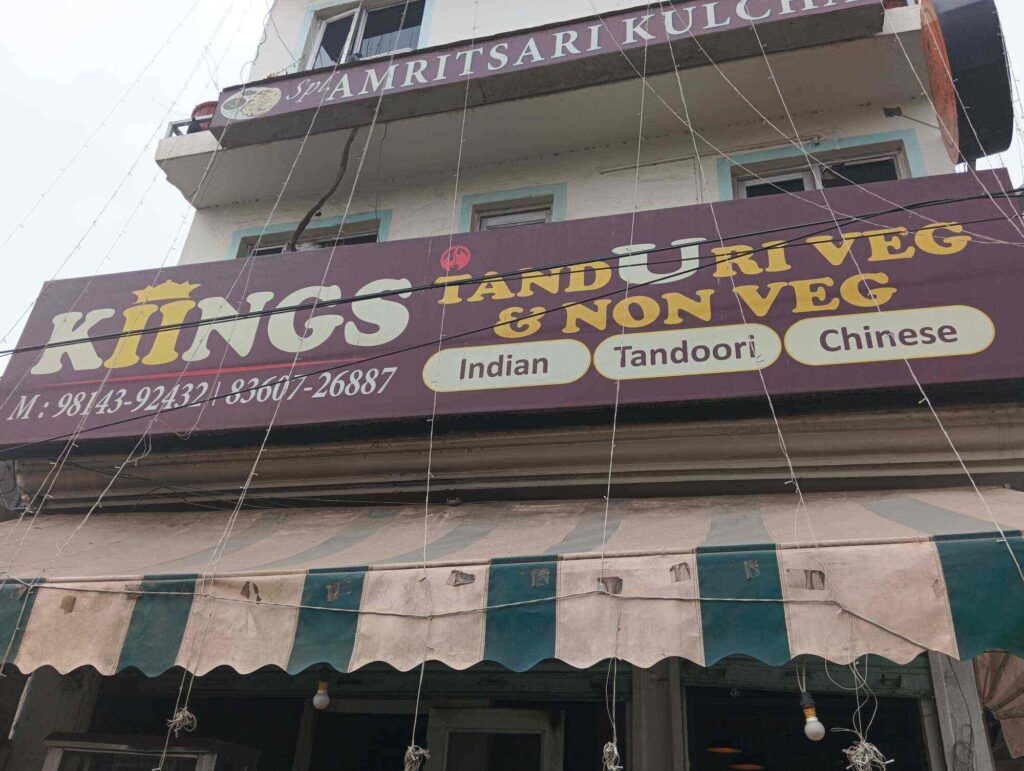
- The rise of the middle classes. Since the liberalisation of the Indian economy in 1991, there has been a rise in what has been called ‘the middle classes’ in India. Whilst it is very difficult to define this class, it does indicate that there is a growing segment of the population with a reasonable disposable income who can afford to eat meat. For example there has been a noticeable increase in the consumption of chicken in recent years in India.
- Eating out. Restaurants and various places to eat out have proliferated in India. R.S Khare notes ‘a modern restaurant represents a total refutation of the entire orthodox and jati commensal rules’ (cited in Sen 2015:277). Eating out also gives more opportunities to consume ‘non-veg’ meals.
- Awareness of environmental and health issues. There is a growing awareness amongst Hindus in both India and the diaspora of the health and environmental consequences of high meat consumption. This has the potential to encourage Hindus to reassess the traditional vegetarian foodways.
There are multiple reasons that Hindus will avoid eating meat – health, ethical, financial, environmental, habit as well as religious. In her fascinating study of attitudes towards vegetarianism amongst young British Hindus Eleanor Nesbitt observes:
Young Hindus are caught in the interplay of influences at work on society as a whole. Young Hindus’ attitudes towards vegetarianism may combine a traditional family norm with the contemporary western concern with animal rights (Nesbitt 1999 :419)
Consequently, there is no simple answer to the question of whether Hindus are vegetarian. It is important to take into account a wide range of factors such as time period, caste, region, generation and so on.
- As with all Hindu texts, it is very difficult to accurately date Manu, but it is known that it was regarded as an important source of authority in the early centuries of the Common Era ↩︎
- The term ‘caste’ derives from a Portuguese word, and is not a good translation of the Hindu concept of varṇa. However, as it is still widely used I will continue to use the term ‘caste’. There is also another system of social classification known as jāti. This is a taxonomy not only of human beings, but includes animals and celestial beings. (see Jacobs 2010: 58–61). In Indian society the jāti system was in origin probably linked to occupation and locality. It is estimated that there are approximately 3,000 jātis. These social groups are endogamous and commensal. In other words, one should only marry and share food with members of one’s own jāti.To some extent the jātis are mapped onto the fourfold division of society, but there is no universal agreement as to which jātis belong to which varṇa. ↩︎
- The concept of ahiṃsā is particularly significant in the Jain traditions. The centrality of ahimṣā in Jainism is linked to the Jain understanding of karma, which is viewed as a substance that adheres to the soul (jīva). Karma, which perpetuates the cycle of transmigration, can be expunged through the practice of ahiṃsā. Furthermore, Jains consider that all living beings have souls, and consequently it is incumbent on Jains to actively avoid harming any living being. Consequently, most Jains not only adopt a vegetarian diet, but they might also sweep the road ahead of them to avoid inadvertently stepping on any insect.
↩︎ - In the Pew Report 8% of Muslims; 10% of Christians ; 59% of Sikhs; 25% of Buddghists and 92% of Jains identified as vegetarian. ↩︎
Sources
Batra, S.M. (1986) The Sacredness of the Cow in India. Social Compass 33 (2–3)
Bryant, E. (2011) Ahimsa in the Patanjali Yoga Tradition. In Steven, J. Rosen (ed.) Food for the Soul: Vegetarianism and Yoga
Traditions. Santa Barbara Ca: Praeger.
Chapple, C.K. (1993) Nonviolence to Animals, Earth and Self in Asian Traditions. Albany: State University of New York Press.
Corici, M. (2021). Eight-in-Ten Indians Limit meat in their Diets, and four-in-ten consider themselves vegetarian. Pew
Research Centre. Available at https://www.pewresearch.org/short-reads/2021/07/08/eight-in-ten-indians-limit-meat-in-
their-diets-and-four-in-ten-consider-themselves-vegetarian/
Doniger, W. (Trans) (1991) The Laws of Manu. London: Penguin.
Fischer, J. (2019) Veg or Non-Veg? From Bazaars to Hypermarkets in India. International Journal of Asia Pacific Studies,
15(1): pp 1–32.
Gandhi, M.K. (1982) An Autobiography: The Story of My Experiments with Truth. London: Penguin.
Gundimeda, S. & Ashwin V.S (2018) Cow Protection in India: From Secularising to Legitimating Debates. South Asia
Research 38(2) pp.156–176
Jacobs, S. (2010) Hinduism Today. London: Continuum.
Jacobs, S. (2015) The Art of Living Foundation: Spirituality and Wellbeing in the Global Context. Farnham Ashgate.
Jacobs, S. (2019) A Life in Balance: Sattvic Food and the Art of Living Foundation. Religions 10(2). Available at
https://www.mdpi.com/2077-1444/10/1/2
Jha, D.N. (2002) The Myth of the Holy Cow. London: Verso.
Koul, S. (2004) Flesh in the Valley. In Niljanana, S. Roy. A Matter of Taste: The Penguin Book of Indian Writing on Food.
Gurugram: Penguin (India)
Nesbitt, E (1999) Being Religious Shows in Your Food: Young British Hindus and Vegetarianism. In Rukmani T.S. (ed)
Hindu Diaspora: Global Perspectives. Montreal: Concordia University.
Roy, P (2002) Meat Eating, Masculinity and Renunciation in India: A Gandhian Grammar of Diet. Gender and History 14(1)
pp. 62–91.
Sen, C.T. (2015) Feasts and Fasts: A History of Foods in India. London: Reaktion Books.