Introduction
In a previous post I have mentioned three major approaches to understanding the relationship between humans and other beings. These are:
- Anthropocentricism suggests that humans are superior to all other beings. This perspective is epitomised by the ideas of Descartes. Many have argued that the inherently anthropocentric nature of Western cultures is the underlying cause of the environmental catastrophe that we all face.
- Biocentrism argues that we have to include other non-human beings into our ethical considerations. This perspective is characterised by the realisation that not only humans, but some animals can experience pain and suffering, and there is an ethical imperative to prevent cruelty towards animals. Biocentrism is epitomised by the ideas of Peter Singer.
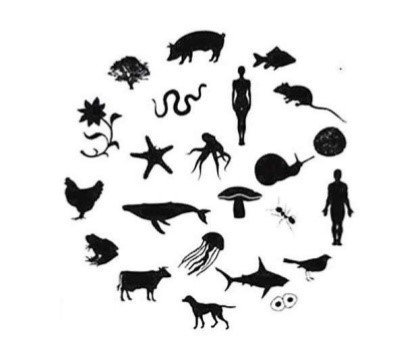
As I mentioned in my previous post, one of the major issues with this approach is that it is difficult to assess where the boundary lies between those beings that suffer and those that do not. Furthermore, whilst a biocentric approach has undoubtedly done much to prevent animal cruelty, it does not fundamentally address the environmental catastrophe. - Ecocentrism is the view that our ethical responsibility should not simply be directed towards discrete beings but towards the system of interconnections between all beings.
Ecocentrism can be defined as:
A picture of reality … in which there are no absolute discrete entities and no absolute dividing lines between the living and the non-living, the animate and the inanimate, or the human and nonhuman (R. Eckersley quoted in Dobson 2002: 78).
Ecocentrism argues that the natural world itself has moral standing. This perspective is most commonly associated with Aldo Leopold (1887 –1948) and the Deep Ecology movement. However, before discussing these, it is necessary to briefly address what is meant by ecology and ecosystems.
Ecology
Ecology can be understood in three interacting ways:
- Scientifically ecology is the meticulous analysis of the interactions between living organisms and their environment.
- Politically ecology manifests in the development of the various green political parties.
- Culturally ecology is a world view that emphasises the interconnectedness of all beings. Jaboury Ghazoul observes ecology has pervaded spirituality and the arts and has ‘become the motivational driver of modern lifestyle choices’ (Ghazoul 2020:3).
There are three significant and interdependent aspects to ecological thinking:
- All organisms from the microscopic to apex predators and humans interact with each other, with other species and the environment.
- Ecology adopts a holistic approach. The term holism was first coined by Jan Smuts in his book Holism and Evolution, published in 1926. Smuts defined holism as the ‘fundamental factor operative towards the creation of wholes in the universe’. Smuts goes on to observe that holism is characterised by a unity of parts, and the whole is more than the sum of its parts. Furthermore ‘the whole and the parts therefore reciprocally influence and determine each other … The whole is in the parts and the parts are in the whole’ (Smuts 1926: p.86).
- All aspects of an ecological system are interdependent and are held in balance. Any change in a single part will have an impact on all other elements, the environment and the system as a whole.
It has been suggested that we have now entered an ecological age. The eco-theologian Thomas Berry argues:
Presently we are entering another historical period, one that might be designated as the ecological age. I use the term ecological in its primary meaning as the relation of an organism to its environment, but also as an indication of all the living and non-living systems of the earth (Berry 2015: 41–2)
Think Like a Mountain
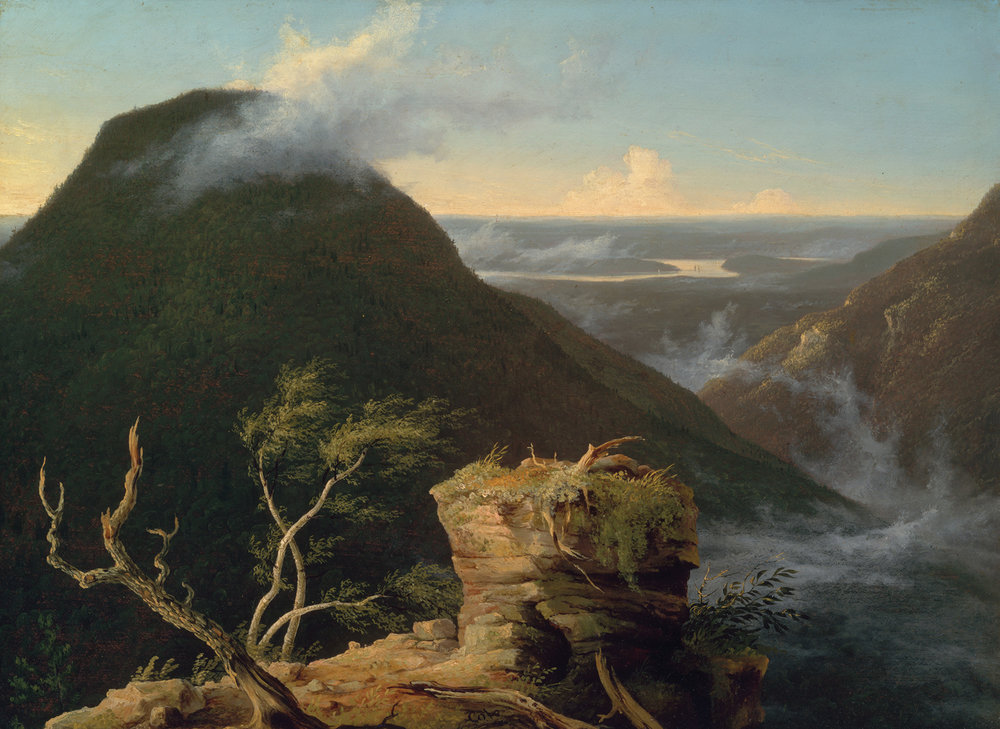
Image from Artist Network
Perhaps the most important and earliest thinker in the West to consider the interrelationships between organisms and their wider environment was Aldo Leopold (1887–1948), a conservationist who worked for the US Forestry Service.
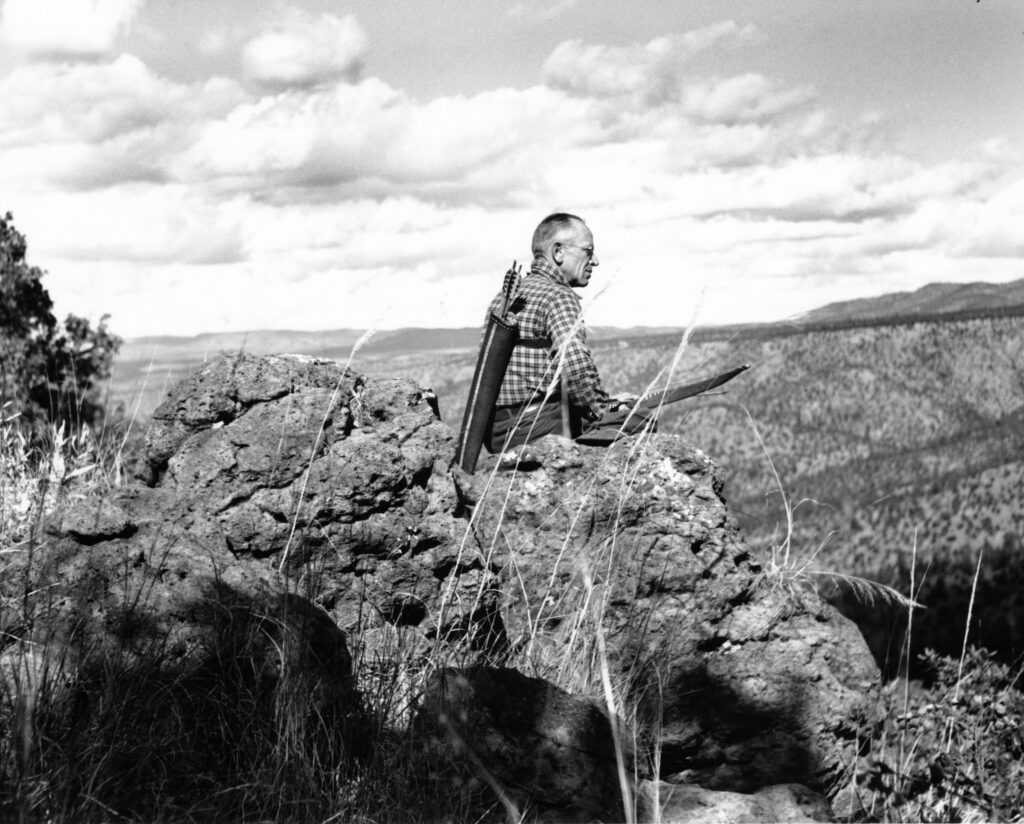
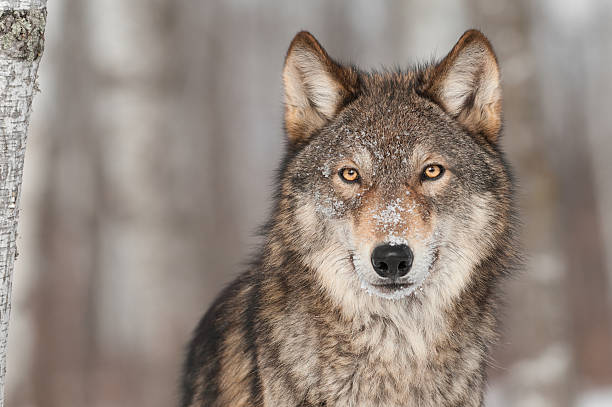
‘Think Like a Mountain’ was the title of an essay that Leopold wrote in 1944. In this essay he reflects on his earlier life when he had been a keen hunter of wolves. His younger self believed that eradicating wolves would protect the deer population of the mountains of Arizona and New Mexico. However, gradually he came to change this view.
In this essay Leopold reflects that this change of heart was motivated by two interrelated factors.
- Leopold recalled that having shot a wolf ‘we reached the old wolf in time to watch a fierce green fire dying in her eyes’. By watching this wolf die he realised the ethical implication of taking the life of a sentient being.
- Leopold also came to the realisation that exterminating wolves was not good for the general environment as it meant that the deer had no predator. Consequently, the deer population increased and this led to over grazing.
I have seen every edible bush and seedling browsed, first to anaemic desuetude and then to death … In the end the starved bones of the hoped-for deer herd, dead of its own too-much, bleach with the bones of the dead sage.
I now suspect that just as a deer herd lives in mortal fear of its wolves, so does the mountain live in mortal fear of its deer.
(Leopold 2020: 98)
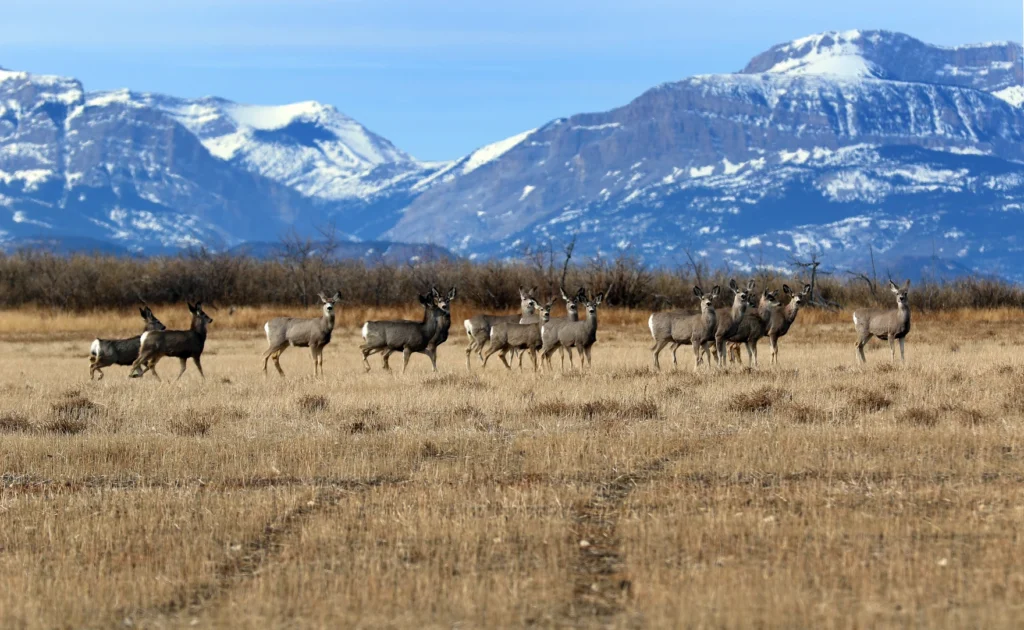
Implicit in Leopold’s call to ‘think like a mountain’ is a move from a biocentric ethic to an ecocentric ethic. This ecocentric perspective acknowledges the interdependence of all beings on the mountain, which includes the sage bushes, deer, wolves and the mountain itself.
Whilst Leopold’s ideas are implicit in his essay ‘Think Like a Mountain’ he is far more explicit in his most famous essay ‘The Land Ethic’ published in 1949.
There is as yet no ethic dealing with man’s relation to the land and to the animal and plants which grow upon it.
All ethics so far evolved rest upon a single premise: that the individual is a member of a community of interdependent parts.
The land ethic simply enlarges the boundaries of the community to include soils, waters, plants and animals, or collectively: the land.
Leopold 2020: 156–157
Leopold calls this extended community the biotic community. This can be defined as all the organisms – animal, plant and the landscape that are mutually sustaining. Leopold argues that we have an ethical responsibility for the biotic community as a whole.
A thing is right when it tends to preserve the integrity, stability, and beauty of the biotic community. It is wrong when it tends otherwise
(Leopold 2020: 172).
Leopold argues that we have an ethical responsibility for the health and wellbeing of the biotic community and asserts that humans are citizen of this biotic community, and not the conqueror of land.
Deep Ecology
Another perspective that promotes an ecocentricism is deep ecology. The term ‘deep ecology’ was coined by the Norwegian philosopher and mountaineer Arne Næss (1912–2009).
Næss makes a distinction between what he calls shallow and deep ecology. Shallow ecology, Næss argues, is only concerned with the ‘fight against pollution and resource depletion’ (Næss 1995: 3). This concern with pollution and resources fails to address the root causes of the environmental crisis.
Næss argues that an ‘ecosophy’, which he defines as a ‘philosophy of ecological harmony’, is crucial to address the root causes of environmental crises (Næss 1995: 8). Næss also distinguishes between the deep ecology movement, which is both diverse and shares common beliefs and his own specific ecosophy, which he calls Ecosophy T, the T standing for Tvergastein – his mountain hut in Norway.

The Apron Diagram
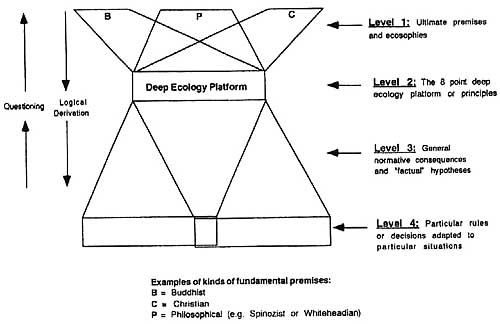

To illustrate the diversity and unity of the deep ecology movement Næss developed what he called The Apron Diagram. This diagram illustrates the relationship between the premises and conclusions of the deep ecology movement.
There are four levels to this diagram:
- The first level indicates the premises that underly a deep ecological perspective. These premises are diverse and are informed by different religious or philosophical perspectives.
- The second level are the common characteristics of the deep ecology movement. Næss calls these shared ideas ‘Platform Principles’.
- The third level are the general consequences and ideas that emerge from from the commonly held platform principles. However, because the root philosophical/religious premises are diverse, these general ideas are varied.
- The fourth level of the Apron Diagram are the various lifestyle decisions made on the best ways to address the environmental crises.
Næss explains that the foundational premises for a deep ecology might for example be derived from either a Christian worldview (C in the Apron Diagram), a Buddhist perspective (B) or philosophical concepts (P) However, they would share the Platform Principles, but because the underlying premises are divergent, the Christian deep ecologist, Buddhist deep ecologist and the deep ecologist inspired by the philosopher Spinoza interpret these shared principles differently and this therefore leads to different lifestyle choices and decisions.
The Platform Principles
Næss suggests that there are eight Platform Principles that are shared by all deep ecologists, irrespective of diverse philosophical or religious premises.
- The well-being and flourishing of human and non-human Life on Earth have value in themselves. These values are independent of the usefulness of the non-human world for human purposes.
- Richness and diversity of life forms contribute to these values and are also values in themselves.
- Humans have no right to reduce this richness and diversity except to satisfy vital needs.
- The flourishing of human life and cultures is compatible with a substantial decrease in human population. The flourishing of nonhuman life requires such a decrease.
- Present interference with the nonhuman world is excessive, and the situation is worsening.
- Policies must therefore be changed.
- The ideological change is mainly that of appreciating life quality … rather than adhering to an increasingly higher standard of living.
- Those who subscribe to the forgoing points have an obligation directly or indirectly to try and implement the necessary changes.
Næss and Sessions emphasise that ‘Life’ includes not only plant and animal life, but also habitats, such as rivers and mountains. Furthermore, all ‘Life’ has intrinsic value, and no being should be regarded as having greater value than any other being. However, this is counter intuitive. Should malaria carrying anopheles mosquitos be regarded as having equal value to higher primates or humans?
Næss and Sessions try and pre-empt this criticism in the third principle when they suggest that humans have no right to reduce the diversity of ‘Life’ except to satisfy ‘vital needs’. It could be argued that destroying the anopheles mosquito through the use of insecticides will eliminate one of the deadliest diseases for humans and is therefore vital for the flourishing of human life. On the other hand, it is possible to assert that the use of insecticides denies mosquitos, which have intrinsic value, the right to life. Leaving aside the potential toxicity of insecticide to the environment, annihilating the anopheles mosquito could be regarded as excessive interference with the non-human world and potentially upsets the balance of the biotic community.


Perhaps the greatest dilemma is stated in the fourth principle, which addresses the issue of the exponential increase in the human population. Not only is over-population detrimental to human flourishing but also has a devastating effect on biodiversity. A UN report from 2019 indicates that around a million species of plants and animals are threatened with extinction in the next few decades unless some action is taken (UN 2019). Much of this threat to biodiversity is caused by human activity such as pollution and the climate emergency. However, one of the greatest threats to biodiversity is the loss of habitats caused by the needs of an ever-expanding human population. Whilst it is now widely acknowledged that human over-population on our planet is a major problem there is no simple solution.
The Platform Principles also clearly indicate that there needs to be an ideological shift from the valorisation of economic growth to other ways of assessing human flourishing. To address the environmental crises that we all face there is an imperative for political, economic, cultural, institutional and ideological change. However, we also have to take personal responsibility. In many ways Næss’s ecosophy focuses on the necessity for individual action, as he regards what he calls self-realisation as essential to addressing the environmental crises caused by human activity.
Self-Realisation and The Ecological Self
The underlying premise of Næss’s Ecosophy T is the idea of self-realisation and what he calls the ecological self. He proposes that our sense of identity is determined by our relationships with others. My sense of self is social and determined by a complex set of relationships with others: I am son, husband, teacher, friend, and so on. The ecological self is an expansion of the social self. The ecological self identifies with all beings in the biotic community. Næss argues that not only will this extended sense of identity lead to an ethical concern for the environment and all beings in the biotic community, but will bring about a greater sense of joy and personal fulfilment.
Like Leopold, Næss was inspired by an encounter with another being, though in this instance it was not a wolf but a humble flea. Næss recollects a flea accidentally landing in the acidic chemical that he was looking at through a microscope. There was nothing that he could do to save the flea from its painful death. He claims that the flea’s dying moments were ‘dreadfully expressive’. Næss indicated that he felt more than simply empathy for the flea:
The empathy was not basic, it was the process of identification, that “I see myself in the flea” (Næss 1993: 14).
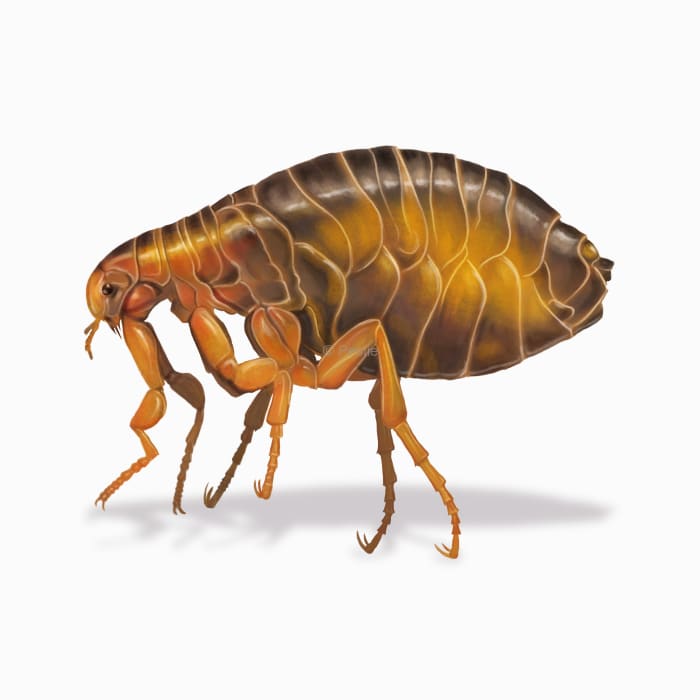
Self-realisation and the development of the ecological self enables us to feel compassion not only for non-human beings in the biotic community, but also for the environment itself. Næss concludes that through this identification people ‘may come to see their own interest served by conservation, through genuine self-love, love of a widened and deepened self’ (Næss 1993:17). The key terms here are ‘widened’ and ‘deepened’ as Næss has a very specific understanding of the ecological self which is inimical to the limited self-interest of egotistical individualism.

Næss draws on the Hindu concept of ātman, which is commonly translated as the ‘Self’, to distinguish it from the Judeo-Christian concept of the soul. Ātman refers to our deepest underlying being. In some Hindu texts ātman is said to be identical to Brahman – the fundamental ground of all existence, which for lack of a better translation might be termed Absolute Reality. An analogy that is often used to illustrate the relationship between ātman and Brahman is the relationship between the drop and the ocean. There is no fundamental difference between the drop (ātman) and the ocean (Brahman). Our sense of individuality separate from the cosmos is a misperception.
If we fully understand that there is no inherent difference between our ‘Self’ and Absolute Reality, then from the Hindu perspective we will be liberated from the wheel of transmigration. However, for Næss, this identification will give rise to the ecological self, and therefore we will act for the benefit of the whole biotic community and the environment that all beings inhabit, not out of a sense of duty but because we see ourselves in all other beings.
If your ‘self’ in the wide sense embraces another being, you need no moral exhortation to show care.
The requisite care flows naturally if the ‘self’ is widened and deepened so that protection of free Nature is felt and conceived as protection of ourselves.
Næss 1995 p.24 & 26.
Some of Næss’s language is distinctly religious. However, whilst Næss’s ideas were inspired by Hindu and Buddhist concepts, Deep Ecology- T is primarily a philosophy. Nonetheless, Naess’s ideas have have been very influential.. Perhaps one of the most interesting groups to be inspired by Deep Ecology is The Council of All Beings.
The Council of All Beings
The Council of All Beings was conceived by the Australian environmental activist John Seed and the American scholar of Buddhism and environmentalist Joanna Macy. Seed and Macey wanted to find ways to actually help break down the illusionary separation between our ourselves and the natural world and facilitate the experience of the ecological self.
Seed describes the Council of All Being as:
A form of group work which prepares and allows people to hear within themselves the sounds of the earth crying …. And to let other life forms speak through them. It is a form which permits us to experience consciously both the pain and the power of our interconnectedness with all life (Seed 2007, p.7).
The Council of All Beings is run as a workshop in which participants creatively imagine that they represent another being from the biotic community. This could be an animal, a plant, a river, a mountain. Joanna Macy and Pat Fleming describe this workshop as:
A natural and easy way to help people expand and express their awareness of the ecological trouble we are in, and to deepen their motivation to act (Fleming& Macy 2007, p.97).
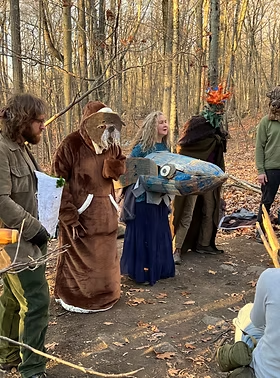
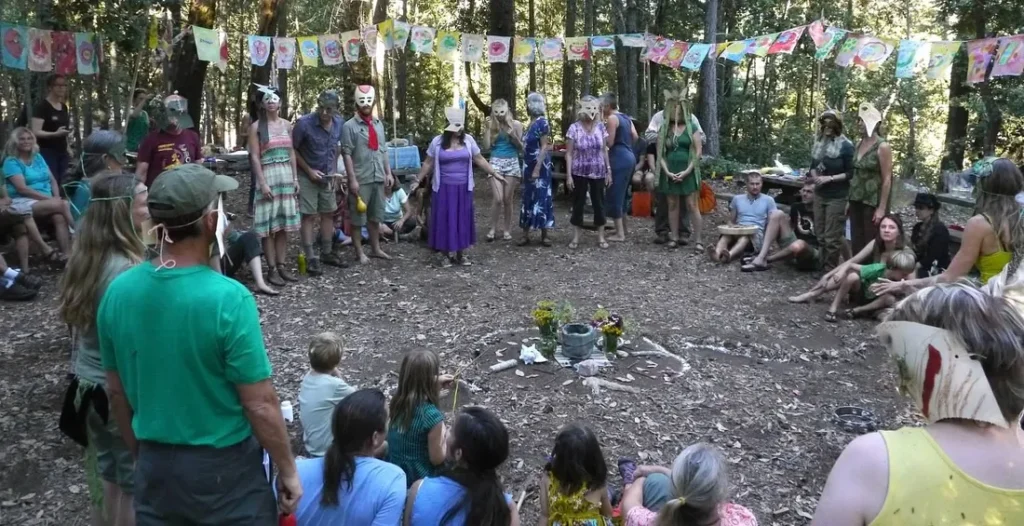
Joanna Macy describes a Council of All Beings ritual that she attended. Participants were first told to go off on their own and chose a particular life form. She describes how almost immediately she has a sense of identity with Mountain. Participants then made masks to represent their chosen being and called upon to introduce themselves to the other beings in the gathered Council. Macy as Mountain laments:
I am Mountain. I am ancient and strong and solid built to endure. But now I am being dynamited and mined, my forest skin is being torn off me, my top-soil washed away, my streams and rivers choked. (In Fleming and Macy 2007, p.85).
A small group of the participants removed their masks and entered the middle of the circle to listen silently as other participants articulate their concerns about the human destruction of the environment and the consequences of this destruction to the non-human beings in the biotic community.
Fleming and Macy assert that many participants experience:
A shift from the shrunken sense of self, to which our mainstream culture and institutions have conditioned us, to a larger, more ancient and resilient sense of our true ecological Self (2007,p.98-9).
Conclusion
Whilst in many ways a land ethic and deep ecology seem to be overly idealistic, we can utilise these ideas as a tool for thinking about how we should approach the ecological crises that all beings, human and others now face. We must consider how our ethical responsibilities can be extended to include not only those closest to us, but to all beings in the biotic community – both animate and inanimate. We must also understand that all life is intimately connected, and that any change to a single aspect of the biotic community has repercussions for all other beings. The flourishing of all beings has a direct impact on our own wellbeing.
Sources
Berry, T. (2015) The Dream of the Earth. Berkley: Counterpoint.
Dobson, B. (2002) Ideas and Actions in the Green Movement. London: Routledge.
Fleming, P. & Macy, J. (2007) The Council of All Beings. n Seed, J. Macy, J, Fleming, P & Næss, A. Think Like a Mountain:
Towards a Council of All Beings
Ghazoul, J. (2020) Ecology: A Very Short Introduction. Oxford: Oxford University Press.
Leopold, A. (2020) A Sand County Almanac and Sketches Here and There. London: Penguin. (First published in 1949).
Næss, A. (1995) The Shallow and the Deep: Long Range Ecology Movement: A Summary. In Drengson, A. & Inoue, Y. (eds)
The Deep Ecology Movement: An Introductory Anthology. Berkley: North Atlantic Books.
Næss, A. (1995) The Apron Diagram. In Drengson, A. & Inoue, Y. (eds) The Deep Ecology Movement: An Introductory
Anthology. Berkley: North Atlantic Books.
Næss, A. & Sessions, G. (1995). Platform Principles of the Deep Ecology Movement. In Drengson, A. & Inoue, Y. (eds) The
Deep Ecology Movement: An Introductory Anthology. Berkley: North Atlantic Books.
Seed, J. (2007) Introduction. In Seed, J. Macy, J, Fleming, P & Næss, A. Think Like a Mountain: Towards a Council of All Beings.
Smutt, J.C. (1926) Holism and Evolution. New York: Macmillan.
United Nations (2019) Nature’s Dangerous Decline. Available at
https://www.un.org/sustainabledevelopment/blog/2019/05/nature-decline-unprecedented-report.
Other sources
John Seed on Deep Ecology https://www.youtube.com/watch?v=27EfOZfEAG4.