Introduction
As I indicated in an earlier post, the environmental crisis faced by our planet is not merely a practical problem that requires a technological solution, it is also a philosophical problem. In this post I argue that the environmental crisis is inherently an ethical issue. Drawing on the work of Murray Bookchin (1921 –2006) I suggest that a sustainable society is an ethical society, and an ethical society is intrinsically environmentally sustainable.
It is sometimes suggested that human activity, particularly the unbridled pursuit of wealth, insatiable consumerism and the imperative for economic growth, is tantamount to ecocide.1
The unlawful or wanton acts committed with knowledge that there is a substantial likelihood of severe and either widespread or long-term damage to the environment being caused by those acts.
Stop Ecocide International (2021)
The concept of ecocide links the environmental crisis to the concept of genocide and therefore emphasises human culpability and the ethical nature of the crisis.
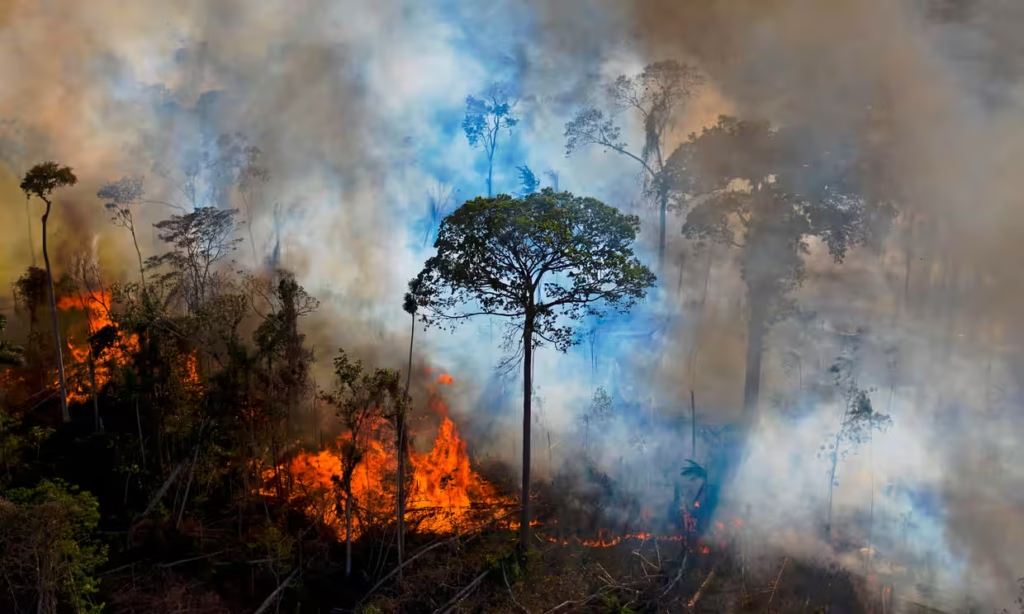
Ethics and the Environmental Crisis

Ethics is inherently about judgements about what is right and wrong. There are two aspects to ethical judgement:
- Knowledge
- Agency
We need to know that something is occurring. I have no ethical responsibility if I am unaware that someone who is unable to swim has fallen into a nearby lake and is in danger of drowning. If, on the other hand, I happen to be walking past and see this drowning person then I have an ethical responsibility to act.
The question of agency is much more complex. If I cannot swim, there is no ethical imperative for me to jump into the lake as my action will be of no benefit to the drowning person. However, there are other actions that I could take, like finding a long stick or running for help.
In the 1970s, at the beginning of the age of ecology, there was little awareness of environmental devastation. Now it is almost impossible not to have some knowledge that our planet is facing an unprecedented crisis. Consequently, we can no longer plead ignorance.
When considering the ethics of the environmental crisis the issue of agency is particularly problematic. Not only is it unclear who has the power to act, but it is also unclear what actions will be effective. Whilst there is an almost universal acknowledgement of the urgency to decarbonise our activities, there is little agreement as to how to go about this.
There are often no clear criteria for making ethical judgements. The ambiguity of making the right decision is referred to as an ethical dilemma. Wicked problems, such as the environmental crisis, are particularly fraught ethical dilemmas. As I indicated in my earlier post, a wicked problem is characterised by complexity, there is no simple causal explanation, and no single unequivocal solution.

Some Rhetorical Questions
Whilst there are no unambiguous answers to the ethical dilemmas raised by environmental crises, we must ask several interrelated, albeit rhetorical, questions. As Roger, S. Gottleib (2019:149) observes ‘in some cases the best a philosophical analysis can offer is a series of queries’.
- Who is to blame for the environmental crisis? Are individuals, corporations, industry or governments primarily responsible for the ecocidal trajectory of human activity?
- Who is responsible for addressing the environmental crisis? This is clearly linked to the question of culpability. This is a fiercely debated issue. There are two aspects to this contentious issue:
- At what level should the environmental crisis be addressed – individual, local, national or global?
- Are those who are most culpable for environmental destruction most obligated to implement solutions? It is commonly accepted that one of the prime causes of the environmental crisis is industrialisation. Are those nations that industrialised first, the so called ‘developed’ world, who have been historically more responsible for environmental destruction, more obliged to act than the developing world?2
- Who is affected most? We are all both contributors and victims of environmental destruction. However, it is clearly established that many parts of the developing world disproportionally suffer the consequences of environmental destruction, primarily caused by the actions of the developed world.
The African continent for example, contributes the least to climate change yet is the most vulnerable to its impacts. African countries that contribute so little will have to spend up to five times more on adapting to the climate crisis than on healthcare. G20 countries, meanwhile, represent around 75 per cent of global greenhouse emissions.
UN Environmental Programme 2022
It is also well established that ethnic minority groups and poorer sectors of developed economies are also disproportionally impacted by environmental degradation. Sadiq Khan, the Lord Mayor of London, in a press release in 2022 observed that:
Areas of London with Black, Asian and minority ethnic populations of more than 50 per cent are more likely to face the highest climate risk in London including flooding, exposure to toxic air, heat risk and limited access to green space.
Khan 2022

Des Gasper succinctly states that ‘in the climate change situation those who are driving might not be those who will go over the cliff’ (Gasper 2012: 983)
Linked to the questions of guilt and responsibility are the concomitant questions of what the causes are and what are the solutions to the environmental crisis. On one level, the answers to these questions are fairly straightforward. Global warming is caused by the increase of greenhouse gases such as CO2 and methane that trap heat in the atmosphere and causes the steady rise in global temperature. This, it is almost universally accepted, is caused by human activity such as burning fossil fuels. Therefore, the solution is to decarbonise our activity. However, if we try and trace the causal chain back to the root of the problem, it becomes more ambiguous and contested. If the root causes are debated, then the solutions are even more contested.
In his important book Green Political Thought, first published in 1990, Andrew Dobson distinguishes between environmentalism and ecologism. Dobson suggests that environmentalism has a ‘managerial approach’ and that there is no need for any substantial social, economic or cultural changes. On the other hand, ecologism proposes that we need ‘radical changes in our relationship with the non-human natural world, and in our mode of social and political life’ (Dobson 2007: 2–3). Consequently, the solutions to the environmental crisis are not merely technological fixes, but involve social, political, economic, cultural and lifestyle changes.
Murray Bookchin: The Ecological Society
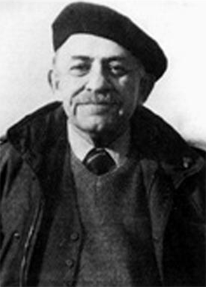
Murray Bookchin is one of the earliest advocates of ecologism. Bookchin argued that we must make radical changes in our social and political life if we are to have any hope of reversing the environmental harms caused by human activity. Whilst, he is perhaps not as well-known as John Muir or Rachel Carson, Bookchin’s writings ideas have been very influential. Steven Best suggests that Bookchin’s ‘theory of social ecology is perhaps the most comprehensive and powerful ecological philosophy yet developed’ (Best 1998: 334).
Bookchin’s argument is the primary cause of the environmental crisis is social.
Environmentally, we are a beleaguered species – not by natural forces that inflict material scarcity and toil as unavoidable features of the human condition, but by social forces that create irrational relations and requirements as utterly needless features of our lifeways.
Bookchin 1962 cited in Best 1998: 336.
Here Bookchin implicitly criticises the managerial approach to the environmental crisis. He argues that we must look at the way which society is structured to determine the root cause the environmental destruction. Bookchin proposes that if we fail to address this social root cause, any attempt to address the environmental crisis will be futile.
Bookchin states that the root cause of environmental destruction is the hierarchical organisation of society. The corollary of a hierarchically organised society is exploitation. He suggests that ‘ecology raises the issue that the very notion of man’s domination of nature stems from man’s domination of man’ (Bookchin 1980: 15). The exploitation of nature is a consequence of the oppression of humans by other humans – this includes the subjugation of class, race and gender.
Unless the ecology movement encompasses the problem of domination in all its aspects, it will contribute nothing towards eliminating the root causes of the ecological crisis of our time.
(Bookchin 1980:43)
There is an implicit ethical dimension to Bookchin’s critique of contemporary society. He calls this ethical imperative to address all aspects of domination an ‘ecological attitude’ . Bookchin calls for ‘a reconstitution of society along ecological lines’, which will reset our relationship with both nature and other humans. (Bookchin 1980: 58).
The achievement of a totally new, non-hierarchical society in which the domination of nature by man, of woman by man, and of society by the state is completely abolished – technologically, institutionally, culturally and in the very rationality and sensibilities of the individual.
(Bookchin 1980:14)
Bookchin suggested that decentralisation is fundamental to the ecological society. He calls for the development of ‘ecocommunities that are artistically moulded to the ecosystems in which they are located’ (Bookchin 1980:68). The ecocommunity must live in harmony with the ecosystem in which they are located.
An ecocummunity:
Allows for direct popular administration, the efficient return of wastes to the countryside, the maximum use of local resources.
Bookchin 1980:68
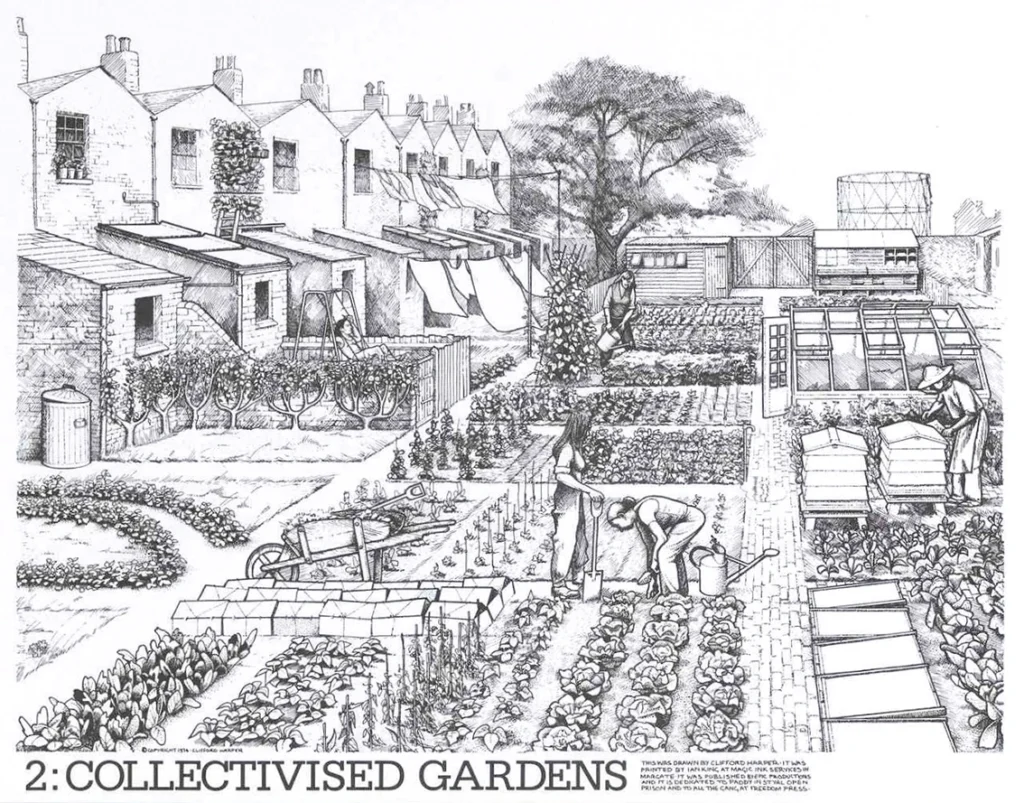
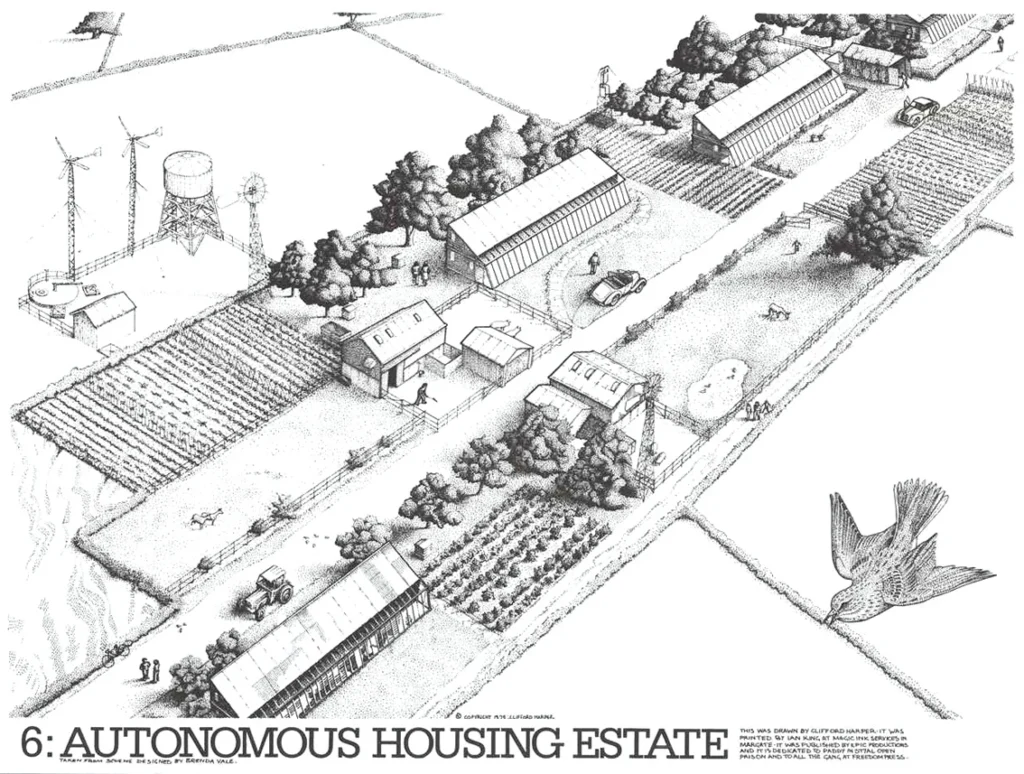
The ecocommunity cannot be too large. Large centrally organised states might be economically efficient, but they are environmentally disastrous. In this sense Bookchin’s ideas can be understood as a form of bioregionalism.
The concept of a bioregion as the basic location where people live, and the practice of reinhabitation of that life-place by its residents, are necessary to rejoin human beings into the overall web of life. Harmonizing with the natural systems of each bioregion is a necessary step toward preserving the whole biosphere. (Berg 2002)
Bookchin makes another point about the decentralised ecocommunity – he suggests that it fosters a sense of ‘living with’ others and this creates a ‘profound sense of oneness between the individual and the group’ (Bookchin 1980: 61). In many ways the early years of the Centre for Alternative Technology can be considered as consistent with Bookchin’s concept of an ecocommunity.
The ecological society is characterised not only by being non- hierarchical, but also relishes diversity. (Bookchin 1980: 59). This celebration of diversity not only includes all humans but also all flora and fauna. Consequently, humans and all non-human beings are valued for their own sake.
This sense of unity with others inevitably extends to the natural world and leads to sense of ‘mutualistic interdependence and cooperation’ (Bookchin 1980:61). Bookchin expansion of ethics to the natural world raises a plethora of questions about the extent of our ethical responsibilities, some of which I will discuss in future posts. In the next short section, I will briefly raise the question of our ethical obligations to the future.
What do we owe future generations?
Whilst we are already experiencing the effects of climate change, pollution and loss of biodiversity across the world, it is future generations that will face the most severe impacts. Consequently, we must consider whether we have an ethical responsibility for these future generations. This requires considering the balance between future needs and current requirements.
There is a natural tendency to assume that we have greater ethical responsibility to those closest to us, and this becomes attenuated the further the distance away. This includes both physical and temporal distance. Naturally, we accept that we have a responsibility for our children and grandchildren, but what about their children and grandchildren?

Dominic Roser and Christian Seidel suggest that there are three possible attitudes to what we should bequeath to future generations?
- We leave future generations as much as we have.
- We leave future generations more than we have
- We leave future generations enough. (Roser and Seidel 2017: 57)
This begs the question of what exactly we should be leaving to the future. Whist this is a complex and much contested issue, for the sake of clarity let’s assume that we owe future generations the possibility of wellbeing. Unless we address the current trend of environmental destruction, the possibility of wellbeing for future generations will be greatly diminished. However, to ensure the wellbeing of future generations, we have to consider what are the implications for our current way of life. In making ethical decisions there is always a question of balance, between current and future needs.
Leaving future generations as much as we enjoy today
Leaving an environment that enables future generations the same opportunities for having as good a life as we currently enjoy seems to make sense. However, this approach does not address the issue of distribution. It is abundantly clear that opportunities for a good life are not evenly distributed today. One way of addressing this issue is to look at John Locke’s theory of property. Locke suggests that private ownership of land is acceptable if it does not have a detrimental impact on others.

Image from History Crunch
Nor was this appropriation of any parcel of land, by improving it, any prejudice to any other man, since there was still enough and as good left, and more than the yet unprovided could use. So that, in effect, there was never the less left for others because of his enclosure for himself. For he that leaves as much as another can make use of, does as good as take nothing at all. Nobody could think himself injured by the drinking of another man, though he took a good draught, who had a whole river of the same water left him to quench his thirst. And the case of land and water, where there is enough of both, is perfectly the same.
(Locke 1690: Chapter 5: Section 33).
Since the Limits to Growth study, it has become apparent that the resources that we will leave to future generations will be much diminished from current levels. Taking Locke’s metaphor at the end of this quote above, if we continue as we are, the river will be insufficient to quench the thirst of future generations. Consequently, we will have to think about our lifestyle choices to ensure future generations equal opportunities. For example, the UK Government’s report Jet Zero Strategy clearly states: ‘At current rates, aviation is expected to become one of the largest emitting [of greenhouse gases] sectors by 2050′. So far, any proposed technical solutions will have very little impact on the aviation industry’s emissions. Consequently, one of the major choices that we can make to protect future generations is to renounce flying. I have many friends who have consciously decided not to fly for environmental reasons, yet many people feel that this is too much to sacrifice.
Leaving more for future generations than we have today
We can also think about leaving the world a better place for future generations. This is also a natural attitude, as most people wish for a better life for their children. We are already experiencing terrible environmental degradation, and if we are to leave future generations a better world, then this will entail immediate and radical sacrifices. One way of supporting such a view is to refer to utilitarian ethics. Utilitarianism is sometimes referred to as ‘the greatest happiness principle’. It suggests that ethics is determined by maximising happiness and minimising harm. An environmental ethical position that suggests that we are responsible for leaving the world in a better state for our descendants extends the greatest happiness principle into the future.
Leaving sufficient for future generations
The dominant ethical position is that we are responsible for leaving enough for future generations. This position makes a distinction between desires and needs and is encapsulated in the famous definition of sustainable development in Our Common Future published by the World Commission on Environment and Development (WCED)3 in 1987, which states that:
Sustainable development seeks to meet the needs and aspirations of the present without compromising the ability to meet those of the future (WCED 1987: 1.49
The difficulty with this position is determining where the boundary between needs and aspirations lies. It is obvious that food, water, shelter and clothing are needs. However, we also think about the quality of life, and needs are often considered as being more than just bare necessities. Is a car, for example, a need or a luxury? This might be contingent on whether you live in a rural or urban area.
Conclusion
It is almost universally accepted that our home planet is facing an unprecedented environmental crisis which is primarily caused by human activity. Many of our decisions and actions not only impact those closest to us, but also those who are physically and temporally distant. Consequently, the sphere of our ethical responsibilities extends to people across the globe and into the future. However, addressing the environmental crisis is not as simple as rescuing a drowning person. The complexity of environmental ethics is that there are no unequivocal and uncontested answers to questions, such as ‘what are the root causes of the environmental crisis?’.
Murray Bookchin, for example, argues that the environmental crisis is inherently social, and therefore an ethical issue. Whilst he was one of the earliest thinkers to develop a comprehensive environmental ethic, there are aspects of his arguments that can be challenged. For example, is Bookchin’s argument of the need to decentralise still valid? Does his call for small scale ecocommunities suffer from the same challenges as the small is beautiful ethos of the early alternative technology movement? Nonetheless, I agree with his view that technological fixes are not in themselves going to solve the environmental crisis.We need to reflect on what our ethical responsibilities are and what impact our current lifestyles have on distant others.
Sources
Berg, P (2002) Bioregionalism: An Introduction. Planet Drum Foundation. Available at
https://planetdrum.org/bioregionalism-an-introduction.
Best, S. (1998) Murray Bookchin’s Theory of Social Ecology. Organization and Environment 11(3) 334–353.
Bookchin, M. (1980) Toward an Ecological Society. Montréal. Black Rose Books.
Dobson, A. (2007) Green Political Thought. London: Routledge (4th Edition).
Gasper, D. (2012). Climate Change: The Need for a Human Rights Agenda within a Framework of Shared Human
Security. Social Research. 79:4, pp.983–1014.
Khan, S (2022) BAME Londoners More Likely to be Affected by Climate Emergency. Available
at: https://www.london.gov.uk/press-releases/mayoral/bame-londoners-bear-brunt-of-climate-emergency
Locke, J. (1690) Second Treatise of Government. Available at https://www.gutenberg.org/files/7370/7370-h/7370-h.htm
Roser, D. & Seidel, C. (2017) Climate Justice: An Introduction. London: Routledge.
Stop Ecocide International (2021) Developing Ecocide Law. Available at https://www.stopecocide.earth/legal-definition
UK Government: Department for Transport (2022) Jet Zero Strategy: Delivering Net Zero Aviation by 2050. Available at
https://assets.publishing.service.gov.uk/media/62e931d48fa8f5033896888a/jet-zero-strategy.pdf
World Commission on Environment and Development (1987) Our Common Future. Available at
https://www.are.admin.ch/are/en/home/media/publications/sustainable-development/brundtland-report.html
Also see
Lecture On the Ecology Movement by Murray Bookchin. Available at https://www.youtube.com/watch?v=wS3-PffLKqM
.
- Ecocide is recognised as a crime by 11 countries including Russia and Ukraine. France is the only European country to recognise ecocide as a crime. ↩︎
- There is much debate about terminology, and whether the distinction between ‘developed’ and ‘developing’ economies is appropriate. This distinction can be evaluative, can imply a hierarchy of nations and be interpreted as disparaging various areas of the globe. The current terminology suggested by the World Bank is four categories determined by Gross National Income: low-income economies, lower-middle income economies, upper-middle-income economies and high-income economies. However, for the sake of clarity I will still use the term developing economies. ↩︎
- More commonly known as the Brundtland Report after the WCED’s chairwoman Gro Harlem Brundtland. ↩︎